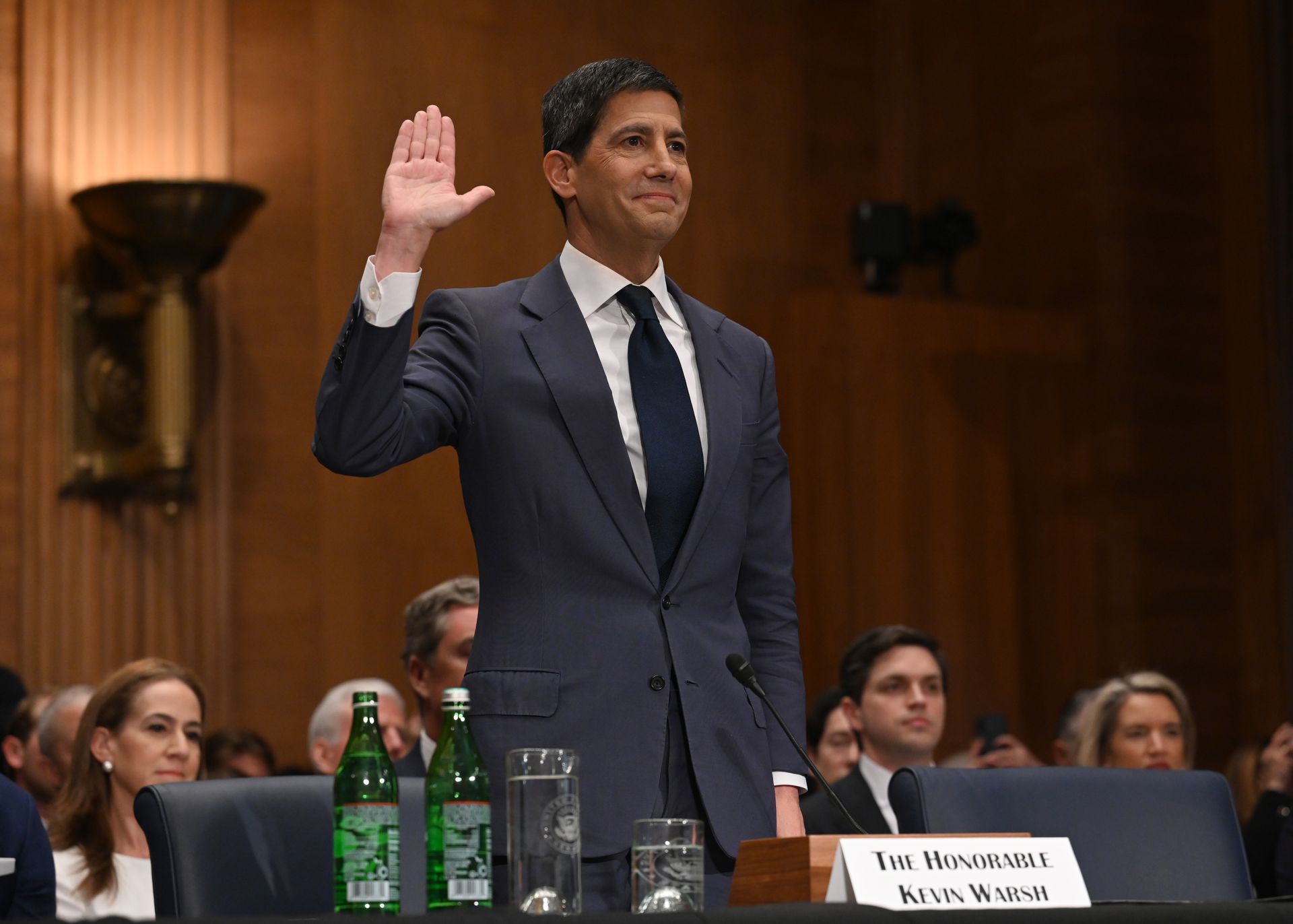
Federal Reserve Chair Kevin Warsh has brought on two conservative policy researchers as temporary advisers, including the author of the Project 2025 chapter that proposed restructuring the central bank, according to multiple reports.

Paul Winfree, who wrote the Project 2025 chapter calling for sweeping Fed reforms, is now advising the new central bank chair
China News Service / Getty Images
Federal Reserve Chair Kevin Warsh has brought on two conservative policy researchers as temporary advisers, including the author of the Project 2025 chapter that proposed restructuring the central bank, according to multiple reports.
Citing an unnamed source, CNBC reported that both men are working in a temporary contractor capacity, assisting Warsh with policy analysis and special projects. Neither has previously worked at the Federal Reserve. The Fed hasn't commented.
Paul Winfree served on the Domestic Policy Council during President Donald Trump's first term and later founded the Economic Policy Innovation Center, a pro-Trump think tank that recently announced it was winding down, according to The Wall Street Journal. Winfree authored the Project 2025 chapter devoted to the Fed, a document that called for stripping the central bank of its congressionally established dual mandate — the requirement to balance employment and price goals — so it could concentrate exclusively on curbing inflation. According to The Journal, the chapter went further, backing a significant reduction in the Fed's asset holdings and arguing for curtailing its emergency lending functions during times of financial stress.
The document attracted wider attention for entertaining a concept called "free banking" as its highest-ranked reform option — a system that would dismantle the Fed and replace it with privately issued currencies tied to commodities, according to the Journal. In a 2024 interview with Roll Call, Winfree sought to separate himself from the chapter's most extreme ideas, saying he supported reforming the Fed but drawing a firm line: "I would not subscribe to the idea of nuking the Fed."
Daniel Heil holds a fellowship at Stanford's Hoover Institution and has written extensively on the fiscal dimensions of federal healthcare programs and Social Security, according to The Journal. Warsh was himself based at Hoover before being confirmed as Fed chair. He previously worked as an economic policy adviser to Jeb Bush's 2016 presidential campaign, according to Bloomberg.
Unlike recent Fed chairs, who turned to seasoned central bank insiders when staffing their inner circles, Warsh has chosen advisers whose careers have unfolded entirely outside the institution.
The appointments come after Warsh was sworn in as the 11th Fed chair of the modern banking era last month at a White House ceremony. At that event, he pledged to lead "a reform-oriented Federal Reserve" and spoke positively about upholding both sides of the dual mandate — a position that sits in tension with some of Winfree's published proposals. Warsh has previously described his broader agenda as "regime change" at the Fed.
Join 500,000+ readers who start their day with Quartz.
By subscribing, you agree to our Terms of Service and Privacy Policy.