
Honda $HMC Motor on Wednesday began assembling the first fuel cell electric vehicle (FECV) built in the United States — the CR-V e:FCEV.
The alternative fuel vehicle can run on both hydrogen and — to a degree — electricity
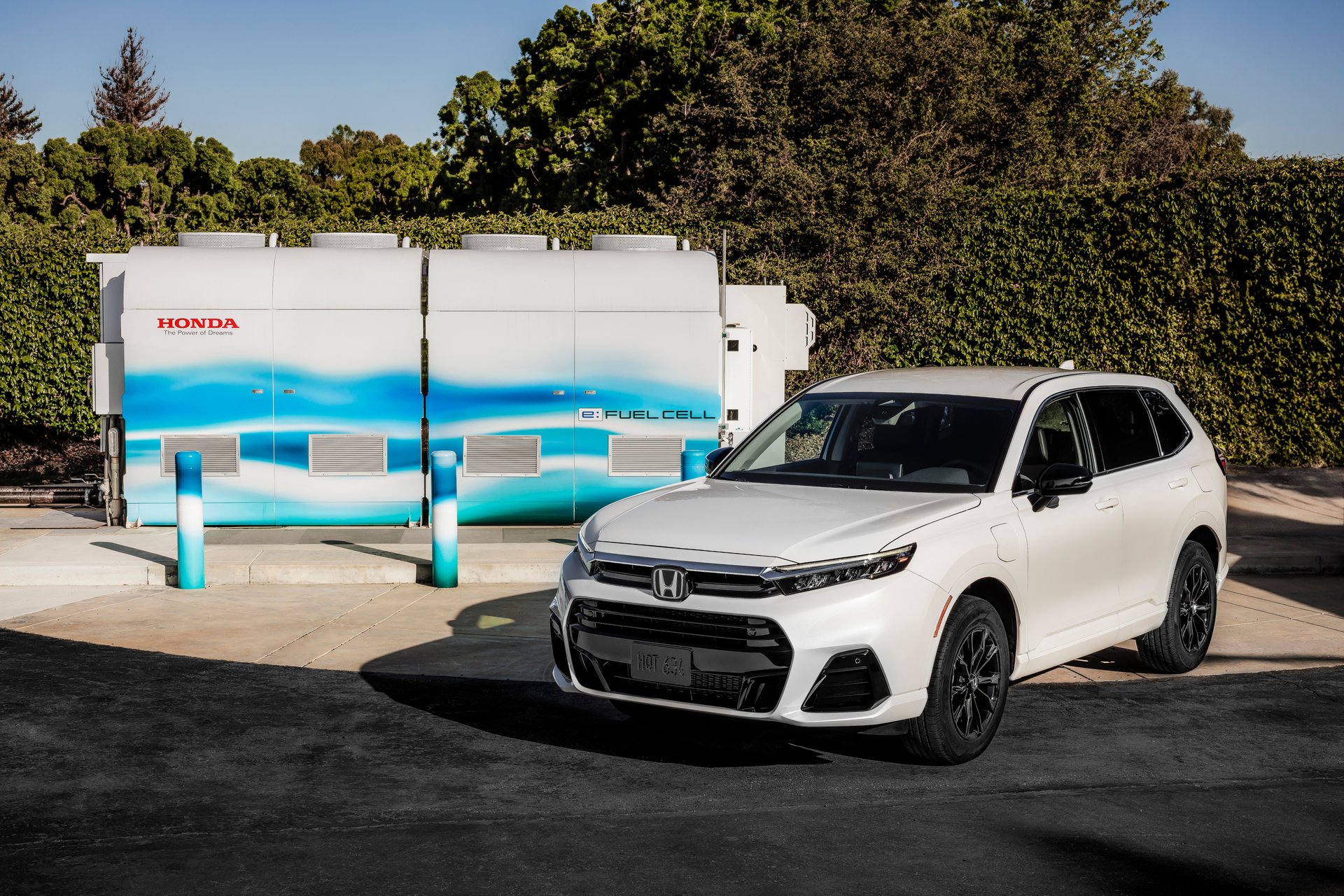
Honda $HMC Motor on Wednesday began assembling the first fuel cell electric vehicle (FECV) built in the United States — the CR-V e:FCEV.
The fuel cell version of Honda’s CR-V crossover is the first plug-in hybrid fuel- cell vehicle that will be sold — and built — in the U.S., according to the company. That means it can be plugged into charging ports and run off electricity, as well as hydrogen. There are currently 56 fuel cell stations in the United States — all of them in California, according to the U.S. Department of Energy.
The new CR-V, which was positively received by some reviewers, can drive up to 270 miles on one ‘tank,’ 29 of which thanks to its electric driving capacity.
The model is being assembled at Honda’s Performance Manufacturing Center in Marysville, Ohio, which makes the Accord sedan and coupe, as well as the Acura TLX and ILX. The fuel cell systems that form the backbone of the cars are made at Fuel Cell System Manufacturing in Brownstone, Michigan, a joint venture between Honda and General Motors $GM. The fuel cell system co-developed by the companies is twice as durable and two-thirds cheaper than the old system used by Honda’s fuel cell Clarity.
“Producing a zero-emission fuel cell electric vehicle is one more step toward Honda’s global goal of achieving carbon neutrality for our products and operations,” Patrick McIntrye, who leads the Ohio facility, said in a statement.
The fuel cell CR-V is part of Honda’s strategy regarding hydrogen-powered vehicles, which it sees as one of the “high-potential energy carriers” to support its electrification goals and pivot to renewable energy. The Japanese automaker recently showed off a concept for a hydrogen fuel cell truck and, last year, began testing a stationary fuel cell power station in California.
By 2040, Honda aims to have battery-powered EVs and FEVs account for all of its new vehicle sales, an ambitious task that aligns with stated goals of several other automakers. The Ohio facility will be one of the company’s EV “hubs” and will take over production of its North American EVs. Honda is also investing heavily in Canada, where it aims to establish a supply chain to support its electrification efforts.
But it’s unlikely that the CR-V e:FCEV will see a lot of success stateside. Fewer than 3,000 hydrogen fuel-cell cars were sold in the U.S. in 2023, while global sales dropped 30% to 14,451 sales.
Join 500,000+ readers who start their day with Quartz.
By subscribing, you agree to our Terms of Service and Privacy Policy.