Notorious for deal-hunting, the pandemic has made India’s online grocery shopping utility driven.
Over 80% of those who purchased groceries online during the nationwide lockdown in 2020 did so for convenience rather than price or selection, according to Sukriti Seth, an analyst at Noida-based TechSci Research. This trend could help build a habit that would pay off in the long run.
India’s online grocery market is poised to reach $24 billion by 2025 (Rs1.8 lakh crore), accounting for 3% of the overall grocery sector, according to RedSeer consultancy.
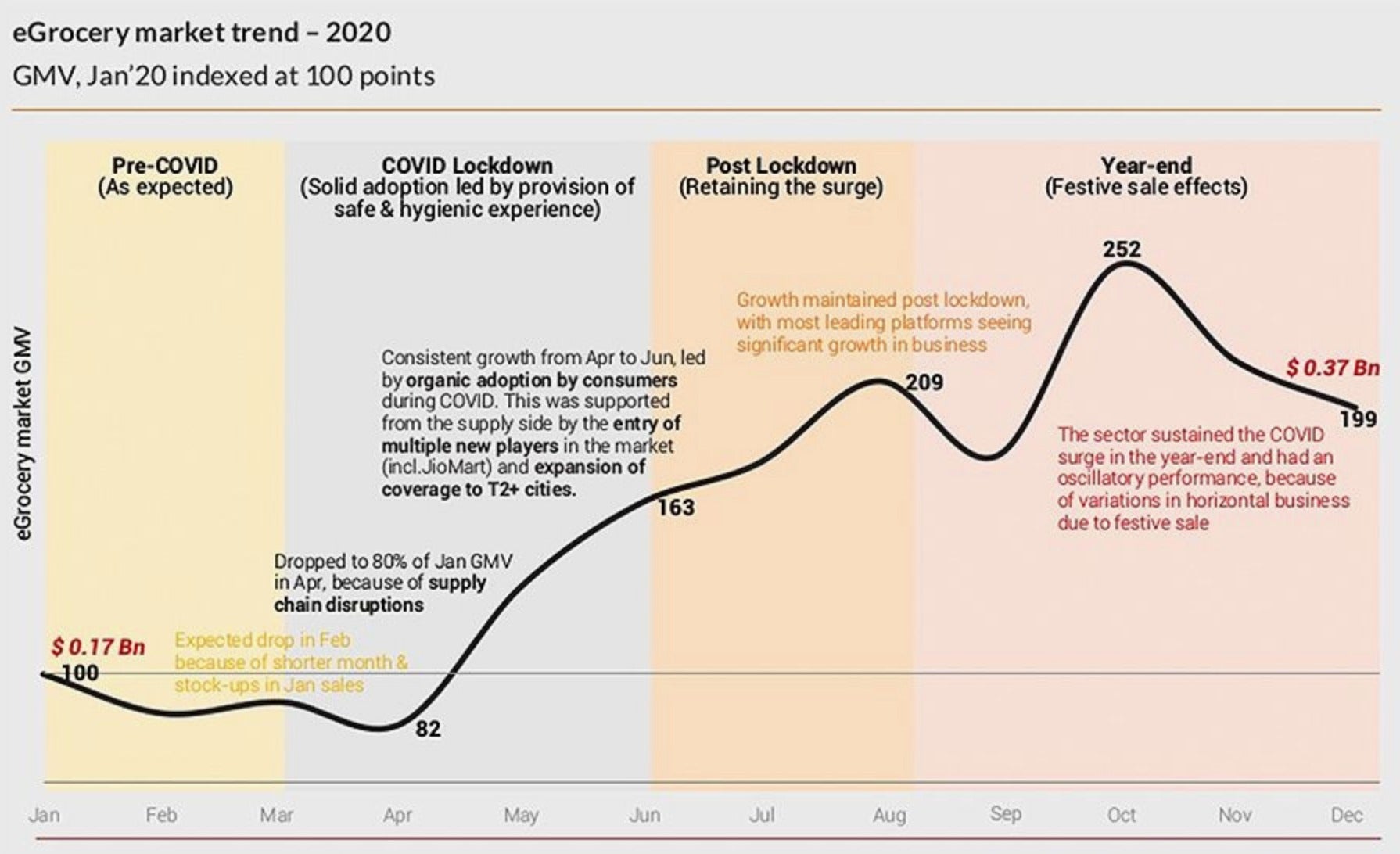
What will also help the online grocery shopping trend to stick around is the fact that companies have been working to fix kinks. For instance, during last year’s lockdown, e-grocers drew much ire from items being out of stock and unreliable delivery timelines as demand far outstripped supply.
Since then, companies have bolstered their networks as well as raised and invested money to minimise hiccups in the long haul.
Over the last year, 10-year-old BigBasket has scaled up on the back of partnerships, automated processes, and community selling, among other things. The company which had a 35% market share in March 2019, spent much of last year in increasing capacity and building infrastructure, a company spokesperson told Quartz. Now, Tata Digital, a wholly-owned subsidiary of Tata Sons, is all set to acquire a majority stake (64.3%) in BigBasket for around Rs9,300 crore.
Getting backed by a cash-rich conglomerate gives the company the ability to offer discounts and deals that make profitability and retention more competitive than it already was, market intelligence firm Kalagato noted in a March 31 report.
Gurugram-headquartered Grofers, BigBasket’s closest rival with whom it was discussing a possible merger until three years ago, claims to be keeping pace. In December 2019, Grofers got fresh ammo from Japanese investing giant Softbank. In April 2020, it announced plans to spend $15 million on private labels. The seven-year-old firm is even planning to go public by the end of 2021.
Meanwhile, JioMart, the grocery delivery service owned by India’s richest man Mukesh Ambani, got off to a rough start last June with customers complaining about rotten vegetables and unresponsive customer service. However, thanks to its tie-up with WhatsApp, it picked up in the coming months. By Jan. 26 this year, it claimed to have served over 1 million customers.
JioMart has since leveraged Ambani’s large network to convert 52 Reliance Retail large-format wholesale stores into JioMart fulfillment centres, a recent report by investment bank JP Morgan said. There has also been an “evolution from bikes to largely vans at several stores, reflecting higher value, and heavier and more complex orders delivered with greater efficiency,” JP Morgan noted.
Besides the sector-focused players, India’s two biggest e-commerce firms are also very much in the race. Amazon $AMZN, which witnessed a wave of first-time users from tier 2 and tier 3 in 2020, is expanding to smaller towns this year. Walmart $WMT-owned Flipkart is also looking to increase its presence in smaller cities.
Every player is vying for a piece of the growing e-grocery pie because there is still a massive untapped market. Amid 2020’s nationwide lockdown, “the consumer base got democratised (smaller towns, diverse income groups), all categories including fresh (fruits and vegetables) were purchased, and the brands started focusing on the online channel,” Redseer had said in February—right before Covid’s resurgence in the country.
