Sometimes children are better at telling it like it is than the adults in the room — even a fictional girl from Argentina
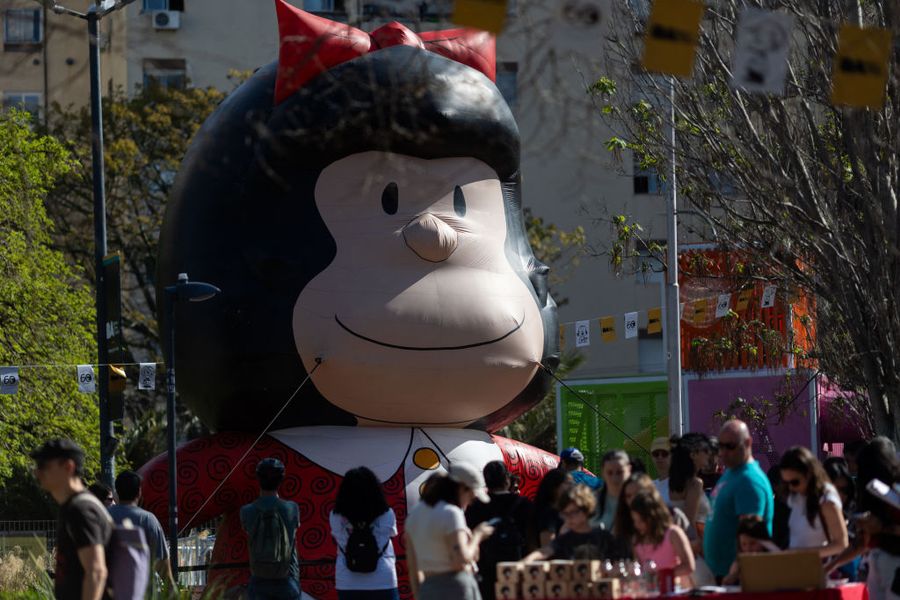
An inflatable figure of the comic book character Mafalda in Buenos Aires. (Photo by TOMAS CUESTA/AFP via Getty Images)
A version of this article originally appeared in Quartz’s Washington newsletter. Sign up here to get the latest business and economic news and insights from Washington straight to your inbox.
Living and working as a reporter in Washington D.C., I’m usually seeking out new perspectives to better understand the hum of activity in the nation’s capital. So I turned to a six-year-old girl not long ago.
The girl, though, is fictitious. Her name is Mafalda, and she’s a precocious, idealistic Argentine child who starred in the eponymous comic strip that caught fire in Argentina and beyond from 1964 to 1973. The soup-hating, Beatles-loving character was drawn by the late cartoonist . The comic has as “Charlie Brown with socialism.”
Join 500,000+ readers who start their day with Quartz.
By subscribing, you agree to our Terms of Service and Privacy Policy.
My uncle Roberto — a longtime Mafalda enthusiast — characterized it another way: Charlie Brown set aside reality but Mafalda didn’t. “The real world did exist for her,” he said.
“Mafalda” is a product of its turbulent time, as Latin America grappled with coups that installed military leaders in Argentina, Peru, and Brazil through the 1960s. But it’s certainly no relic of the past either. Mafalda and her friends question capitalism, democracy, nationalism, and war with a mix of disarming humor and theatrical antics that showcase endless curiosity about improving their malfunctioning world. Their observations carry new relevance, particularly as democratic guardrails are eroded in the second Trump administration. I can’t recall the last time I came across political satire that’s this enjoyable, timely, and comforting. I’m keeping Mafalda close during the holidays.
In one famous episode, Mafalda gets a pet tortoise and names it “Bureaucracy.” In another, her friend Felipe despairs at the "monstrous" realization that there’s more paper money in circulation than printed books. “Wouldn’t the world be more beautiful if libraries were more important than banks?” he asks. Felipe is promptly labeled an “extremist” by another character who fervently believes in the free market.
Mafalda was translated to English for the first time in June. I’m surprised it didn’t happen in the U.S. much, much earlier. Perhaps Americans are a little more ready now to hear a young girl take apart politicians of all stripes at a moment when President Donald Trump is strong-arming private and public institutions into submission, including the legislative branch, with little resistance.
In one strip, Mafalda’s middle-class parents are excited about surprising her with an evening at the children’s theater. “I think Mafalda will love it,” one of them says. “They’re all great actors and people say that it's a really hilarious farce.” When Mafalda's father asks her to guess their destination for the evening, she responds: “I heard, to Congress.”
To be clear, this year was not the first time I’d heard of Mafalda. My mother, aunts, and uncle were big fans of the comic while growing up in Peru. In the case of my mother, she played with a Mafalda doll. In my case, I recently snapped up the entire series to read in the original Spanish.
Her popularity doesn’t end there. The Peruvian capital of Lima inaugurated a Mafalda bench in 2023 where fans can take a photo next to a life-sized statue of the character, donning her trademark ‘60s bob cut. Both times while visiting Buenos Aires in the past two years, I saw lines of at least a dozen people long waiting to have their photo taken at the original Mafalda bench there. I’m still waiting for a shot at mine.
In the past, Quino said he never intended for Mafalda to be understood as a children’s comic. He always had an adult audience in mind. Still, he lamented that the world hasn’t changed much over the years. Quino retired the comic in 1973 after a right-wing military dictatorship seized power in Argentina. Partly out of boredom, he said, but partly out of fear too. He went into exile three years later. Eventually, he returned to Argentina.
“I'm flattered that Mafalda is still being read, but it's sad to think that the issues she talked about back then still exist,” Quino said in a 2000 interview. “Many essential things haven't changed. The world she criticized in '73 is the same or worse.”
He’s not far off the mark, then and now. I’ll be reading Mafalda and following her journey diagnosing the fevers afflicting our world. Sometimes children like her are better at telling it like it is than the adults in the room. Even a fictional girl from Argentina.
