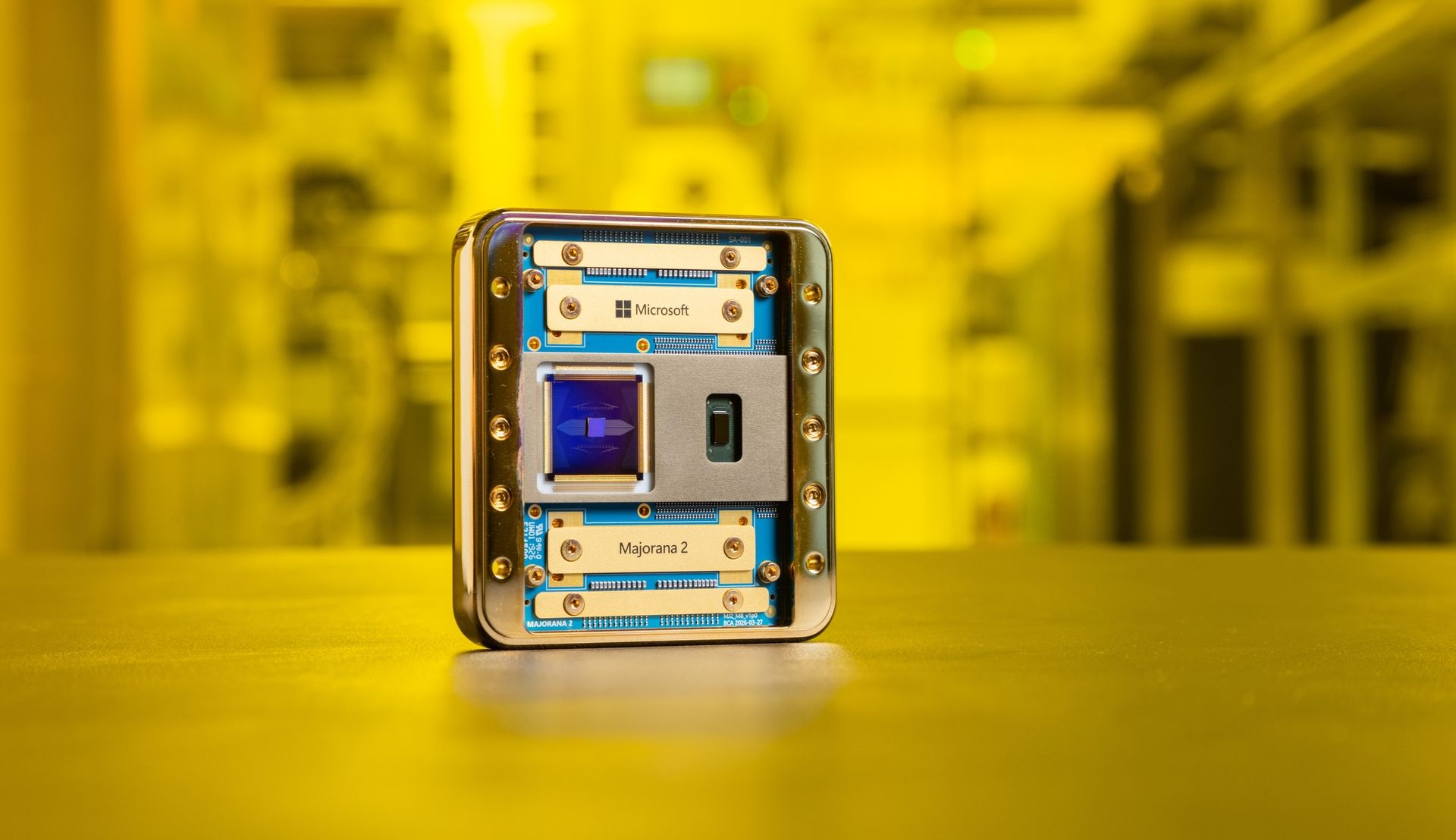
Microsoft $MSFT on Tuesday unveiled Majorana 2, a next-generation quantum chip it says is 1,000 times more reliable than its predecessor, and said it now expects to deliver a scalable quantum computer by 2029 — cutting its previous timeline in half.

The Majorana 2 chip, built with help from agentic AI, achieves qubit lifetimes of 20 seconds — cutting Microsoft's original timeline in half
Credit: Microsoft News
Microsoft $MSFT on Tuesday unveiled Majorana 2, a next-generation quantum chip it says is 1,000 times more reliable than its predecessor, and said it now expects to deliver a scalable quantum computer by 2029 — cutting its previous timeline in half.
Qubit lifetimes on the new chip reach a mean of 20 seconds, and the company said certain qubits have held their state for up to a full minute. On the previous chip, qubits were surviving for under 12 milliseconds before collapsing, Bloomberg reported. Majorana 2 also adds four qubits over its predecessor, bringing the total to 12, and operates at speeds of one microsecond per operation, the company said.
At the heart of the stability gains is a shift in materials: where the previous chip relied on aluminum for its superconducting components, Majorana 2 uses lead instead. The company said lead's properties make it more effective at insulating qubits from the environmental interference that leads to calculation errors. Because lead dissolves in water, engineers had to devise a specialized fabrication process to stop it from being lost during chip production, Reuters reported.
Microsoft developed the chip with the help of its agentic AI platform, Microsoft Discovery, which the company also announced is now available to all customers. According to the company, the agents took on tasks ranging from running complex measurements and refining the fabrication process to combing through roughly 20 years of accumulated research and surfacing manufacturing defects that had gone undetected by human researchers.
"Agentic AI has permeated almost everything we do — it's just become kind of a very natural part of our workflow," said Chetan Nayak, Microsoft technical fellow, in a statement.
Microsoft is taking a different approach to quantum computing than most of its rivals. As Quartz has covered the competing strategies of Microsoft, IBM $IBM, and Nvidia $NVDA, Microsoft's method relies on topological qubits — which store quantum information across two or more particles rather than in a single one — theoretically making them less prone to errors than the superconducting qubits used by companies like Google $GOOGL and IBM. According to Reuters, IBM announced last month a $10 billion commitment to quantum hardware and has set 2029 as its own target for a scalable system.
Microsoft's quantum program has faced scrutiny from some physicists who say the company has not released enough data to verify its claims. A separate concern arose when the journal Science notified its readership that it had opened an inquiry into data from a Microsoft quantum paper published in 2020, Reuters noted. A Microsoft researcher told reporters that DARPA scientists are embedded in the company's quantum work on a weekly basis and have been given full access to its data, Bloomberg reported.
Alongside Majorana 2, Microsoft introduced a Microsoft Discovery app in preview that individuals can download for free and run locally with a GitHub Copilot account, the company said.
Join 500,000+ readers who start their day with Quartz.
By subscribing, you agree to our Terms of Service and Privacy Policy.