
Some Nevada Democrats are urging the Trump administration to revamp swaths of their no tax on tips policy. Not all of it might be legal.
A letter from five Nevada Democrats spotlights an intensifying lobbying blitz as the Trump administration starts carrying out its new law
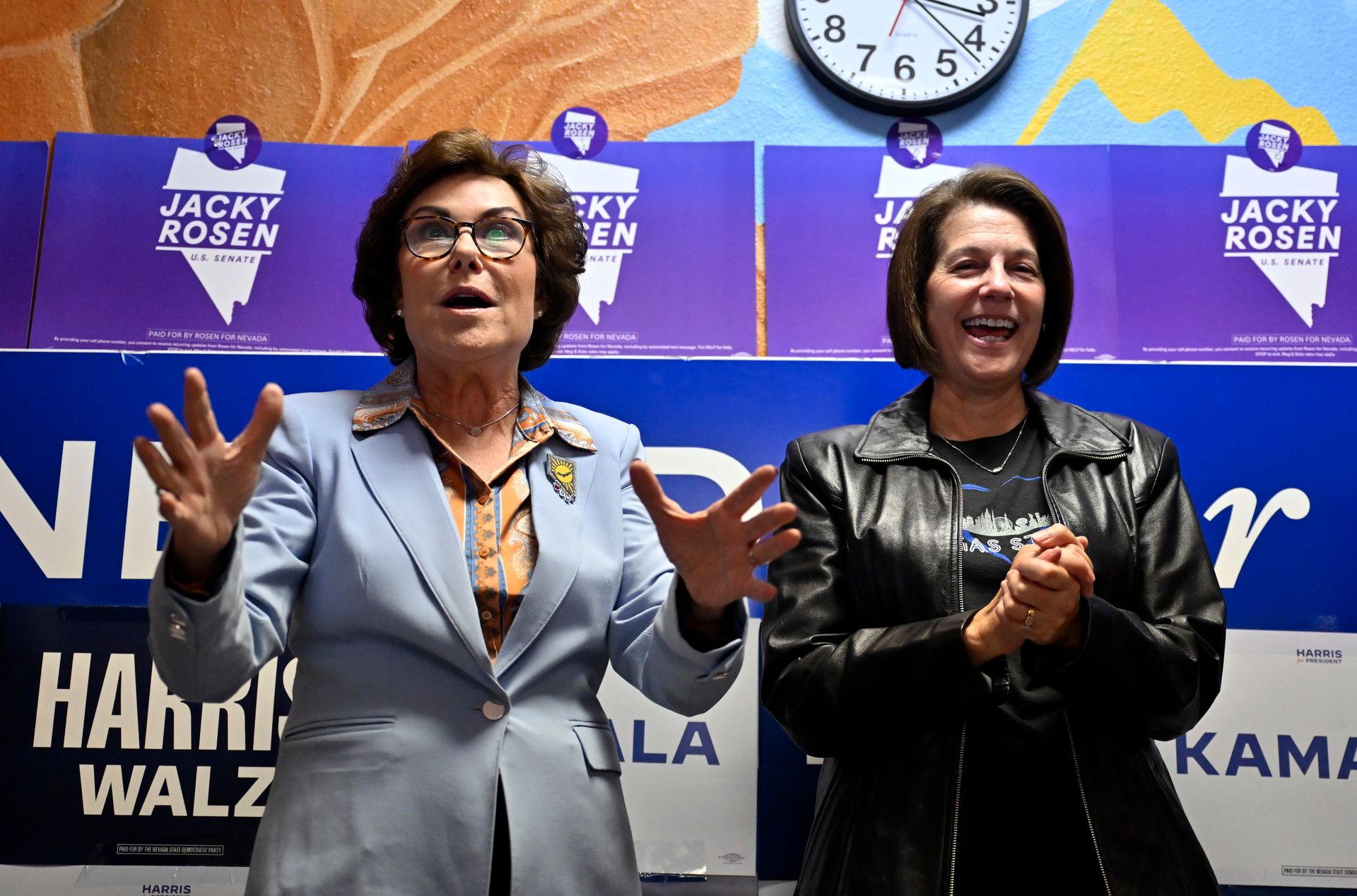
Sen. Jacky Rosen (D-NV) (L), joined by Sen. Catherine Cortez Masto (D-NV), in November 2024 in Las Vegas, Nevada. (Photo by David Becker/Getty Images)
Some Nevada Democrats are urging the Trump administration to revamp swaths of their no tax on tips policy. Not all of it might be legal.
In a letter sent Tuesday, five Democratic lawmakers from Nevada pressed the Treasury Department to alter several parts of President Donald Trump’s ‘no tax on tips’ policy as it implements the law. Sen. Catherine Cortez-Masto spearheaded the letter. Signatories included Sen. Jacky Rosen along with Reps. Steven Horsford, Dina Titus and Susie Lee.
“As lawmakers representing our nation’s most hospitality and service industry dependent economy, we hope to maintain a productive dialogue with Treasury and IRS as your agencies work to implement this provision,” the lawmakers wrote.
Among the changes they seek: doubling the maximum $25,000 deduction to $50,000 so married couples can claim a larger tax break. Another would extend the tip deduction to automatic gratuities, like a service fee that’s tacked onto a customer’s restaurant check for serving a large group. However, as written, the GOP law caps the deduction amount and designates as a tip only payments provided to a worker under no obligation.
Lawmakers seeking modifications through federal agencies to policy getting woven into the tax code is not out of the ordinary. The letter, though, ignited a flurry of concerns among tax experts who said certain changes sought by the Democratic bloc push the boundaries of the Treasury’s authority. In some cases, the Treasury would be overriding the legislative text of the Trump-signed law to satisfy their appeals.
“This is an unusual letter,” said Corey Husak, the director of tax policy at the Center for American Progress Action Fund, a Democratic-leaning organization. “They're essentially asking the Treasury to ignore or violate the law as passed, instead of asking them to take different interpretations of the law.”
Others didn’t go as far to say the proposed changes flouted the law. Andrew Lautz, the tax policy director at the Bipartisan Policy Center, said he believed it was “a stretch” for Treasury to double the $25,000 deduction for couples along with allowing automatic gratuities to qualify for the deduction within the law’s confines. “The statute seems pretty clear,” he said.
The Treasury Department did not respond to a request for comment. Quartz reached out to spokespeople for the five Democratic lawmakers and only one responded. “The Nevada delegation is simply asking the U.S. Treasury to fairly implement the no tax on tips law in a way that provides maximum relief for Nevada workers,” a spokesperson for Cortez-Masto said in a statement.
Under the law, individuals earning up to $150,000 can deduct the first $25,000 in tipped earnings from their annual tax bill. Payments that are at the discretion of the customer and voluntarily given count as a tip. Workers, however, still owe payroll taxes on their tips. It’s a temporary provision that expires near the end of Trump’s term.
The Treasury Department must publish a list of jobs that “customarily or ordinarily” receive tips by the start of October. Many workers in the service industry, such as bartenders and waiters, are expected to benefit from the measure.
The Democratic letter spotlights an intensifying lobbying blitz as the Trump administration starts carrying out the law. Similar efforts ensued once the Biden administration kicked off the rule-making process for the Inflation Reduction Act in late 2022. Clean energy tax credits and a 15% corporate minimum tax attracted sizable industry lobbying seeking favorable interpretations of the law.
Earlier this year, Uber $UBER, Doordash, and Instacart were among the companies pushing the Trump administration to ensure gig workers who earn tips while working for their app-based platforms were wrapped into the new tax break. Those provisions made the cut.
The Nevada Democrats said that their state traditionally counts valets, cooks, and cocktail servers as tipped occupations and urged the Treasury to classify them similarly. “That's the type of thing very much at the discretion of Treasury,” said Adam Michel, director of tax studies at the libertarian-leaning Cato Institute, adding that the “Treasury has the ability to write those rules very broadly or very narrowly.”
In Nevada, almost a quarter of jobs are in the leisure and hospitality industries. The state was also home to Trump’s initial rollout of no tax on tips during the 2024 presidential campaign.
A separate request in the letter, though, raised some eyebrows.
The Democratic lawmakers want performing artists like actors, singers, directors and other entertainment professionals to benefit from eliminating tax on tips. “The problem is, the text of the bill says that they are specifically excluded from being counted as tipped occupations,” Husak said. “Perhaps they should have been. But that is not what the law says.”
A Senate Democratic aide argued fears of Democrats prodding the Treasury to take steps that risk violating the law were overblown. The Trump administration and Republicans in Congress “blew their opportunity to handle this kind of thing on a bipartisan basis,” the aide said. “I can’t blame Cortez-Masto for fighting for what she thinks Nevadans deserve.”
Democrats like Cortez-Masto, Rosen, and Lee are spearheading efforts in their respective chambers to establish no tax on tips as a permanent feature of the U.S. tax code, co-opting a popular piece of Trump’s agenda. In April, Rosen used a special Senate maneuver for the upper chamber to pass a bipartisan measure to eliminate federal tax on tips.
Yet the Trump administration has sought to expand the power of the executive branch. Husak warned of a slippery slope if the Treasury strays too far in interpreting legislative intent. “If they get their way on some of these asks," Husak said, "you could imagine so many different areas of law where if the President or Treasury were so inclined, they could give extra tax breaks to favored industries, favored occupations, whether as part of a quid pro quo or just because they wanted to.”
Join 500,000+ readers who start their day with Quartz.
By subscribing, you agree to our Terms of Service and Privacy Policy.