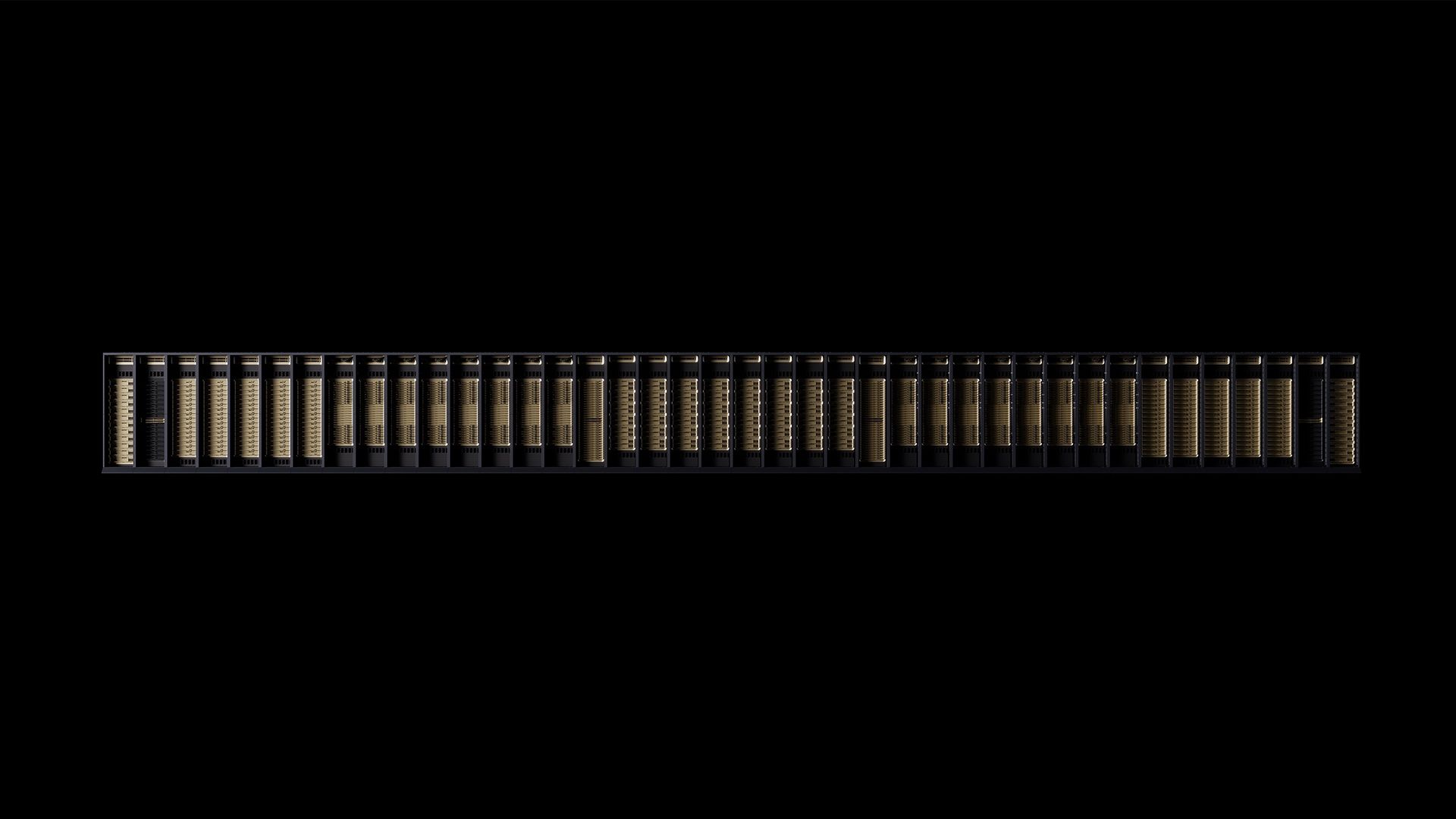
Nvidia $NVDA announced Monday that its Vera Rubin AI infrastructure platform is entering full production, with systems set to ship to cloud and enterprise customers this fall. The announcement came during a keynote by Nvidia CEO Jensen Huang at the Computex conference in Taipei.

The Vera Rubin platform is designed to power what Nvidia calls "agentic AI" workloads, where autonomous AI systems reason, use third-party software tools, and execute complex tasks on behalf of humans. The company said the platform delivers 10 times the agentic AI throughput of its previous-generation Grace Blackwell platform at one-tenth of the cost per token.
At the center of the platform sit Nvidia's new Rubin GPU and the Vera CPU, the latter of which the company confirmed has entered full production. Olympus, a custom core architecture, underpins the Vera CPU, which packs 88 cores and an LPDDR5X memory subsystem capable of 1.2 terabytes per second of bandwidth. According to Nvidia, the chip outpaces x86-based processors by 1.8 times on tasks central to agentic deployments, such as database queries and compiling code.
"AI agents will be the largest users of computing," Huang said in a statement. "Vera is the first CPU designed for that future — built to run agentic AI at hyperscale with extraordinary performance, efficiency and programmability."
Sitting at the top of the product lineup, the Vera Rubin NVL72 pairs 36 Vera CPUs with 72 Rubin GPUs in a liquid-cooled rack, all tied together via NVLink 6 high-speed interconnects, according to SiliconAngle. Training large mixture-of-experts models on the NVL72 requires only a quarter as many GPUs as would be needed with Nvidia's prior Blackwell generation, the company said.
Early customers planning to deploy Vera include AI developers Anthropic, OpenAI, and SpaceX's xAI, along with cloud providers CoreWeave, ByteDance, and Oracle $ORCL Cloud Infrastructure. Server manufacturers Dell $DELL Technologies, HPE, Lenovo, and Supermicro are building Vera Rubin systems at scale.
Rounding out the platform is the BlueField-4 STX storage processor, which Nvidia positions as a persistent context layer that lets AI agents stay coherent across lengthy, multi-step conversations. Nvidia says routing cached context through the BlueField-4 chips rather than the primary system can push inference throughput as much as fivefold higher.
Production of the platform draws on a global supply chain spanning 30 countries and involving upward of 350 partners, according to SiliconAngle. On the competitive landscape, Vera enters a market occupied by Intel $INTC's Xeon processors, AMD $AMD's Epyc line, and custom silicon developed internally by major cloud operators, according to Bloomberg.
