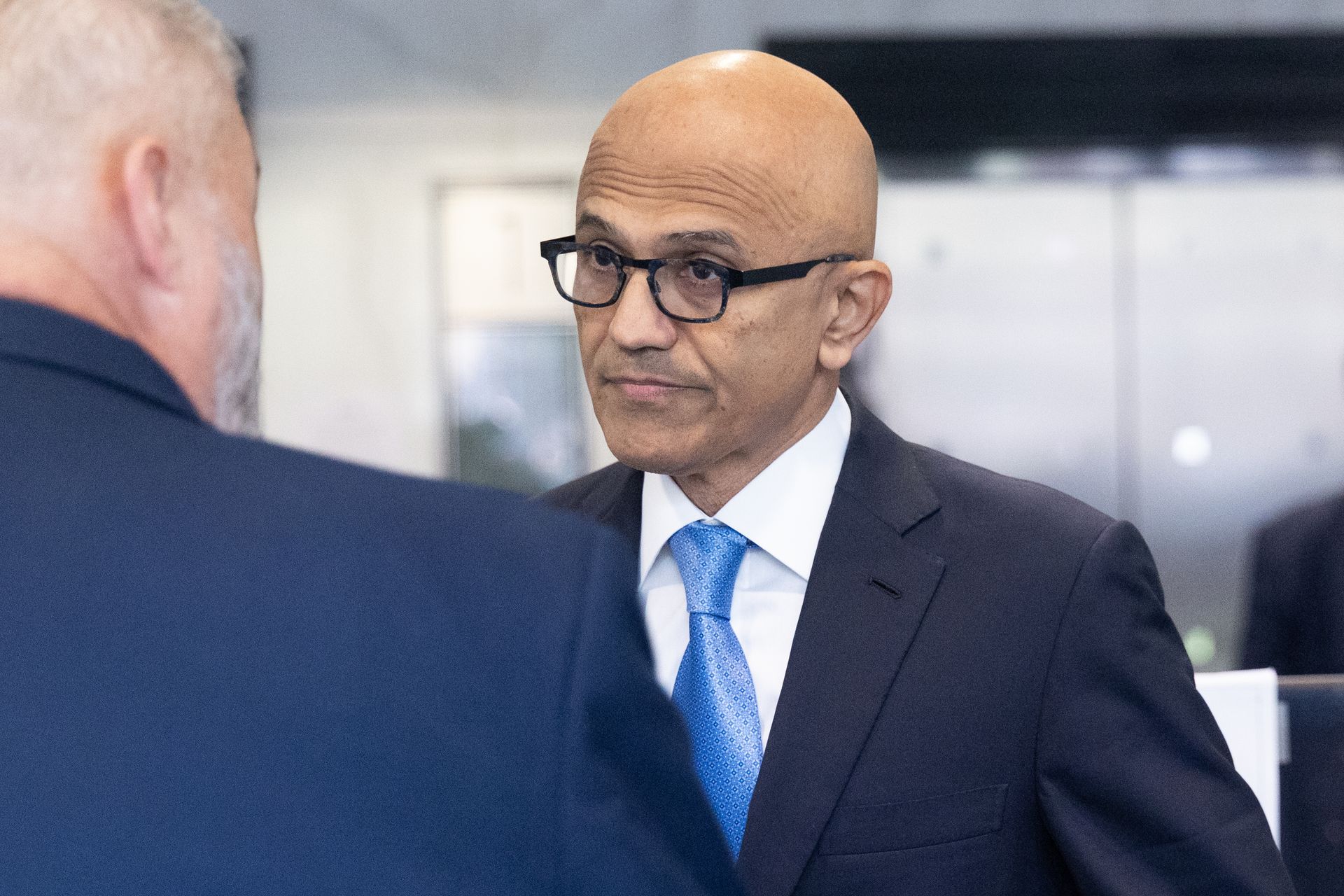
Microsoft $MSFT CEO Satya Nadella took the stand Monday in the Musk v. Altman trial in federal court in Oakland, California, testifying that Elon Musk never contacted him to express concern that Microsoft's investments in OpenAI violated any special terms or commitments.
From the witness stand, Nadella pushed back on any characterization of Microsoft's OpenAI funding as charitable giving, saying the arrangement had been commercially motivated from the beginning. Testifying further about the partnership's origins, Nadella said reduced pricing on computing infrastructure was extended to OpenAI early on, with Microsoft anticipating promotional advantages as part of the exchange. Nadella also expressed pride that Microsoft had stepped up to back the early-stage lab at a time when, as he put it, other potential investors had passed.
Jurors also heard recorded testimony from Michael Wetter, who works on corporate development at Microsoft. He put the total revenue the company has collected through its OpenAI relationship at roughly $9.5 billion.
Microsoft's investments in OpenAI have been a recurring focus throughout the trial. Those funding rounds have totaled upward of $13 billion, with individual tranches of $1 billion in 2019, $2 billion in 2021, and $10 billion in 2023. Musk, who testified late last month, said the $10 billion investment was the moment he concluded OpenAI was straying from its nonprofit mission. "I was concerned they were really trying to steal the charity," he said from the stand.
Musk is also skeptical of Microsoft's role more broadly. "All due respect to Microsoft, do you really want Microsoft controlling digital superintelligence?" he said during his own testimony.
The trial centers on Musk's 2024 lawsuit against OpenAI, CEO Sam Altman, and president Greg Brockman, in which he alleges that the three steered OpenAI away from the nonprofit structure under which it was founded in 2015. Microsoft is named as a co-defendant on the theory that it helped enable an alleged breach of charitable trust. The case has been narrowed to four claims heading into trial: unjust enrichment, fraud, constructive fraud, and breach of charitable trust.
Among the original 2015 co-founders was Musk, who departed the board three years later after clashing with colleagues over the lab's trajectory — disputes that included an unsuccessful bid to bring OpenAI under the Tesla $TSLA umbrella. Since then, he has started his own AI venture, xAI, and folded it into SpaceX. OpenAI has dismissed the lawsuit as a campaign rooted in competitive grievance rather than legal merit.
OpenAI's current valuation exceeds $850 billion, with Microsoft's equity position in the for-profit arm — approximately 27% — carrying an estimated worth of around $135 billion. Under a newly restructured deal between the two companies, OpenAI gained the ability to limit how much it pays Microsoft in revenue share and to route cloud computing business to other vendors.
