Companies keep announcing chip plants that cost billions, and every number sounds equally enormous. Most of that money isn't going into the building. It's going into the machines inside it, and that's the part of the bill that actually separates one announcement from another.

The machines account for 70% to 80% of a modern chip plant's total cost, according to an analysis by Construction Physics. A single facility can run $10 billion to $20 billion or more, and most of that money goes to machines, not concrete and steel. Elon Musk has proposed a $119 billion semiconductor complex in Texas, and machines would likely account for most of that price, too.
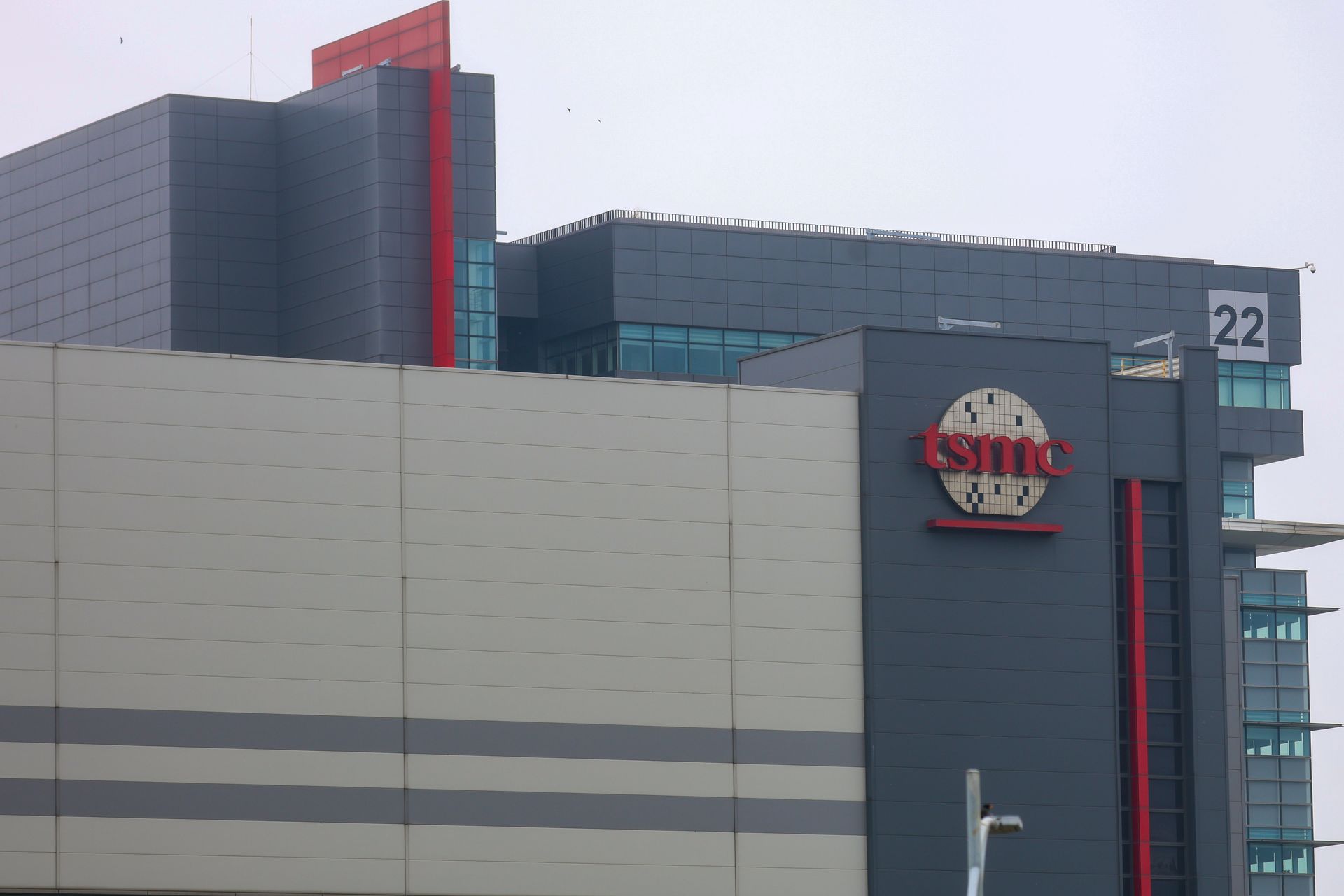
That escalation follows a predictable curve. A facility that cost about $4 million in the early 1970s grew to roughly $14 billion by 2015, doubling every four years or so under what the industry calls Rock's Law. TSMC $TSM has committed $165 billion to its Arizona campus, spread across six plants, two packaging facilities, and a research center, matching the scale Rock's Law would predict for today.
The machines that cost more than the factory shell
Samsung has committed at least $17 billion to its plant in Taylor, Texas, but only $6 billion of it is going toward actual construction. The remaining $11 billion will be spent on machinery and equipment.
The single most expensive piece of that equipment budget is the lithography system, the machine that prints circuit patterns onto a silicon wafer. ASML $ASML, the Dutch company that holds a near-monopoly on extreme ultraviolet lithography, prices its newest lithography systems at about $380 million each. Its previous generation cost about $183 million apiece. A plant needs several of these machines, and lithography tools alone can account for about 20% of total plant cost, equal to the price of the entire building and its infrastructure combined.
Paying for those machines is only half the problem. ASML's 2024 annual report recorded only 44 EUV systems sold that year, barely above the roughly 40 it sold back in 2021 despite years of promised production increases. A company can announce a plant in a press release. It still has to wait years for ASML to actually deliver the machines that run it.
Etch and deposition systems make up the other major equipment expense, accounting for an estimated 40% to 50% of total equipment spending in advanced chip manufacturing, according to SEMI's 2026 industry outlook. SEMI projects that spending on equipment for 300-millimeter wafer plants, the standard size for modern chip manufacturing, will rise from $133 billion in 2026 to $151 billion the following year, a jump of about 14% in twelve months.
Hidden costs inside a plain-looking building
The 20% to 30% of plant cost that goes to the building sounds modest, but even that share buys far more than a shell. Construction Physics found that services, the HVAC, exhaust systems, and ultra-pure water infrastructure, make up close to two-thirds of a facility's cost alone, compared with less than 20% for a single-family home.
One of those services matters most: keeping the air clean enough to build a chip in. Semiconductor manufacturing requires cleanrooms classified under ISO 14644-1, the international standard that grades air cleanliness by how many particles float in it. The most advanced plants run at ISO Class 1, which allows no more than 10 particles per cubic meter of air, about the size of a virus. Hitting that standard requires filters that catch 99.999% of everything else in the air, often lining the entire ceiling.
The same lithography tools that need clean air also need a floor that won't move under them. They pattern features measured in nanometers, and the slightest vibration can ruin a wafer. Plants are built to meet vibration criterion curves, an engineering standard the Institute of Environmental Sciences and Technology adopted after Ungar and Gordon first proposed it in 1983, according to Colin Gordon Associates. The strictest tier, called VC-E, limits floor vibration to 3.12 micrometers per second, which the standard's own authors call "a challenging criterion to achieve." Foundations have to be mechanically separated from the rest of the building, with physical gaps between isolated slabs and the surrounding structure.
Water and power bills that never stop
Building the plant is only the first bill. Running it costs just as much, every single day. An average manufacturing facility uses 10 million gallons of ultra-pure water per day, as much as 33,000 U.S. households use in a day, according to the World Economic Forum. Producing that water burns through 40% to 60% more water than the plant ends up using.
The electricity bill is just as heavy. A large plant can use as much as 100 megawatt-hours of electricity every hour, more than many car factories or oil refineries, according to McKinsey. TSMC alone burned through 25.55 billion kilowatt-hours in Taiwan in 2024, about 9% of the entire country's electricity use.
These bills are exactly why governments now help pay for construction instead of leaving companies to absorb it alone. The U.S. Department of Commerce awarded TSMC Arizona up to $6.6 billion in direct funding under the CHIPS and Science Act, and Intel $INTC received up to $7.86 billion of its own across four states.
Building a chip plant used to be a company's problem. It's a national one now.
