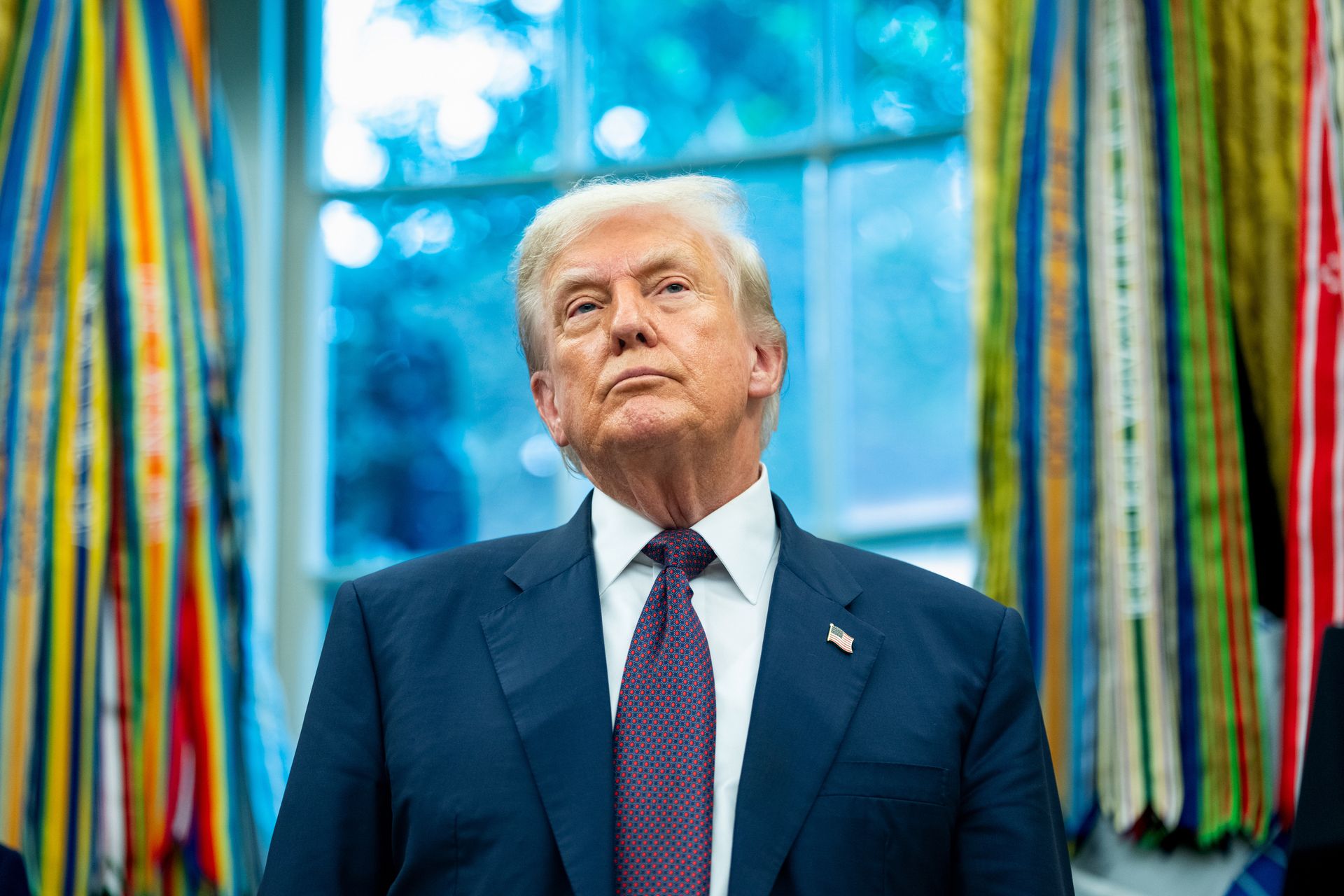
Tariffs on nearly 70 countries took effect early Thursday, with import taxes ranging from 10% to a staggering 50% depending on the trade relationship — and President Donald Trump’s mood. U.S. allies like Switzerland are now facing a 39% levy, while Brazil is subject to 50%. Canada won’t be spared either.

For countries with a trade deficit against the U.S., a baseline 15% tariff is now in force. Meanwhile, the Yale Budget Lab estimates the average U.S. import tariff will hit 18%, the highest since 1933.
Effects of Trump's escalating trade wars
The White House claims the tariffs will bring trade partners to the negotiating table and protect American manufacturing, even as officials struggle to explain such logic in televised interviews.
But U.S. companies are already seeing multibillion-dollar impacts to their businesses. GM took a $1 billion hit this quarter. Toy companies like Hasbro have seen similar billion-dollar damages, while others are preparing to raise prices in time for Christmas while also cutting features from products in an effort to preserve some margin.
U.S. stock market indices remain in positive territory for the year, in large part led by Magnificent 7 stocks riding the AI boom to constant fresh highs. Other factors also come into play for these closely watched companies. The CEOs of Apple $AAPL and Nvidia $NVDA appear to be finding that elaborate White House gifts and donations to Trump-related PACs – alongside promises to accelerate cap-ex spend within U.S. shores – are helping them to achieve tariff policy carve-outs.
Why markets move faster than the larger economy
One reason why stock-market investment doesn’t always slow down immediately — even in the face of steep tariffs or policy uncertainty — is that investors can’t afford to sit on the sidelines. For those who are not fully invested, missing even a few strong days can mean dramatically underperforming the broader market over time.
That dynamic creates pressure to stay in the game, even when the outlook is murky. Portfolio managers, corporate CFOs, and private investors alike often continue deploying capital not because they’re confident, but because waiting too long can mean missing the rally. This helps explain why, even amid economic warning signs, investment activity can remain surprisingly strong — until a delayed real-economy pullback finally forces a reset.
In other words: while the market runs ahead, the physical economy may limp behind.
Individual companies don’t necessarily raise prices or shift supply chains overnight. Most operate with existing inventories, long-term contracts, and hedging strategies that buffer immediate impacts. Many may attempt to absorb higher costs in the short term rather than alienate consumers or lose market share. And in a volatile environment like the current one — where tariff rates change week to week, or even day to day — businesses have every incentive to wait and see rather than make costly, permanent moves too soon.
That means the most serious consequences of Trump’s new tariff regime — margin compression, offshoring reversals, delayed capital investment, and the most severe job cuts — may not show up for quarters or even years. Retooling a supply chain takes time. Rethinking a pricing strategy can take board-level discussion. And hiring freezes or layoffs tend to lag the pressure points that cause them.
Still, some labor-market effects appear to be hitting.
Why "lower income households are struggling"
Experts point to an increasingly dual reality, in which the wealthiest companies and consumers within the U.S. can ride out the chaotic operating environment, while more vulnerable parties suffer from contractions in the labor market and rising prices.
On Thursday, consulting firm Oxford Economics warned of “the bifurcated nature of the consumer, business environment, and labor market” that “leaves the US economy more vulnerable and masks some fissures beneath the aggregate economic data.”
“High-income consumers are doing well while lower-income households are struggling,” said Oxford’s chief U.S. economist Ryan Sweet. “Trade and fiscal policy will reinforce the bifurcated consumer. The net impact of tariffs and fiscal policy will reduce the lowest-income quintiles' real disposable income by 2.5%-3% while boosting the highest incomes by the same amount.”
“As large businesses can weather tariffs better, they outperform small ones, reinforcing recent labor market weakness,” Sweet said. “Employment among small businesses, the backbone of the labor market, has barely budged and fundamentals remain unfavorable.”
A new federal report last week showed the U.S. economy added just 73,000 jobs in July, a fresh sign that uncertainty from tariffs is affecting employers and prompting them to scale back their hiring. The prior two months of post-tariff jobs reports were sharply revised down by 258,000 jobs, making for the weakest stretch of employment growth since the early pandemic.
—Joseph Zeballos-Roig contributed to this article.
