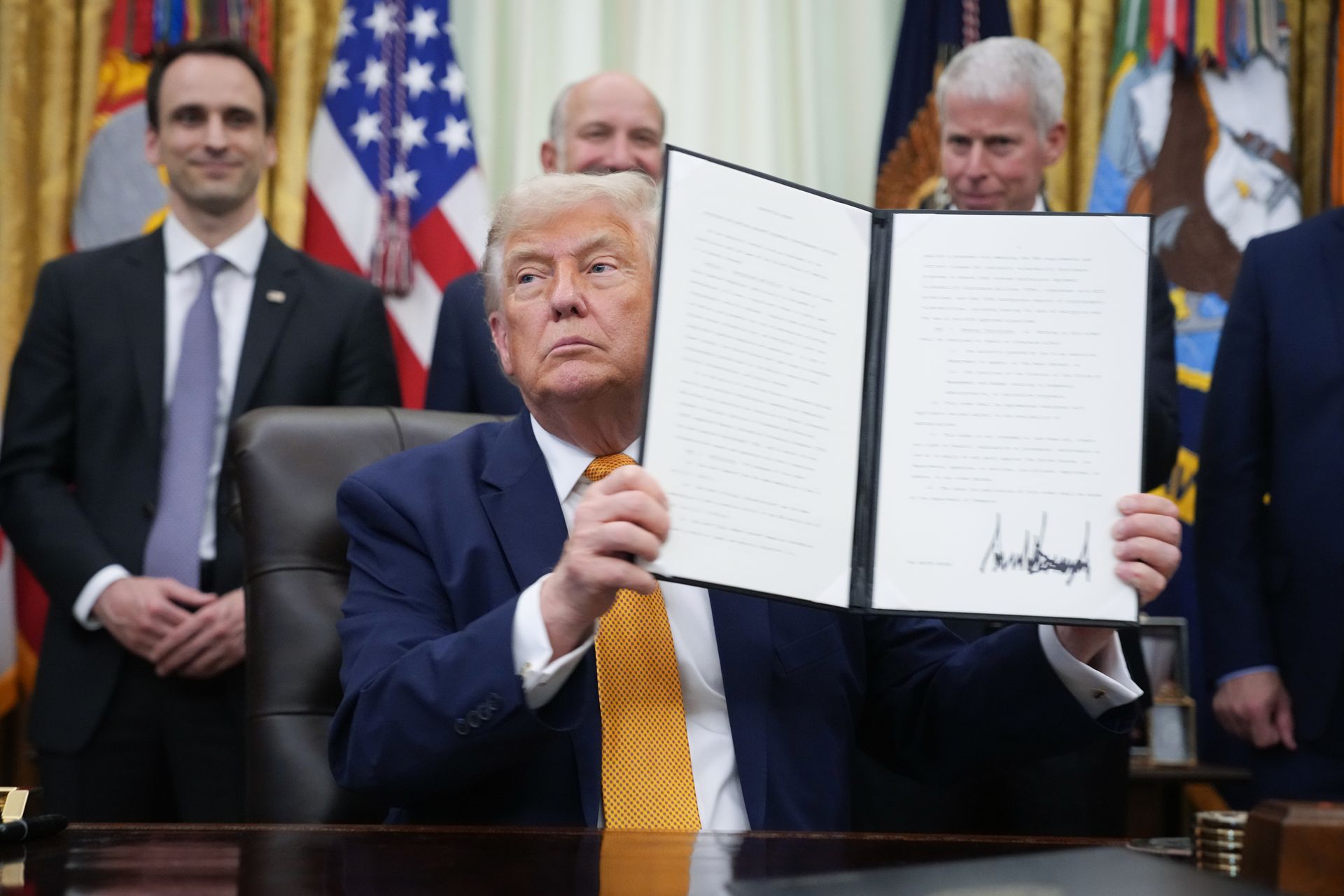
President Donald Trump signed two executive orders on Monday aimed at securing U.S. leadership in quantum computing, directing a push to build a powerful quantum computer for scientific research and speeding government preparations for quantum-enabled cyber threats.

Michael Kratsios, director of the White House Office of Science and Technology Policy, said the administration believes a quantum computer capable of initiating the era of quantum-enabled scientific discovery can be built "by 2028." The first order establishes the Quantum Computer for Application Development and Discovery Science effort, directing the Department of Energy to identify technical specifications for such a system and explore private-sector partnership models within 180 days.
The second order, which Trump also signed Monday, directs federal agencies to migrate high-value government computing systems to post-quantum cryptography by 2030 or 2031, depending on the use case. That deadline is ahead of a previous target of 2035 set during the Biden administration. The order also requires agencies to designate a post-quantum cryptography migration lead within 30 days and directs the Department of Commerce to complete a pilot migration project by Dec. 31, 2027.
The quantum computing orders do not allocate new funding, instead directing agencies to use existing resources, according to Yahoo Finance. The Energy Department will be responsible for setting the technical specifications that define what qualifies as powerful enough for scientific research, with a public summary due within 90 days.
Quantum sensing is also addressed in the first order, which sets a Sept. 30, 2028 deadline for the Pentagon to have sensors deployed. Reuters reported that among the potential applications are satellite-based detection of underground tunnels or missile silos, as well as navigation tools for aircraft operating in GPS-denied environments.
The orders arrive as quantum processors begin moving from research labs into data center environments, with companies including IBM $IBM and Microsoft $MSFT deploying quantum hardware alongside classical supercomputers for scientific workloads. The 2028 target for a research-grade machine is ahead of IBM's own timeline — the company does not expect to launch a fault-tolerant system until 2029, according to Barron's.
Among those present at the Oval Office for the signing were Arvind Krishna, who leads IBM, and Ruth Porat, who serves as president of Alphabet $GOOGL, Google's parent company, The Wall Street Journal reported. Last month, the Commerce Department announced it would take $2 billion in equity stakes across nine quantum-computing companies, including a new IBM venture.
