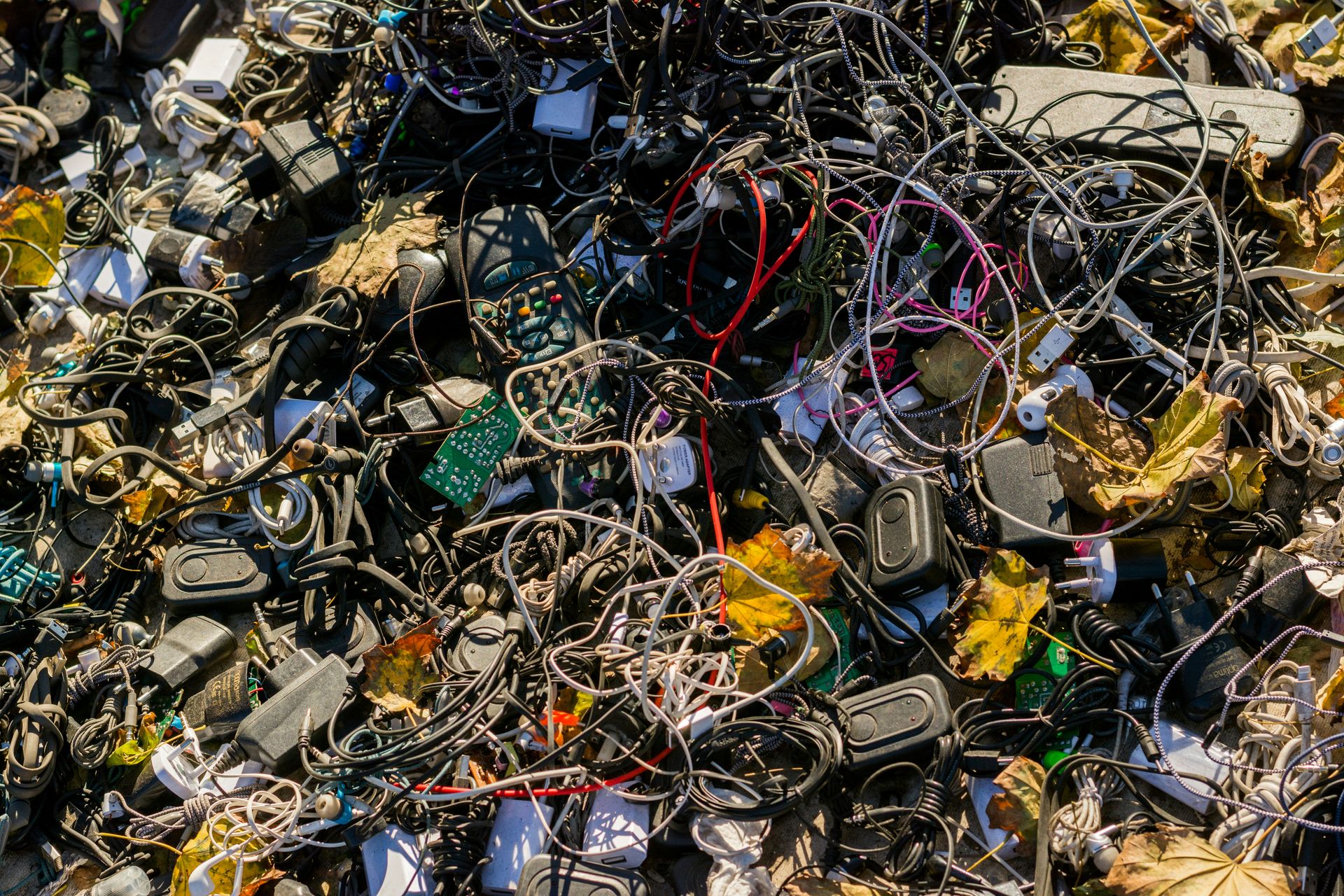
Callie Babbitt has spent years studying what happens to electronics after people throw them away. As a sustainability professor at the Rochester Institute of Technology, she has watched a promising industry try and fail, repeatedly, to grow beyond its local market. The reason, she says, is not technology. It isn't capital, either. It's the law. And there are 25 different versions of it.

"E-waste is governed by 25 different state laws, all slightly different," Babbitt recently told Quartz. "If you're a company trying to build a national business around recycling technology, every market is a different regulatory puzzle."
For the growing number of companies betting that AI and robotics can extract value from discarded electronics, the regulatory landscape is a veritable minefield.
25 laws, 25 different definitions
Twenty-five states plus the District of Columbia have enacted some form of e-waste legislation, according to the Environmental Protection Agency. The remaining 25 states have nothing: no comprehensive electronics recycling programs, and no reporting requirements, according to Minnesota-based recycler Repowered. In those states, it's legal to throw a television or a laptop in the garbage. No one there is keeping score.
The states that do regulate e-waste disagree on almost everything. Some, like Illinois, ban certain electronics from landfills outright but impose no mandate on who collects them or how, according to Close the Loop. Others set collection targets. Indiana orders manufacturers accountable to take back at least 60% of the total weight of everything they sold the year before, according to Californians Against Waste. Maine makes manufacturers foot the bill for shipping and recycling, including for products made by companies that have since gone out of business. New York takes a consumer-first approach, obligating manufacturers to offer free collection for computers, televisions, keyboards, mice, and printers, according to RecycleOldTech.
For a company operating across state lines, the obligations vary depending on product type, reporting cycle, fee model, and cost recovery structure, according to Close the Loop. States define "covered electronics" differently, set unique deadlines, and use different funding models. A company's New York compliance plan will not, for example, work in Texas.
Three funding models, no consensus
Most states with e-waste laws start from the same premise: the manufacturers who made the products should pay to recycle them. All but California and Utah have built their programs around that idea. But the details diverge sharply from there. Some states demand annual performance reports. Others set recycling targets or impose penalties for noncompliance.
California is the outlier. The state charges consumers an electronic waste recycling fee at the point of purchase and uses that money to fund a state-run network of certified recyclers. CalRecycle set the fee at $4, $5, and $6 per device depending on screen size in 2025, according to Human-I-T. In January 2026, California expanded the program to include battery-embedded products such as cordless tools, toys, and small appliances. No other state has replicated this advance-recovery-fee model at the same scale.
Expanding into California means rebuilding from scratch. Instead of billing manufacturers, a company has to work within a consumer-fee system, deal with a state-run recycler network, and comply with a different set of covered products and reporting rules. The structural differences create real costs.
Why federal law remains elusive
The U.S. has never enacted a federal law governing domestic e-waste recycling. Attempts go back to the 1990s. The EPA brought industry stakeholders together between 2001 and 2003 to negotiate a national standard, Scott Cassel, CEO and founder of the Product Stewardship Institute, told Knowledge at Wharton, but the electronics industry couldn't reach an agreement, and the issue was thrown back to the states.
The Secure E-Waste Export and Recycling Act has been introduced in Congress multiple times. Its sponsors say it would prevent discarded electronics from becoming a source of counterfeit products reentering U.S. supply chains, and grow the domestic recycling industry. But it's yet to become law.
The structural barrier goes beyond lobbying. State laws often reference international regulations that forbid the export of toxic e-waste, but states have no jurisdiction over foreign commerce. The patchwork of varying state requirements makes compliance more difficult and expensive for manufacturers than a single federal law would. And because no state can solve that alone, the mishmash persists.
What the fragmentation costs
The European Union offers a comparison. Though E.U.'s e-waste collection rate was 40.6% in 2022 — some way short of the bloc's 65% target — a single directive applies across all member states. The U.S. has no national collection target and no federal reporting framework to measure progress against one.
Academic research has put a finer point on it. A study by Kelsea Schumacher and Lawrence Agbemabiese in the Journal of Environmental Planning and Management concluded that the regulatory patchwork is itself impeding e-waste recycling, and that the disparate designs of state programs influence collection rates in measurable ways.
The country isn't failing for lack of technology or ambition. It's failing because the rules — where they exist at all — can't work together.
