
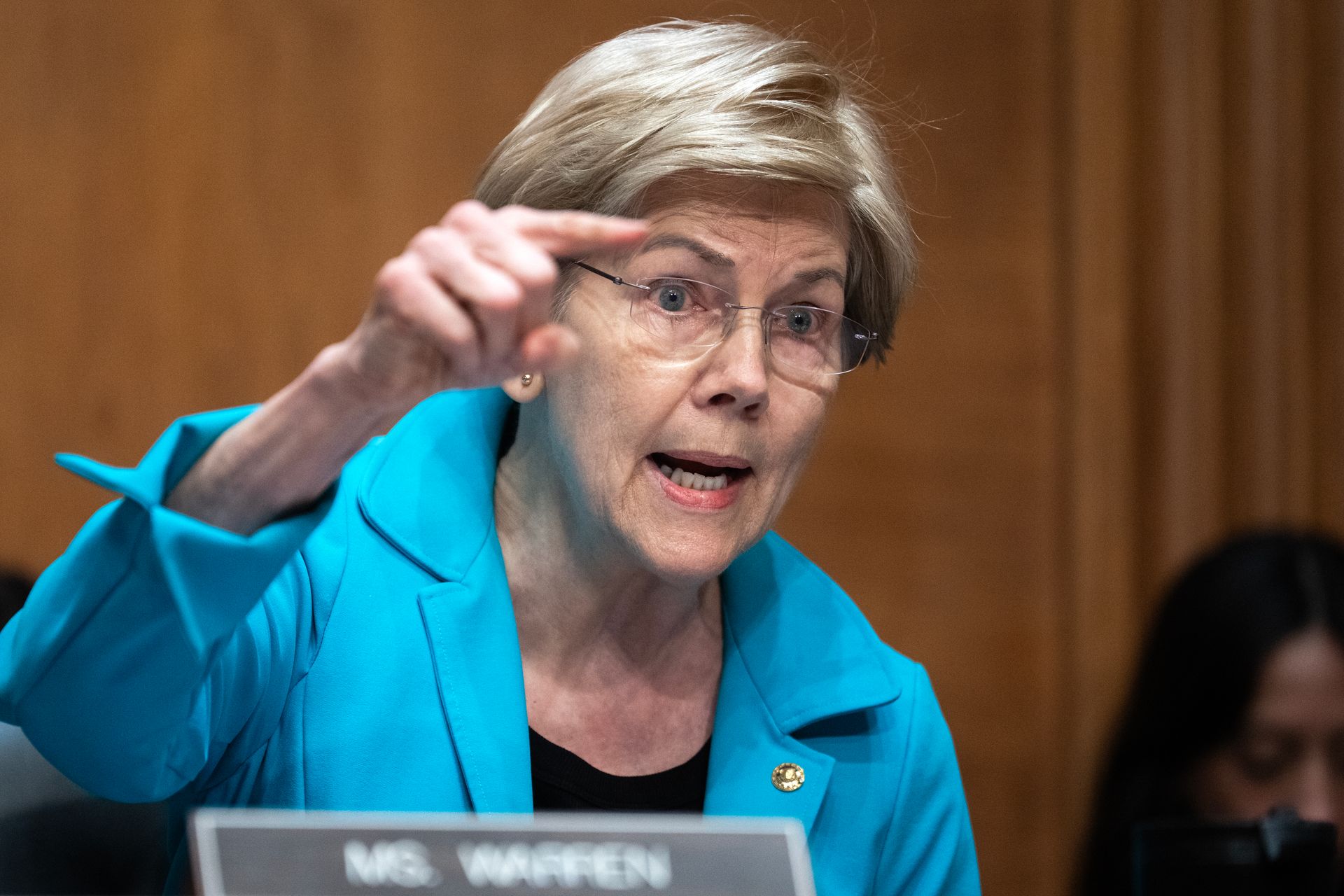
Sens. Elizabeth Warren and Mark Kelly wrote to three of President Donald Trump's top trade officials on Monday, according to a letter received by CNBC, arguing that the administration's tariff policy has cost U.S. manufacturing workers jobs while benefiting corporations and wealthy allies.
U.S. Trade Representative Jamieson Greer, Treasury Secretary Scott Bessent, and Commerce Secretary Howard Lutnick were each named as recipients of the letter, which challenged the administration's trade strategy and demanded a response to two specific questions: why the manufactured goods trade deficit has expanded on Trump's watch, and what concrete steps the officials plan to take to address what the senators characterize as harm to the sector.
"Blue-collar jobs are disappearing, a trend that economists blame at least in part on the president's historic and volatile tariff policy," the senators wrote. "The Trump administration's trade agenda has favored the interests of wealthy corporations and Trump allies, leaving manufacturing workers behind."
To support their case, the senators invoked a February report compiled by Joint Economic Committee Democrats — a congressional body on which Kelly is a member — that drew on Bureau of Labor Statistics figures to conclude 108,000 manufacturing positions disappeared during the first twelve months of Trump's second term. Capital investment in manufacturing construction has similarly retreated from a high point reached in the summer of 2024.
Two companies served as the letter's central illustrations of offshoring under the tariff regime: hedge fund billionaire and Trump ally John Paulson, whose Ohio brass instrument plant is being shuttered in favor of Chinese production, and appliance maker Whirlpool, which has eliminated close to 500 positions while growing its presence across the border in Mexico. Warren and Kelly argued these cases show the tariffs have not stopped the offshoring of American jobs.
Physical goods imports also factored into the senators' critique: Census Bureau figures released earlier this year showed the gap between what the U.S. imports and exports in tangible merchandise reached an all-time high in 2025, even as the broader overall trade deficit with the rest of the world shrank. Spokespeople for Greer, Bessent, and Lutnick did not respond to a request for comment.
The tariff fight has played out in courts as well as in Congress. The Supreme Court struck down a majority of Trump's import taxes that were imposed under the International Emergency Economic Powers Act, ruling that the president does not have unilateral authority to levy tariffs. Trump responded by imposing a new round of import taxes under a separate legal authority, and tariffs on steel, aluminum, lumber, and furniture remain in place.
The economic cost of the remaining tariffs has drawn scrutiny beyond Capitol Hill. The Congressional Budget Office found that tariffs raise the cost of imported goods, reduce household purchasing power, and leave employment slightly below what it would otherwise be, with consumers bearing roughly 70% of the burden.