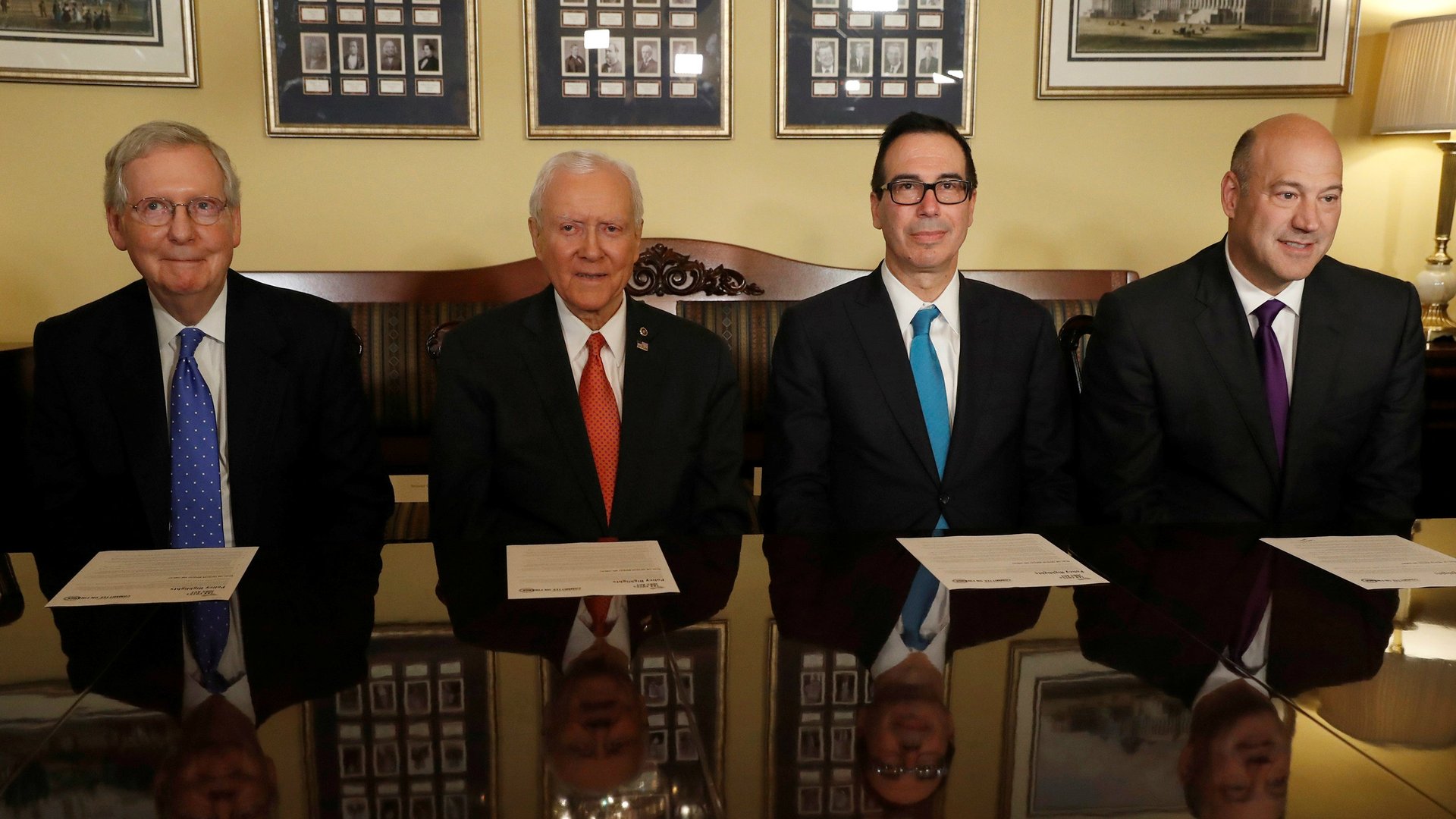
Sweeping changes are coming to the US tax system. The Republican-led House and Senate have proposed tax reform bills that are similar enough that something like them will probably pass into law. If the majority party’s lawmakers can quickly agree on a compromise—a big “if”—it may happen by the end of the year.
Sweeping changes are coming to the US tax system. The Republican-led House and Senate have proposed tax reform bills that are similar enough that something like them will probably pass into law. If the majority party’s lawmakers can quickly agree on a compromise—a big “if”—it may happen by the end of the year.
The Republicans’ tax proposals, as currently written, are pretty unpopular. As we approach the legislative endgame, now is a good time to take a step back and ask: How did we get here?
Join 500,000+ readers who start their day with Quartz.
By subscribing, you agree to our Terms of Service and Privacy Policy.
Quartz has been following tax reform for much of the year, and we are here to help. We’ve compiled a list of stories to demystify the debate and get up to speed if you’re just tuning in.
At its core, the proposals are mostly about cutting corporate taxes.
Take a look at these charts.
Probably, but someone has to pay for it.
Higher income taxes on the rich would do the trick. That’s not on the table.
Why not? ¯_(ツ)_/¯
Instead, Republicans plan to pay for the corporate cut via higher government debt and increasing taxes on some middle-income families.
Yep.
They are betting that cutting corporate taxes will “trickle-down” and boost economic growth.
Not necessarily. Some Republicans might decide they are uncomfortable increasing the debt, or that the proposals don’t help small businesses enough.
Of course! Take five…
The reform plan is worse for people in Democratic states than Republican ones.
The plan includes a thinly veiled attack on the endowments of Ivy League schools.
Small-government conservatives can cite high-tax Sweden as a model for repealing the estate tax.
True tax reform would mean introducing a value added tax (VAT), like nearly every other country.
It turns out that it’s really good for Trump and his family’s businesses.
