Yesterday, Donald Trump met with a group of students, teachers, and parents to discuss last week’s school shooting massacre in Parkland, Florida and the uniquely American epidemic of school shootings. Referring to the shootings, Trump asked his guests, “Does anyone have any ideas for how to stop it?”
Yesterday, Donald Trump met with a group of students, teachers, and parents to discuss last week’s school shooting massacre in Parkland, Florida and the uniquely American epidemic of school shootings. Referring to the shootings, Trump asked his guests, “Does anyone have any ideas for how to stop it?”
The White House’s selected guests suggested a variety of areas to troubleshoot: Mental illness, bullying, FBI negligence, gun-free zones (which the president has publicly blamed for attracting “maniacs”), censorship, partisanship, lack of relatedness, obsession with identity, lack of expert “consultants,” lack of safety training for students, and even the absence of armed, undercover police in schools. But as 18-year-old Parkland survivor Sam Zeif pointed out, one well-known idea has already been consistently proven to stop mass shootings: Stricter gun laws.
Join 500,000+ readers who start their day with Quartz.
By subscribing, you agree to our Terms of Service and Privacy Policy.
Research shows that countries with fewer guns have lower homicide rates. Even US states with fewer guns have fewer homicides; in a landmark 2002 study, analysis of data from 1988 to 1997 showed that states with “high” gun ownership had three times the rate of homicide than states with few guns. A decade later, a 2013 study found that every percentage point increase in gun ownership corresponded to a 0.9% higher risk of gun homicide. Countries and states that legally limit overall gun ownership simply have fewer gun deaths.
Of course, mass shootings do occur in other countries. Germany, China, Russia, Switzerland have all suffered mass shootings in recent years. Unlike the US legislature, German and Swiss lawmakers responded to massacres by changing the law to prevent such shootings from happening again.
China and Russia’s governments are also tightening the law on who may own guns, and what kinds of guns.
The United States stands out among countries for the frequency with which its mass shootings occur. But last year, after the US witnessed its most fatal mass shooting in history at Las Vegas, the Trump administration made it easier—not harder—for people with mental illness to buy guns. (That decision rolled back Obama-era restrictions that had been passed in the wake of Sandy Hook.)
Back in 1996, it took only 12 days after a mass shooting for Australia to pass the National Firearms Agreement, which banned automatic and semi-automatic weapon for “personal defense.” The country created a temporary buyback program for guns that had become illegal. Stricter background checks were enforced. As Zeif pointed out yesterday, there have been no school shootings in Australia since.
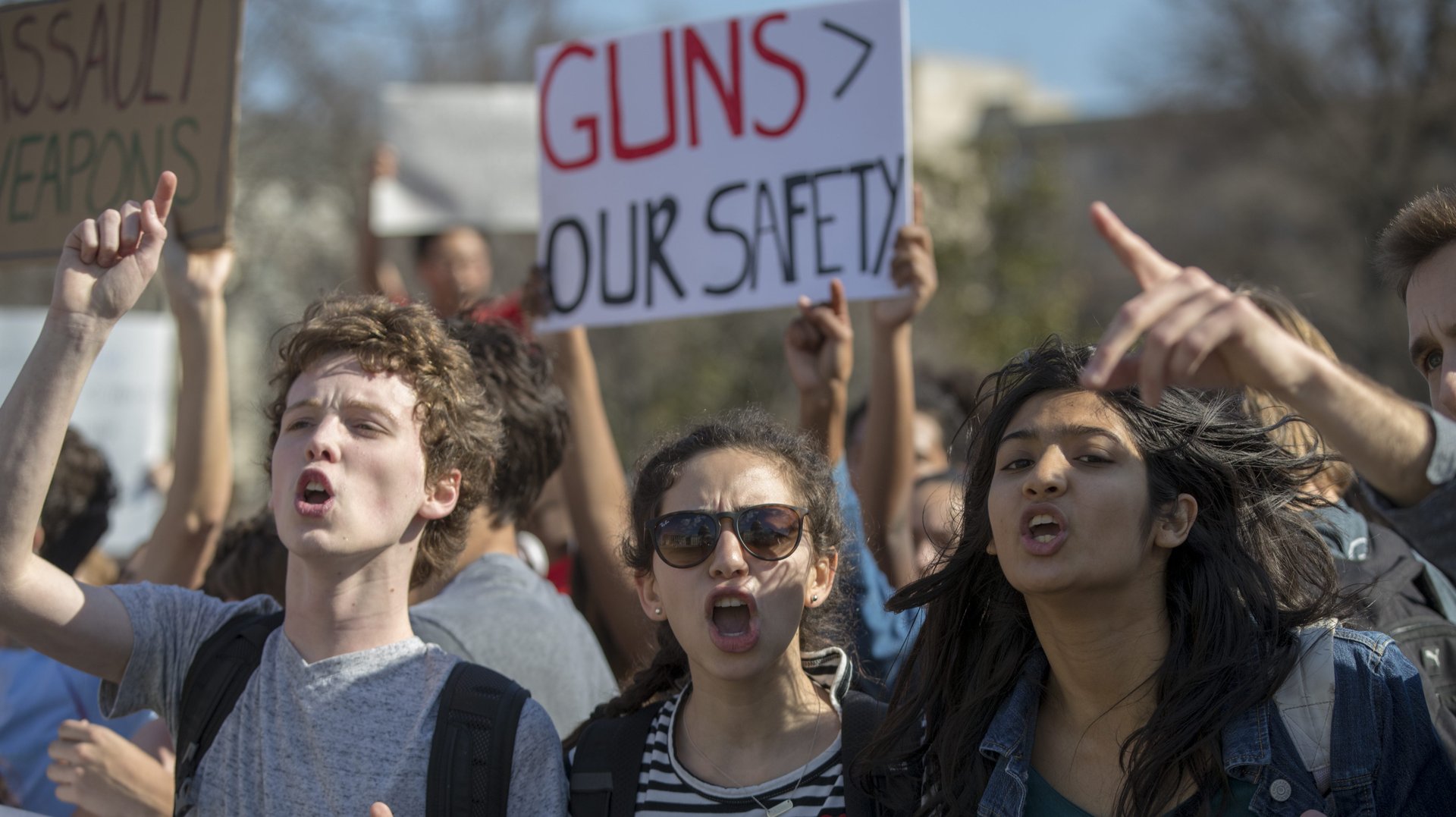
As the televised meeting in the White House continued, thousands of other US teenagers walked out of their high schools, echoing his call for gun control.
