Spanish residents aren’t merely out of work—they’re out of the country.

Spanish residents aren’t merely out of work—they’re out of the country.
According to a new report by Spanish think tank Fundación Alternativas (Spanish link), more than 700,000 people—equivalent to roughly 1.5% of Spain’s population—have left the country since 2008. Since 2011, Spain has seen more people emigrate to other countries than arrive.
Join 500,000+ readers who start their day with Quartz.
By subscribing, you agree to our Terms of Service and Privacy Policy.
That’s especially surprising given that Spain’s statistics bureau (INE) puts the number closer to 200,000. But these numbers don’t properly account for fleeing foreigners. In 2012, 162,000 foreigners left Spain, 83% of the total number of emigrants, according to the think tank. Foreigners, however, often fly under the radar, because of Spain’s historically poor system of registry, the report says.
The country’s inability to keep accurate records has led to some stark discrepancies between its and other countries’ immigration numbers. Between 2008 and 2012, for example, Spain estimates roughly 30,000 people emigrated to the UK; the UK, however, puts the number at nearer to 113,000—five times as many. For Germany, the discrepancy is much the same: Spain’s statistics claim about 17,000 people emigrated to Germany over that period, while Germany’s hold that the number is upwards of 80,000.
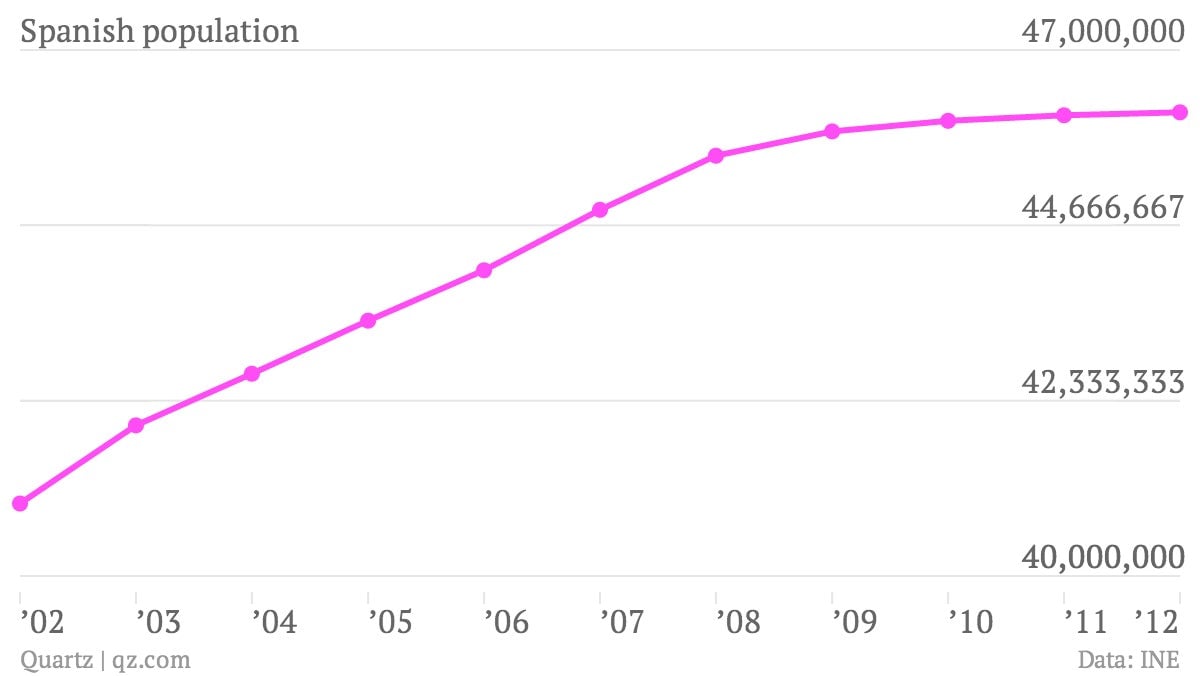
The flight from Spain also comes on the heels of what was a pretty prosperous six years of immigration. Between 2002 and 2008, the population grew by some 720,000 a year. Now it isn’t growing at all. Such a sudden stop looks like the result of a mass exodus.
While those abandoning ship are leaving for cities far and wide, there appears to be tendency towards European Union countries close by. The UK, France and Germany have remained favorite destinations; in 2012, the three received 30% of Spain’s emigrants.
With unemployment still hovering near 26% and the prospects of an economic turnaround still looking grim, tempering the urge to flee won’t likely be an easy task. According to a study by the Center for Sociological Investigations (CIS) last year, just under 50% of Spanish citizens said they would live abroad, and nearly 20% admitted that they are actively considering the possibility.
