
Reviewing the history of recordings on your Alexa-enabled device can be a useful exercise. In my own family’s case, a month of Alexa commands reveals intergenerational conflicts:

Reviewing the history of recordings on your Alexa-enabled device can be a useful exercise. In my own family’s case, a month of Alexa commands reveals intergenerational conflicts:
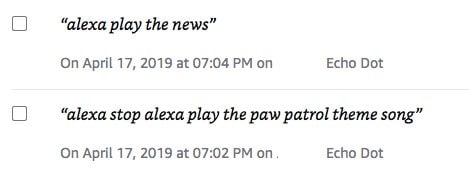
Sibling conflicts:

And our youngest member’s unhealthy fixation on the “Mighty Pups” cartoon theme song.

Reviewing Alexa history also offers users of Amazon $AMZN’s smart speakers the chance to delete those recordings. And if you want to limit the company’s use of your data, you might want to consider doing so.
Amazon’s marketing materials describe Alexa as a god-like figure who “lives in the cloud and is always getting smarter.” The texts that further Alexa’s education are bits of speech sourced from millions of users.
Amazon’s virtual assistant is designed to record everything it hears after a spoken “wake word” (which users can change from the default “Alexa.”) Those audio files are stored in the cloud, and a small percentage are chosen at random and analyzed by Amazon contractors and employees—real, live humans—to improve Alexa’s responses.
Deleting an audio file from a user’s history also deletes that file from any training sets it has since become a part of, Amazon says. If this is information you’d rather not share with the company, it takes just a few taps or clicks to erase it all.
Here’s how to do it:
Join 500,000+ readers who start their day with Quartz.
By subscribing, you agree to our Terms of Service and Privacy Policy.