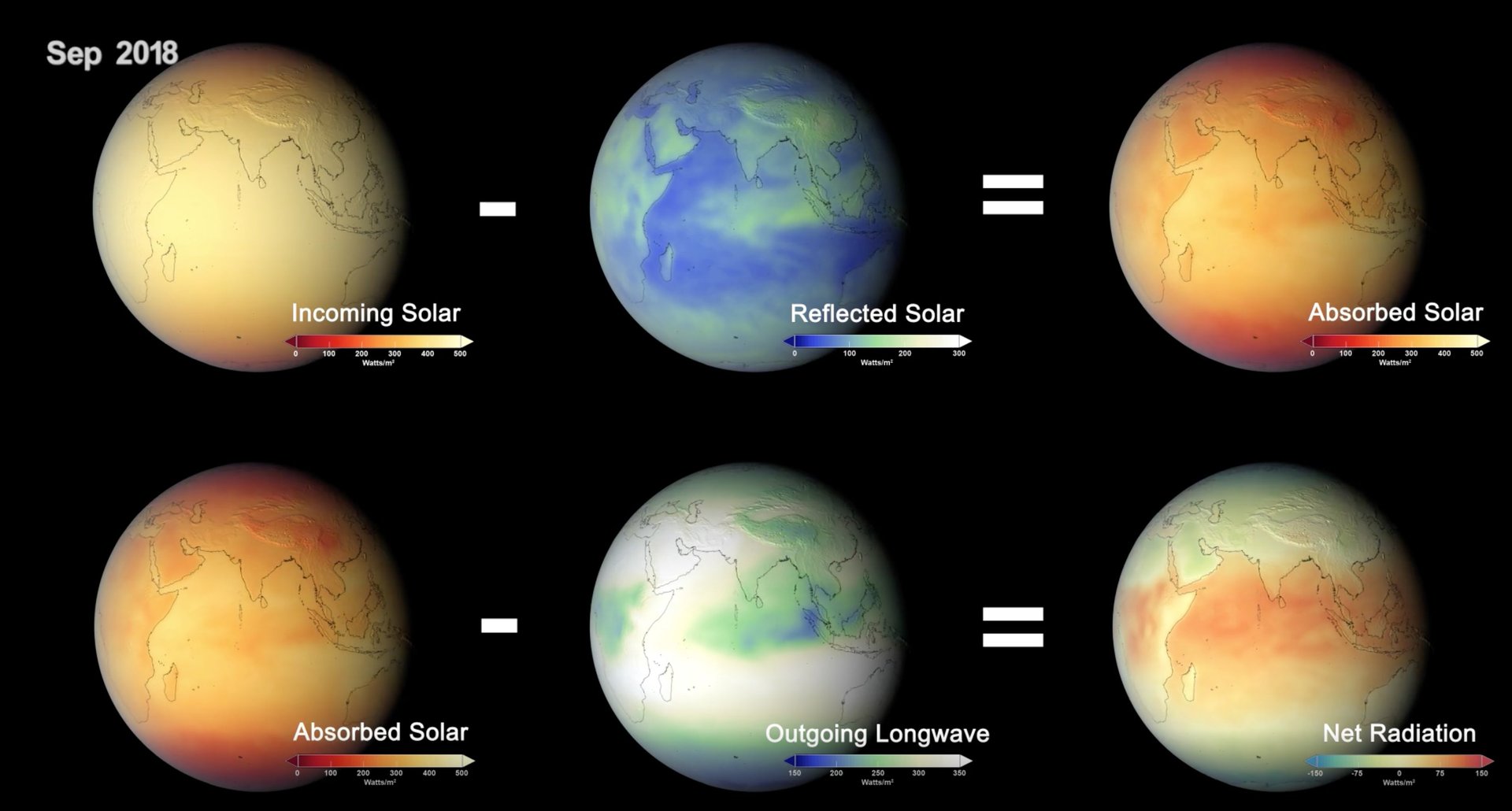
Every year, the sun sends radiation toward Earth equivalent to more than 7,000 times humans’ annual energy consumption. Much of it (about 30%) ricochets off the atmosphere into space; the rest is absorbed or reflected back out after reaching Earth’s surface. Global warming happens when the greenhouse gases dumped into the atmosphere act like a warm, insulating blanket, capturing this energy rather than letting it escape.
Every year, the sun sends radiation toward Earth equivalent to more than 7,000 times humans’ annual energy consumption. Much of it (about 30%) ricochets off the atmosphere into space; the rest is absorbed or reflected back out after reaching Earth’s surface. Global warming happens when the greenhouse gases dumped into the atmosphere act like a warm, insulating blanket, capturing this energy rather than letting it escape.
For decades, scientists have relied on models to predict exactly how fast the world is warming due to human activities. And they’ve gotten very good at them. But scientists publishing in the journal on March 25reported the first direct global observations of how much aerosols and greenhouse gases released by humans are driving climate change. “It’s direct evidence that human activities are causing changes to Earth’s energy budget,” , co-author of and a researcher at NASA’s Goddard Space Flight Center and the University of Maryland, Baltimore County.
Join 500,000+ readers who start their day with Quartz.
By subscribing, you agree to our Terms of Service and Privacy Policy.
Since 1977, NASA has been continuously studying Earth’s energy budget by flying instruments aboard satellites with the Clouds and the Earth’s Radiant Energy System (CERES) project. These have delivered detailed measurements of the planet’s radiation: how much enters, how much escapes, and how much soaks into the oceans. The new study is the first to account for human activities—as well as natural factors such as water vapor, clouds, and surface reflectivity—to precisely pin down the Earth’s energy imbalance, the “distinct fingerprints of anthropogenic activity in Earth’s changing energy budget.”
The study concluded human activities increased this imbalance, also known as “radiative forcing,” by about 0.5 watts per square meter between 2003 to 2018, mostly due to rising greenhouse gas concentrations. For context, that’s about the equivalent of keeping nearly 5 trillion 60-watt light bulbs lit across the Earth’s surface all the time.
Zeke Hausfather, a climate scientist at the environmental research group Breakthrough Institute, said the study “largely validates what we already know but in a more straightforward observation-based way,” pointing to a 2015 study in Nature that measured CO2 radiative forcing on the Earth’s surface as another example.
That data lines up well with scientists’ climate models, but it also offers a faster way to monitor how mitigation efforts are working and to test computationally-intensive models. It might also influence those who continue to doubt the overwhelming climate consensus among 97% of publishing climate scientists. “In my experience,” said Hausfather, “skeptics tend to be more swayed by observations than models, so it’s certainly helpful. It creates a pretty high bar to explain away.”
