Is China facing a US-style housing crash and banking crisis? Unlikely, Zhu Haibin, an economist at JP Morgan, told Xinhua on May 16; China’s not about to have a wave of mortgage defaults. And Zhu’s probably right—if you’re only talking about mortgage defaults.

Is China facing a US-style housing crash and banking crisis? Unlikely, Zhu Haibin, an economist at JP Morgan, told Xinhua on May 16; China’s not about to have a wave of mortgage defaults. And Zhu’s probably right—if you’re only talking about mortgage defaults.
The problem is that Chinese banks also use property as collateral for a lot of loans that aren’t mortgages. (In other countries they might ask the borrower for an income statement instead, but these aren’t too reliable in China.) At the end of 2013, 38% of the value of outstanding loans (paywall) issued by big commercial banks used real estate as collateral, according to China’s banking regulator. That’s roughly 28.8 trillion yuan ($4.6 trillion) in loans.
Join 500,000+ readers who start their day with Quartz.
By subscribing, you agree to our Terms of Service and Privacy Policy.
And it’s likely much bigger. The regulator’s data counts only loans to developers or individuals—overlooking some of the companies in unrelated sectors that invested in property for profit, as well as the untold sums of shadow loans issued off bank balance sheets and supported by property collateral.
What all this means is that, if the property market continues to slide and the slowing economy makes it hard for borrowers to pay back those debts, banks with defaulting borrowers will be left with collateral worth only a fraction of what they’re owed. And then, as banks try sell off this collateral en masse, prices will plummet still further, causing a vicious cycle.
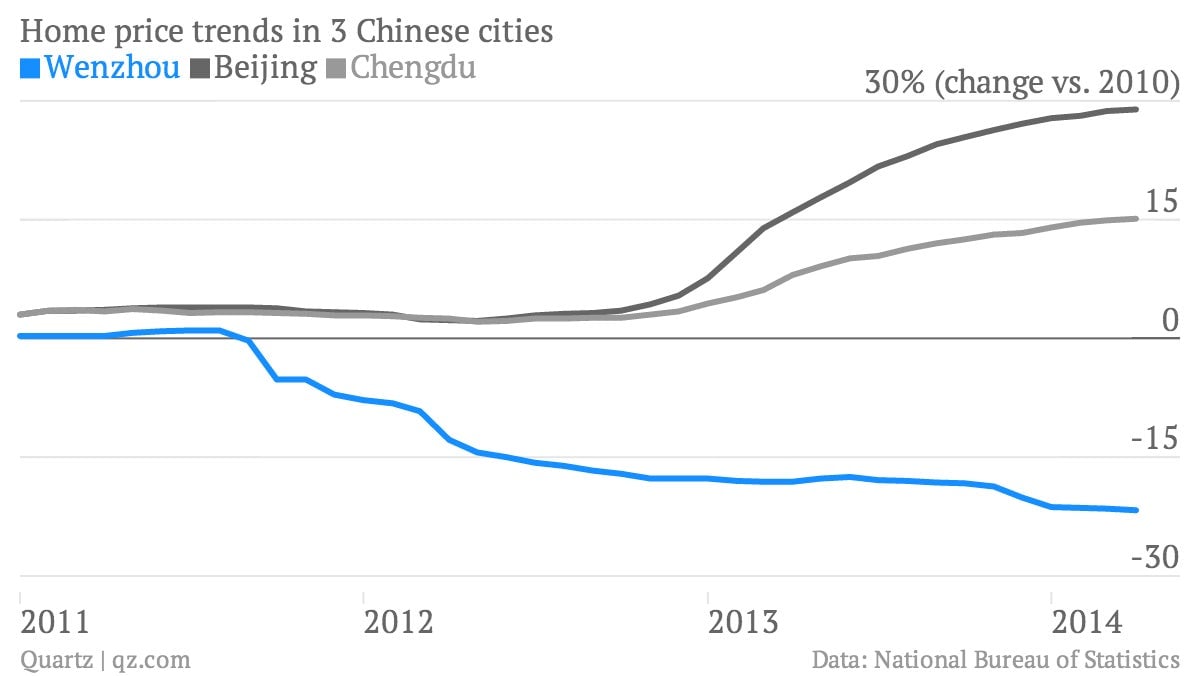
That’s what happened in the Chinese city of Wenzhou in mid-2011, when a rash of corporate bankruptcies left banks unloading real estate to salvage their loan books, crashing Wenzhou’s housing market. As you can see, it still hasn’t recovered:
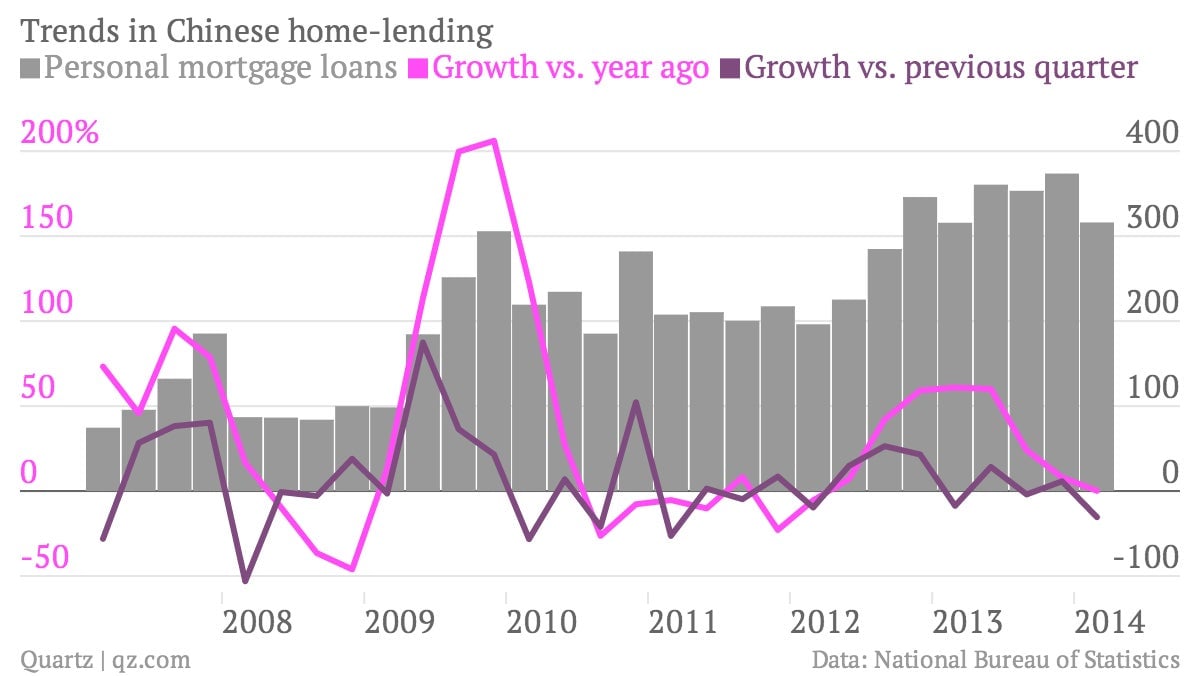
But while property collateral is a more serious threat to China’s financial system than a wave of mortgage defaults, mortgages could still hit banks hard.
Housing prices have soared so much that nearly four-fifths of the average family’s income (paywall) goes toward mortgage payments, according to Ha Jiming, Goldman Sachs $GS’ vice-chairman for China. Only four years ago, that share was two-thirds. If a slowing economy leads Chinese families to cut back on spending, their loan payments will likely slide.
As for whether China’s market is really faltering, here’s the round-up of the latest news that provides a pessimistic snapshot:

