For the last few days, media coverage of India’s incoming prime minister, Narendra Modi, has been mostly euphoric—except for the perfunctory mentions of the pesky 2002 genocide of more than 1,000 Muslims in the state of Gujarat under his watch.
As Modi takes his oath of office, it’s worth being mindful of the fuller picture:
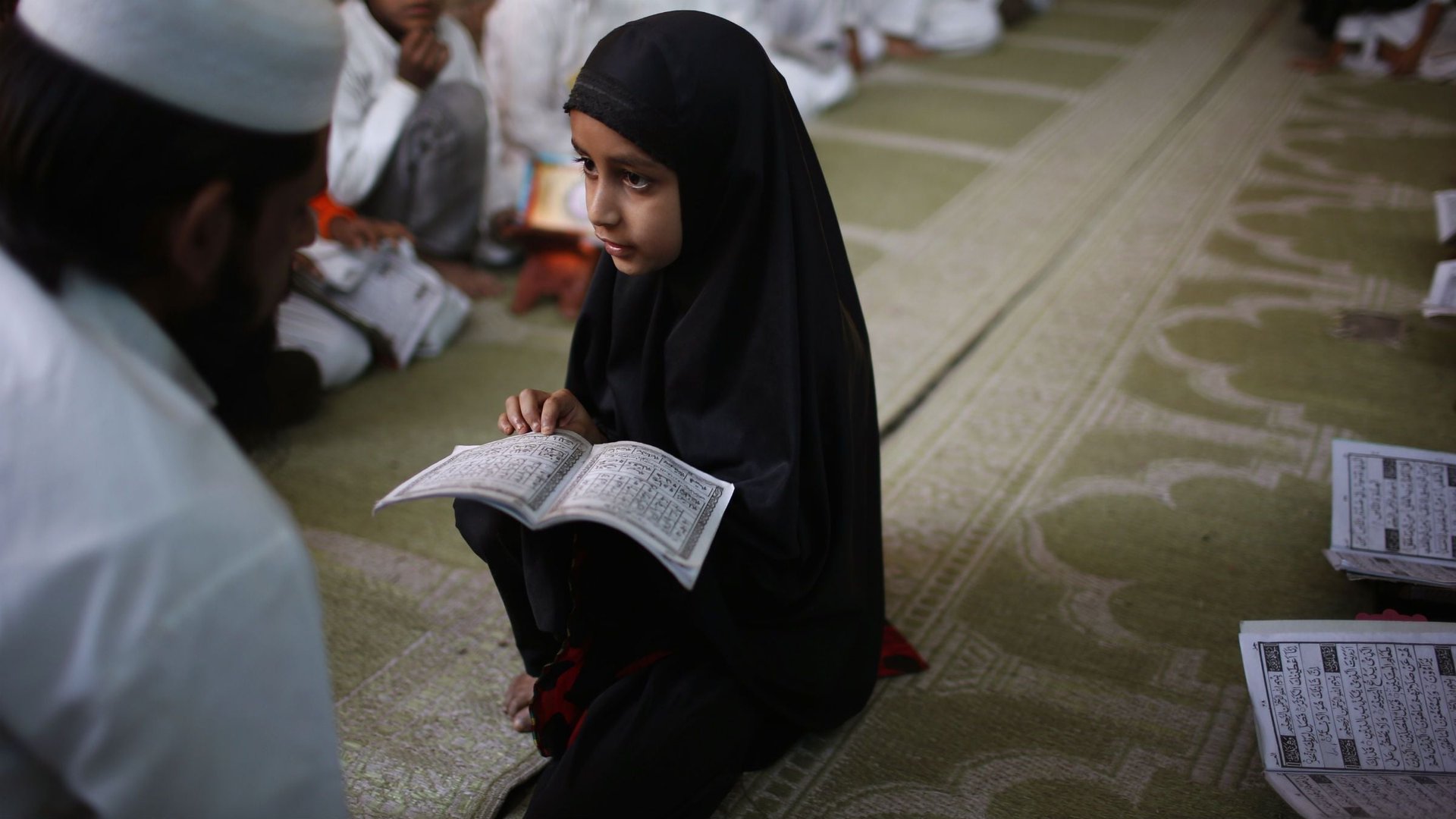
This narrative is important because India has the third largest Muslim population in the world, behind Indonesia and Pakistan. Since Modi’s political ascendancy has been largely based on a right-wing Hindu nationalist platform, many analysts are questioning the future of 140 million Muslims in India, relegated to second-class citizenship in their own country of birth. Modi came to power on a promise of turning around India’s economy. It’s worth remembering that though Muslims represent the largest religious minority within India (roughly 13% of India’s total population), they are also the demographic which suffers the most in terms of economic disenfranchisement and poverty.
A Gallup poll, for example, found that Indian Muslims are “more economically disadvantaged and dissatisfied than Indians of other religious groups” in their standard of living. Furthermore, Muslims in India are more likely than the rest of the population to live below the poverty line—1% compared with 26%—according to the National Council of Applied Economic Research in India. Muslims in India are more likely to live in villages without schools or medical facilities and less likely to qualify for bank loans simply because of their Islamic faith.
There is such widespread blatant discrimination against Muslims in India, “so rampant that many barely muster outrage when telling of the withdrawn apartment offers, rejected job applications and turned-down loans that are part of living in the country” as a Muslim, according to a recent piece in the New York Times.
They do have something in common with Modi, though. “The new generation wants a better India that isn’t bogged down in religious strife,” says Junaid Memon, a Muslim Bollywood director trying to promote religious harmony through his work and social media. “We shouldn’t be an India that ghettoizes all Muslims to apartments near a mosque. This is a real test for modern India.”
And yet the situation is unlikely to get better under a prime minister Modi.
“Relations between the communities are not normal,” Rajiv Shah, former political editor in Gujarat for the Times of India, told the Los Angeles Times recently. “There is no interaction between Hindus and Muslims except at very high income levels”—where money trumps religion.
So for the next few years, the country of India will have an enigmatic right-wing ultra-nationalist firebrand named Narendra Modi who will serve as the prime minister of the largest democracy in the world.
But if his statements and personal history are any guide, Modi appears an unapologetic Hindu nationalist. He has been referred to as “India’s Vladimir Putin” by Dalrymple.
To salvage his reputation—and his legacies, past and future— Narendra Modi’s entire political legacy could very well rest on his treatment of 140 million Muslims who are living as second-class citizens in India today. Will he improve the economic and societal well-being of all of his citizens? Or will he turn a blind eye to their suffering once again?
History gives me little hope.
