Silicon Valley CEOs (and many from farther afield) are constantly complaining that good technical talent is expensive and in short supply. There’s something to their concerns. At every education level, jobs requiring STEM (science, technology, engineering or math) skills in the US take far more time and money to fill than just about anything else, according to a new study from the Brookings Institution.

Silicon Valley CEOs (and many from farther afield) are constantly complaining that good technical talent is expensive and in short supply. There’s something to their concerns. At every education level, jobs requiring STEM (science, technology, engineering or math) skills in the US take far more time and money to fill than just about anything else, according to a new study from the Brookings Institution.
Researcher Jonathan Rothwell, together with Burning Glass, a labor-market data analysis company, collected data on thousands of American job ads, the dates they opened and were taken down, and the skills that they require.
Join 500,000+ readers who start their day with Quartz.
By subscribing, you agree to our Terms of Service and Privacy Policy.
Google $GOOGL, for example, took an average of 97 days to fill computer-related jobs (primarily software engineers), 56 for sales, and 79 for management in the San Jose area (which encompasses Mountain View, where the firm’s headquarters are). About half of the jobs in Rothwell’s dataset that were posted for 70 days required high levels of STEM knowledge.
The dataset also tracks required skills, and identifies which ones pay off most handsomely. Computer skills make up a large portion. The average salary value of a skill is calculated from the averaged advertised salary of jobs that mention any particular ability.
Rothwell passed the detailed data on to Quartz, and we made the graphs below to show the average salary value for each skill. (We confined ourselves to skills with more than 2,000 job ads in the dataset.)
Some caveats: This isn’t a perfect dataset. It scrapes from a large set of job advertisements, not all of which include salary data. Some of the skills broken out are catch-alls, broad tags like “big data,” “machine learning,” and and “data modeling,” rather than skills with particular techniques or programming languages. Others, like “IT management,” “process management,” and ”concept development” seem like proxies for managerial positions, which likely accounts for why jobs with these “skills” have higher high salary figures.
What’s more, these descriptions don’t identify the primary skill a job is hiring for, just those skills that were mentioned prominently in the listing. So some less consequential skills likely come out on top. And it will always be a combination of skills rather than any one that employers look for. But the data do provide a useful window into some of the specific skills and areas of knowledge that are in greatest demand. First, the data for computer-centric skills:
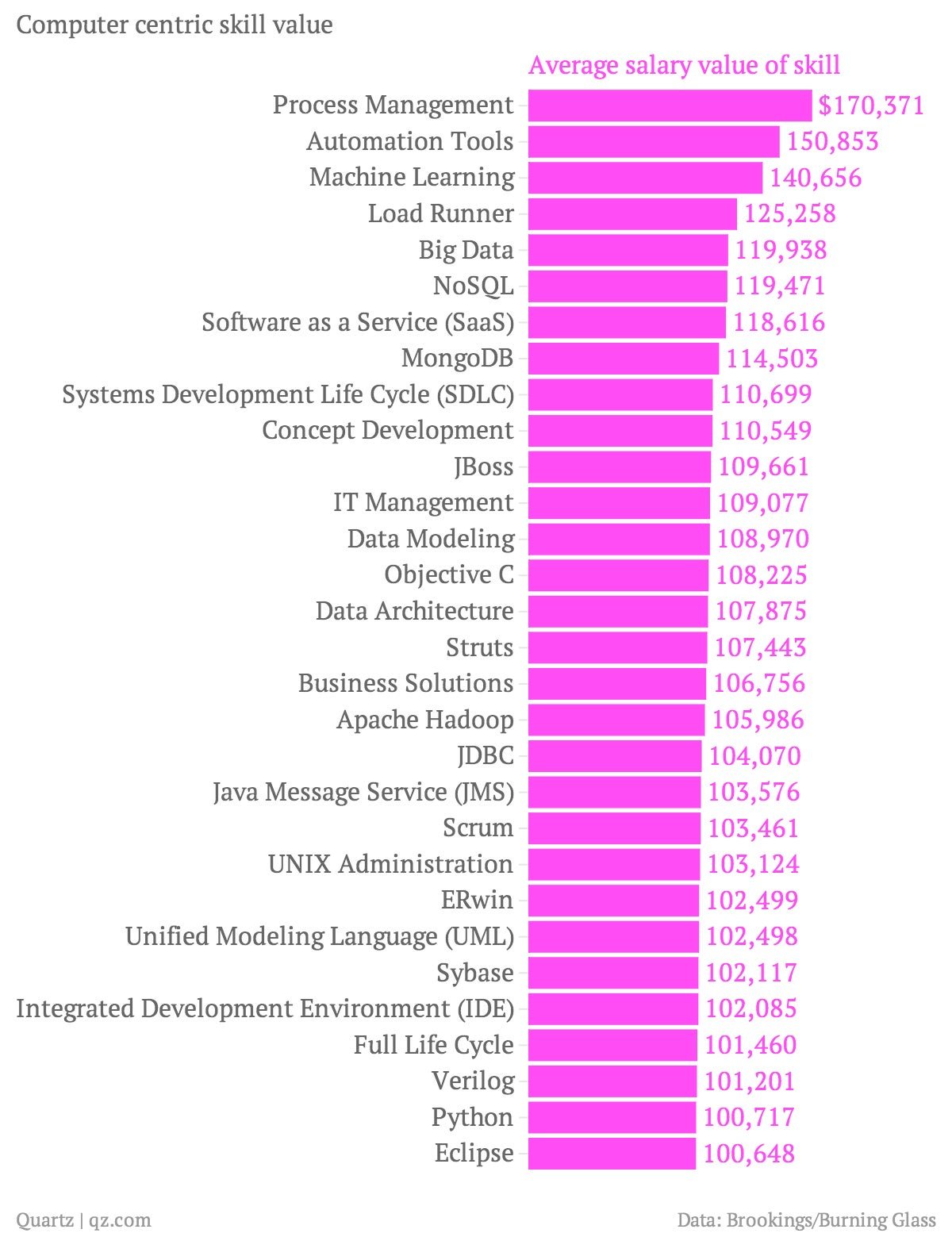
Many of the top paying skills are related to big data (NoSql and MongoDB $MDB for example, beyond the catch-all “big data” tag), and likely come in concert a lot of the time. A few others are web-related, and the popular core languages that form the backbone of the web economy, such as Python, make the list.
Some skills are tied to a particular company’s software (like the HP $HPQ load-testing software Load Runner), and specializing in these can be a risky move, given how quickly once-essential software can be replaced by newer alternatives.
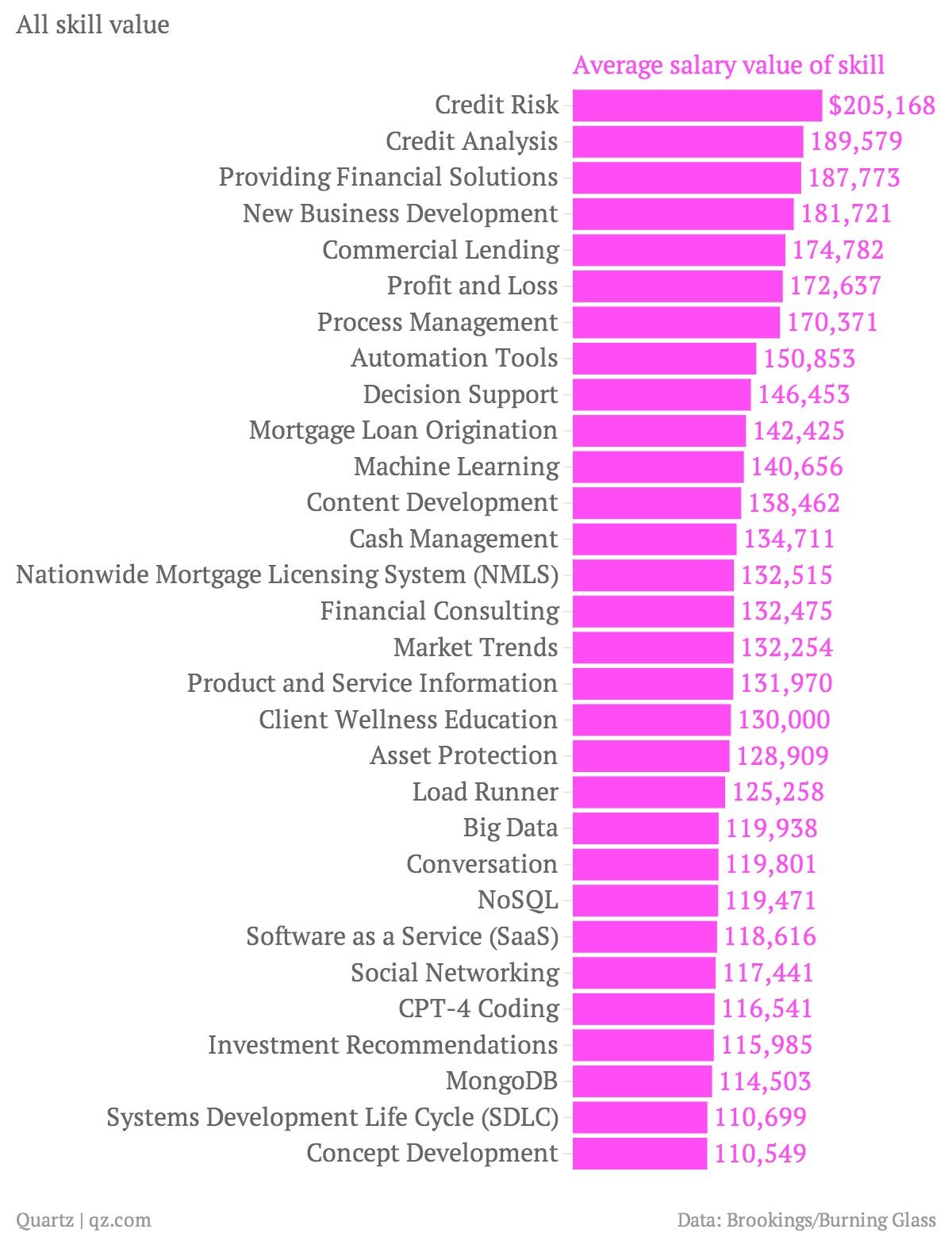
Here are the data on all skills combined, including medicine, biology, and management. Though tech skills take up some of this list too, others, especially finance and banking skills, make a strong showing:
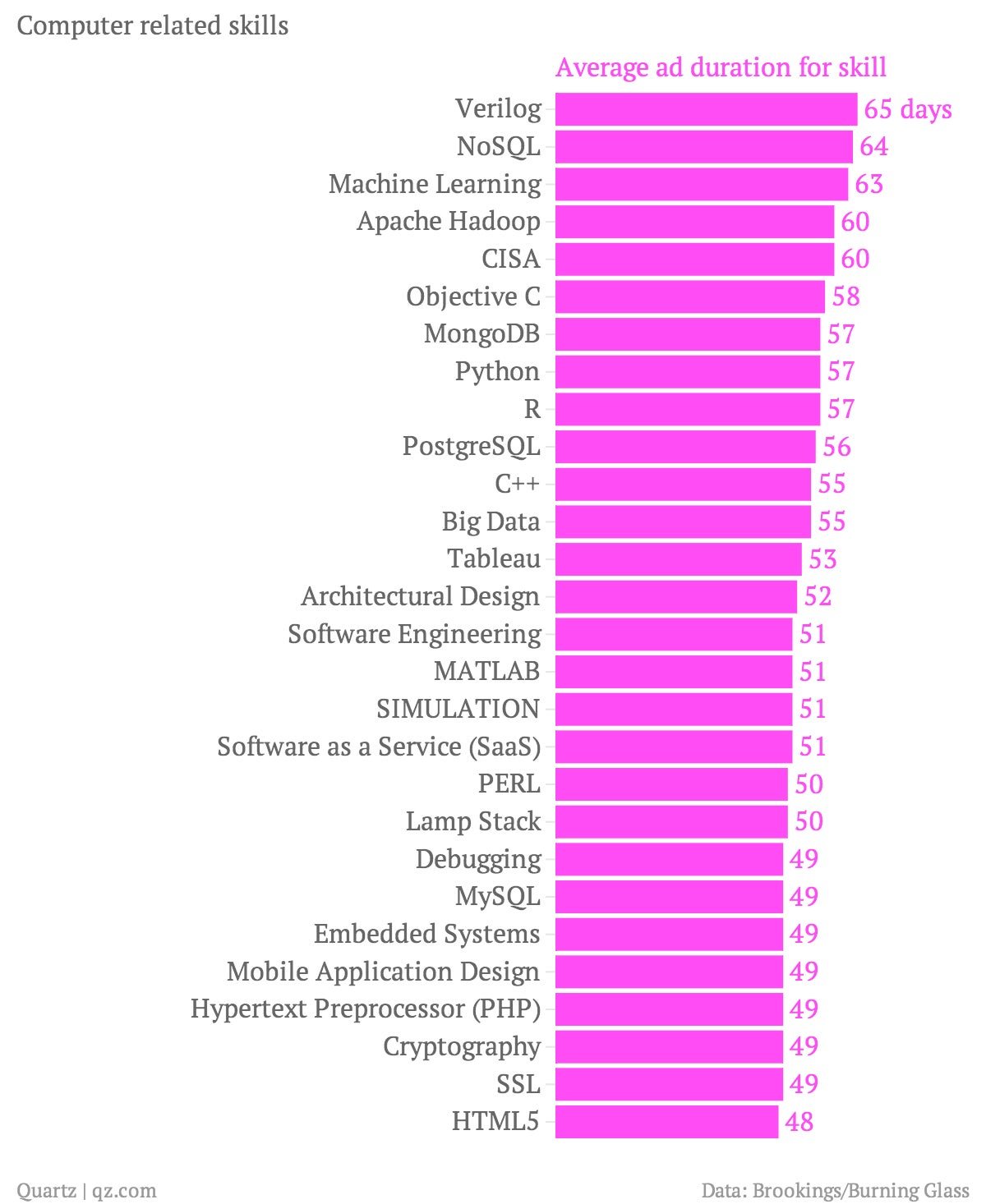
The data set also gives an idea of the demand for each skill, based on how long it takes to fill a job that requires it (i.e., how long each posting remained up). Here are the tech job skills that on average take the longest to fill. The average non-STEM posting is usually open for 33 days, and a STEM job requiring a professional degree stays open 50 days on average. Overall, tech jobs stay open 15 days longer on average than non-STEM jobs:
See the full study here.
