Amazon appears to be planning to let US customers order groceries online and pick them up at designated drive-in spots, according to planning documents reviewed by several local news outlets. The e-commerce giant is reportedly testing a ”click and collect” model in Sunnyvale, California, a little further up the San Francisco peninsula in San Carlos, and in Seattle, Washington.
Amazon $AMZN appears to be planning to let US customers order groceries online and pick them up at designated drive-in spots, according to planning documents reviewed by several local news outlets. The e-commerce giant is reportedly testing a ”click and collect” model in Sunnyvale, California, a little further up the San Francisco peninsula in San Carlos, and in Seattle, Washington.
Online grocery is a notoriously tough business and even Amazon has struggled to crack it. With the drive-in model,
Join 500,000+ readers who start their day with Quartz.
By subscribing, you agree to our Terms of Service and Privacy Policy.
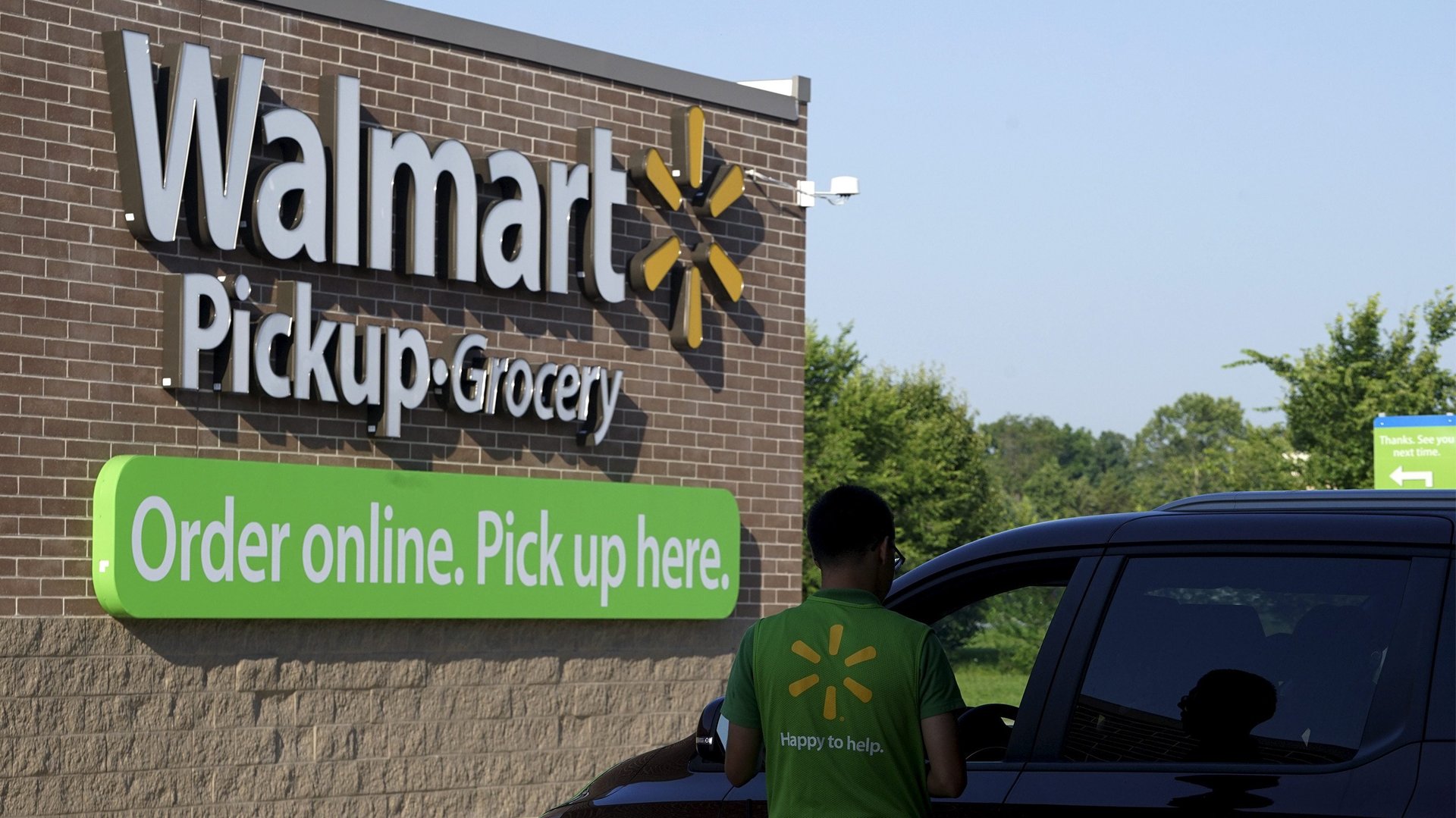
Walmart began testing curbside pickup of online grocery orders for the US in Denver in 2013. This time last year, online grocery pickup was available in five US markets; it has since expanded to nearly 400 stores across more than 60 markets. Pickup is same-day, free for customers, and available from 7am to 11pm local time.
Curbside pickup has worked well for Walmart, which has a ready-made storage and distribution network in its more than 4,000 US stores. The service is convenient for customers—Walmart says it takes less than five minutes to drive up and have groceries placed in your car. At no additional cost, it also likely appeals to Walmart’s core shoppers, who tend to be in the mid- or lower-income brackets.
“That value proposition is something that has resonated really strongly with our customers,” says Ravi Jariwala, a Walmart spokesman.
By having shoppers pick up their groceries at the store, Walmart also eliminates most of the expensive and complicated logistics that have burdened other delivery companies, and which often end up getting passed along to the customer. Instacart, an online grocery startup valued at $2 billion, charges as much as $11.99 for each of its deliveries.
Amazon has focused its online grocery efforts thus far on Amazon Fresh, a same- and next-day grocery delivery service it introduced in 2007. Fresh is a competitor to FreshDirect and Peapod, two established US grocery delivery services, as well as startups like Instacart. But nearly a decade after its launch, Fresh is only available in a handful of US cities. And at $299 a year it remains an expensive add-on to Amazon’s flagship Prime membership.
Walmart doesn’t break out numbers on its grocery business but Neil Ashe, the company’s outgoing head of global e-commerce, said in June that he expected the grocery segment to contribute “hundreds of basis points” to the US over time. For the quarter ending on July 29, Walmart CEO Doug McMillon pointed to ”the continued roll out of online grocery and growth of pick-up in stores” as a key driver of Walmart’s 11.8% increase in e-commerce sales.
“We wouldn’t be expanding this as quickly as we have—going from five to now well over 60 [markets], with a view to even further expansion this year—if we weren’t encouraged by the response we were seeing from customers,” Jariwala says.
Amazon did not respond to requests for comment.
