
Quartz
Subscribe
Quartz
Subscribe
Edition
Business News
A.I.
Technology
Money & Markets
Leadership
Lifestyle
Latest

Get Quartz in your inbox

Free daily briefing on global business news.

Business News
AirlinesAutomobilesFoodPharmaceuticalsPolitics & GovernmentRetail & EcommerceSpace & AerospaceEarnings
Technology
A.I.ComputingConsumer TechSpace & AerospaceEarnings
Money & Markets
Economic IndicatorsMarketsPersonal FinanceEarnings
Lifestyle
Cars & BikesCollectingEntertainmentFood & Fine DiningHealth and FitnessReal EstateTravel
Quartz

Global business news for a smarter world

Topics

  • Business News
  • Money & Markets
  • Tech & Innovation
  • Generation A.I.
  • Lifestyle
  • Leadership

Products

  • Daily Brief
  • Weekly Digest
  • Member Benefits
  • Quartz Pro

Legal

  • Sitemap
  • About
  • Accessibility
  • Privacy
  • Terms of Service
  • Advertising
  • © 2026 Quartz Media, Inc. All rights reserved.

    Business News

    Bird, the bankrupt scootershare unicorn, owes money to more than 300 cities and towns

    The company's map of creditors shows how quickly and widely it expanded before flaming out

    By Melvin Backman·4 min read·Updated December 21, 2023
    Add QZ to Google

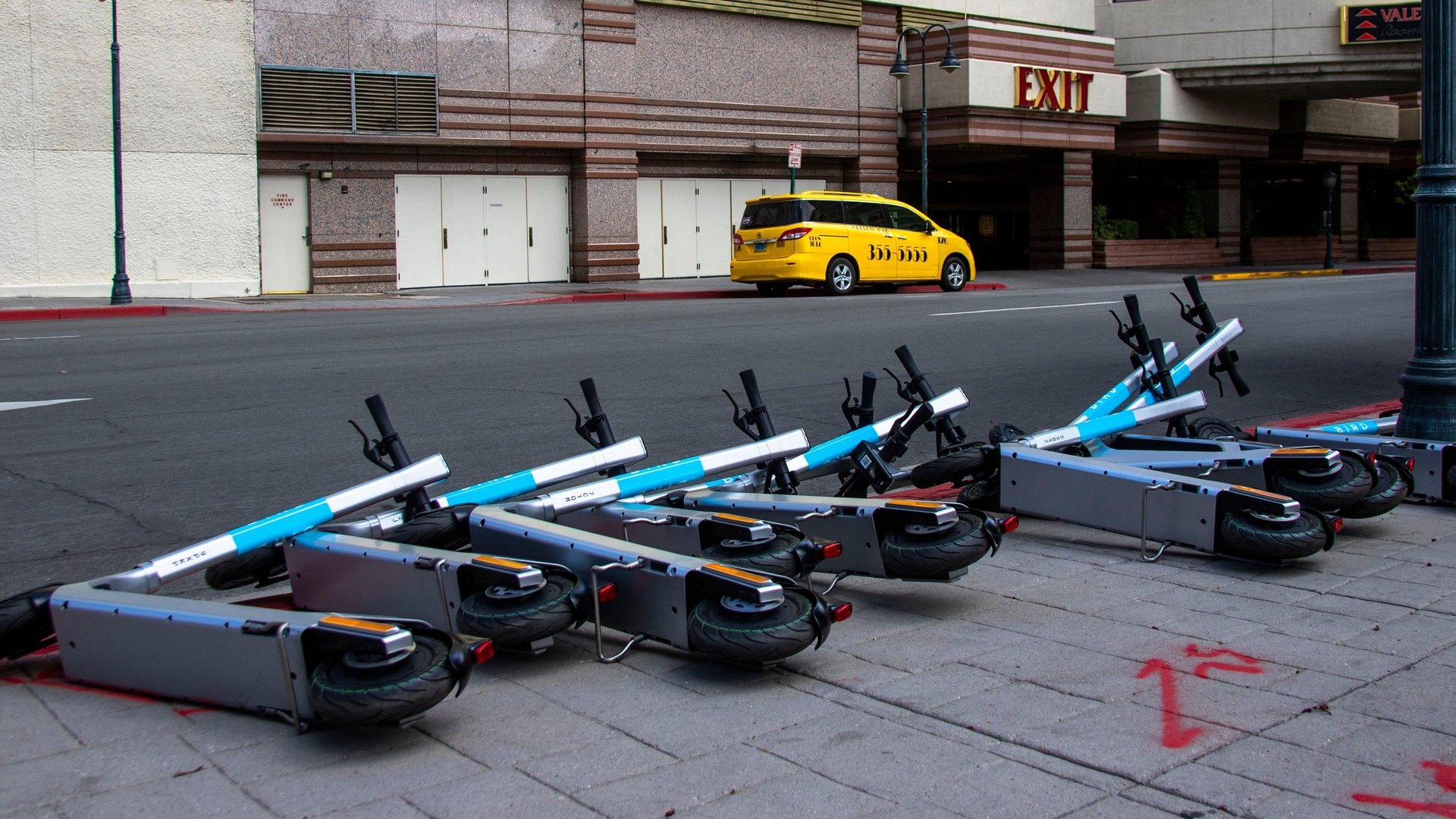
    Consider Bird grounded. The scooter rideshare company, which was once a high-flying transportation startup, has filed for bankruptcy. In its paperwork, the company blamed huge losses—$235 million and $471 million in 2021 and 2022, respectively—plus a post-covid slump in ridership, and more than 100 personal injury lawsuits.

    The company is trying to discharge somewhere between $100 million and $500 million. Its largest non-lender creditor, owed nearly $5 million, is Amazon $AMZN Web Services. But elsewhere on its long list of parties waiting to get paid back are more than 300 municipalities and governments, from Maine to California to Canada to Australia, a sign of how far the company had expanded before having to call it quits.


    A noble start in the mobility business

    Founded in 2017, Bird was an early rideshare entrant in the so-called “micromobility” category. Founder Travis VanderZanden, an ex-Uber $UBER employee, developed his first flock in Santa Monica. The premise was that short-range motorized scooters, able to drive a dozen miles or so on a charge, could help people get where they needed to go more quickly absent a bike. Riders could pick them up wherever they could find one, and drop them off whenever, and wherever, they needed to.

    “We know the city has parking and traffic problems like the rest of LA,” he told the Santa Monica Daily Record at the time. “We feel like it’s a great city for all of those reasons and we feel Bird can have a big impact on traffic and parking.”

    In that same writeup, Santa Monica mobility manager Francie Steffan gave the scooters a tentative embrace. “The most healthy way is to offer a diversity of options that coexist for the long term,” she said.

    Eventually the scooters floated back up to VanderZanden’s old stomping grounds in the Bay Area, where they were a hit. It was an idea that a lot of people were into, especially investors with lots of money to throw around. In 2018, Bird was the fastest-ever US startup to secure a $1 billion valuation and become a so-called unicorn.

    Bumps in the road

    From the beginning, not everyone was on board. In February 2018, Bird paid a $600,000 fine and pleaded no-contest to charges from its hometown that it was operating without a license and failing to comply with city-issued citations. That April, the San Francisco city attorney issued Bird and similar scooter-share companies like Lime a cease-and-desist order. People were riding the scooters on the sidewalk, and leaving the scooters in the path of people on foot or in wheelchairs needed to be, while scooter riders without safety gear were getting hurt and dying.

    Like its car-based ride-share peers, Bird took on an ask-forgiveness-not-permission tack on expansion. In its 2022 annual report, the company said it was operating in more than 350 markets. Many went along with the scooters’ popularity, entering partnerships to promote their usage. Others decided they didn’t want to deal with all the trouble: Earlier this year, Parisians voted overwhelmingly to ban scooter-share companies from city streets.

    A short ride in public markets

    Regulatory troubles notwithstanding, and despite early pandemic-era strains on revenue, Bird filed to go public in 2021 at a valuation of $2.3 billion. But it wasn’t a buzzy startup anymore. Not only was there more competition, but a lot of people’s “return to normal” post-vaccine meant driving or taking the train, not scooting. The company’s stock has nearly continuously plummeted.


    Crunchbase figured out that, by the fall of 2022, VanderZanden’s stake was worth less than a house he had bought in Miami. Soon, it was delisted from the New York Stock Exchange. Around that time, VandenZanden was nudged out of the CEO job. Embarrassingly, the company announced in November 2022 that it had been overstating its revenue numbers in its annual reports.

    And now it’s bankrupt. It filed under Chapter 11, which means the company will try to discharge some of its debts and give scooter-sharing another go after a reorganization and a fresh start.

    “This announcement represents a significant milestone in Bird’s transformation,” interim CEO Michael Washinushi spoke euphemistically in a company statement announcing the bankruptcy. “We remain focused on our mission to make cities more livable by using micromobility to reduce car usage, traffic, and carbon emissions.”

    Daily Brief

    The essential business news, delivered fresh every morning.

    Join 500,000+ readers who start their day with Quartz.

    By subscribing, you agree to our Terms of Service and Privacy Policy.

    Related

    MarketsRoblox stock posted its worst day ever after pulling its full-year outlook
    SpaceA discarded SpaceX rocket is about to slam into the moon at 5,400 mph
    Cloud ComputingSpaceX will take another year to remove xAI's unpermitted gas turbines near Memphis
    PharmaRohto is recalling nearly 12 million eye drop bottles over sterility concerns
    MarketsAn ex-OpenAI researcher's AI hedge fund collapsed from $45 billion to $10 billion in a week