
China's top diplomat on Wednesday called for the creation of a global AI cooperation organization and said Beijing welcomes participation from all countries, as the Group of Seven nations held a summit in France that China was not invited to attend.
Beijing's top diplomat called for a new global AI cooperation organization as the G7 discussed restricting access to U.S. AI models
VCG / Getty Images
China's top diplomat on Wednesday called for the creation of a global AI cooperation organization and said Beijing welcomes participation from all countries, as the Group of Seven nations held a summit in France that China was not invited to attend.
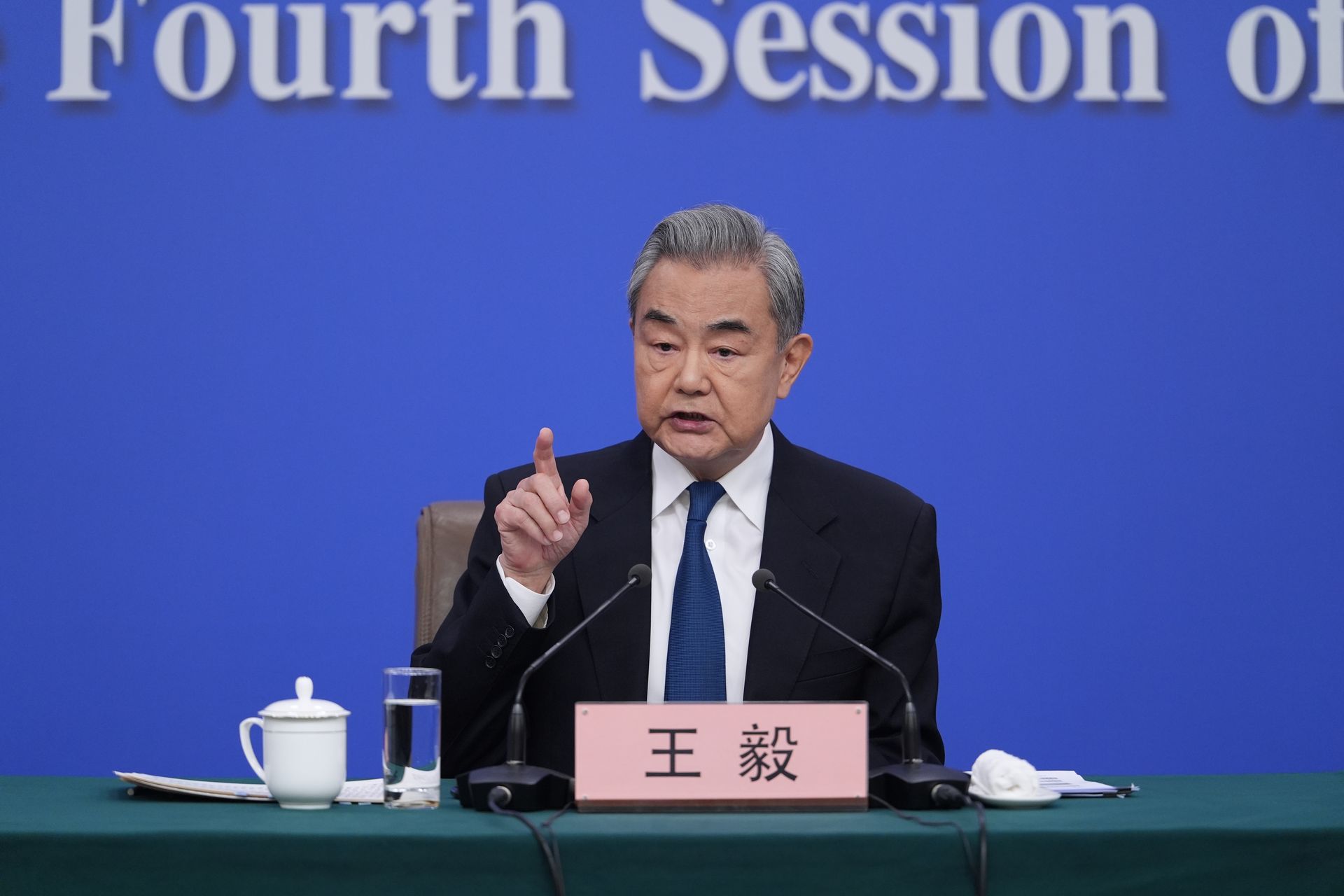
Speaking to reporters, Chinese Foreign Minister Wang Yi declared that Beijing is moving to stand up a worldwide AI cooperation body open to any nation that wants to participate, according to CNBC, which translated his Mandarin remarks. Wang added that the technology ought to be developed in service of humanity.
Wang's remarks came at the release of a white paper from China's State Council Information Office titled "More Just and Equitable Global Governance: China's Principles, Proposals and Actions," which criticized trade wars and emphasized support for developing economies.
Also addressing reporters was Zhao Haibing, vice chair of China's top economic agency, who took aim at what he called "closed, exclusive and monopolistic approaches to tech development." Among the alternatives Zhao held up were China's AI partnerships within BRICS and the Shanghai Cooperation Organization, a separate "AI Capacity Building for All" program, and Beijing's backing of a UN-led framework for global AI governance.
The timing contrasts with moves by the U.S. to limit foreign access to its AI models. G7 nations debated a framework under which access to American AI systems would be extended only to countries deemed trustworthy allies. Separately, export controls the Trump administration imposed on Anthropic's frontier models figured prominently in the summit's technology agenda, according to Fortune.
The two countries have pursued sharply different distribution strategies for their AI products: American models generally sit behind paywalls, whereas Chinese offerings are frequently available at little or no cost and can be pulled down as complete packages.
Beijing had no seat at the G7 table, though Macron spoke with Xi in an "unprecedented" phone call before the summit got underway. Stanford's 2026 AI Index, cited by Fortune, found that Washington and Beijing collectively account for nine-tenths of the world's computing capacity.
Beijing has been building out its domestic AI hardware to reduce dependence on U.S. chips. Alibaba recently unveiled a new AI chip, the Zhenwu M890, designed for training and inference workloads as U.S. export restrictions continue to block Chinese firms from purchasing advanced Nvidia $NVDA processors.
Join 500,000+ readers who start their day with Quartz.
By subscribing, you agree to our Terms of Service and Privacy Policy.