
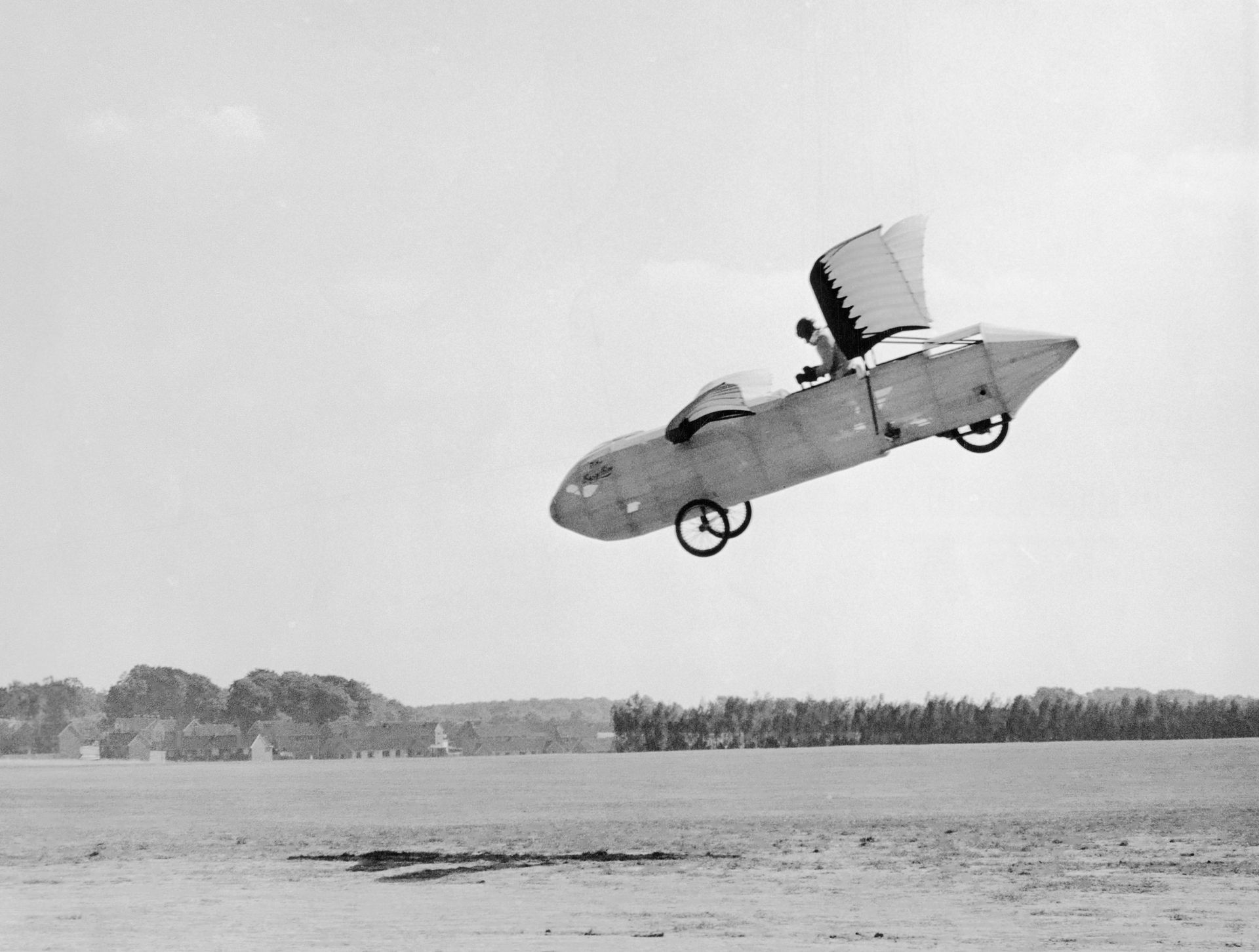
The flying car has been one year away from mass production for about a century. Engineers have built prototypes, test pilots have flown them, and companies have taken deposits — and every time, the same combination of technical limits, regulatory costs, and thin markets ended the program before it reached scale.
Today's electric air taxi companies insist the current moment is different. To judge that claim, it helps to know exactly what happened before, because the failure wasn't random. It followed a pattern.
The technology worked well enough to generate headlines but not well enough to satisfy regulators. Compliance drove up prices beyond what customers would pay. Too few customers materialized, and the thin market scared off the capital needed for mass production. That sequence repeated itself from 1917 to 2023.
A century of attempts, a century of the same trap
Aviation pioneer Glenn Curtiss designed the Autoplane, a triplane with an aluminum body, detachable wings, and seating for a pilot and two passengers. It was exhibited at the Pan-American Aeronautic Exposition in New York City in February 1917 and, as Scientific American reported, was intended to combine the luxury of a limousine with the freedom of an airplane. It managed a few short hops. The U.S.'s entry into World War I in April 1917 ended development before the vehicle could prove itself.
Two decades later, Waldo Waterman built the Arrowbile, a tailless, two-seat plane designed to be driven on roads as well as flown. It first flew on Feb. 21, 1937, and three Arrowbiles attempted a cross-country flight from Santa Monica to Cleveland for the National Air Races. One force-landed in Arizona. The other two completed the trip and gave demonstration flights. The Arrowbile's price of $3,000 was far more than the $700 airplane the government's original "flivver" competition had envisioned, according to the Smithsonian. Little market response materialized, and the production line halted in 1938 after only five were built. Waterman spent two more decades refining the design into the Aerobile, which received FAA experimental certification in 1957. By then, according to the Smithsonian, "the market for such an aircraft had vanished."
Henry Ford $F saw the same opportunity. The EAA Aviation Museum described his Ford Flivver of 1926 as Ford's vision of an "everyman's airplane," a counterpart to the Model T. The project ended in 1928 after Ford's friend and test pilot Harry Brooks was killed in a crash. Ford himself later predicted in 1940 that "a combination airplane and motorcar is coming." He died in 1947 without seeing it arrive.
The postwar era brought more ambitious corporate backing. The Convair Model 118 ConvAirCar, designed by Theodore Hall, was a fiberglass-bodied car with a detachable wing and a 190-horsepower engine. Test pilot Reuben Snodgrass flew it for the first time on Nov. 15, 1947. Three days later, it crash-landed near San Diego after running out of fuel. A second prototype flew in January 1948, but Convair cancelled the program.
Moulton Taylor's Aerocar was the most successful drive-and-fly plane of the era. The prototype flew in 1949, but federal aviation certification didn't come until 1956. Taylor reached a deal with a defense manufacturer for serial production, contingent on securing 500 orders, but obtained roughly half that. Ford commissioned a feasibility study in the 1970s estimating 25,000 units per year in potential sales, but federal officials worried about thousands of commuters in the sky, and new auto safety regulations would've made the vehicle too heavy to fly. Only six Aerocars were ever built.
The modern era, the same outcome
Of almost 100 published flying car concepts, Popular Science has noted, only a few have ever been built, fewer still have flown, and not one entered production. "Having a car attached to an airplane is hard to make efficient," Ella Atkins, an aerospace engineering professor at the University of Michigan, told Popular Science. "The car is not going to notice much difference from having the parts of an airplane, but the plane is going to really be impacted by the presence of a car."
The attempts kept coming.
Paul Moller spent more than 50 years developing the M400 Skycar, an aircraft designed to take off and land vertically that he claimed would travel above roadways at over 400 miles per hour. The Skycar never achieved free flight. The Securities and Exchange Commission filed a settled civil fraud action against Moller and his company in 2003, alleging they had raised about $5.1 million from more than 500 investors through a fraudulent unregistered stock offering and made false statements about the vehicle's prospects. Moller paid a $50,000 civil penalty and the company went dormant in 2015.
Terrafugia, founded by MIT graduates in 2006, took a more cautious approach. Its Transition was a light sport airplane with folding wings designed to be driven on roads. Federal regulators granted weight exemptions that allowed it to exceed standard limits for its aircraft category, making it street-legal. Chinese automaker Geely acquired the company in 2017, and in January 2021, the Transition received an FAA Special Light-Sport Aircraft airworthiness certificate. Less than four weeks later, between 80 and 100 U.S. employees were laid off and operations moved to China, according to the Virginia Department of Aviation. At an estimated price between $350,000 and $400,000, the aircraft "may have been too expensive with very limited utility to find any significant sales," the agency noted.
The Slovak company AeroMobil followed the same arc. Its CEO projected deliveries by 2018, then 2020, then 2023. Its 3.0 prototype crashed during a test flight in May 2015 after entering a spin, though the pilot walked away. The production model, unveiled at Top Marques Monaco in April 2017, was priced between 1.2 million and 1.5 million euros. AeroMobil failed to acquire new financing and closed down in February 2023.
Today's electric air taxi companies have abandoned the drive-and-fly concept entirely. They're not trying to build a car that flies. They're building an aircraft that replaces short car trips. That's a different engineering problem entirely.
The FAA hasn't yet certified a single electric air taxi for commercial passenger service. Battery technology limits flight times to short urban hops. The infrastructure required to operate these vehicles at scale doesn't exist. The history is clear about what those conditions produce.