
A currency impasse has frozen Russia's arms trade with India
Russia is unwilling to opt for rupee-trade mechanism due to volatility in the rupee-ruble exchange rate.
By
Russia is unwilling to opt for rupee-trade mechanism due to volatility in the rupee-ruble exchange rate.
India’s military trade with Russia has come to a halt following an exchange rate impasse, with up to $2 billion reportedly remaining unpaid over the past year.
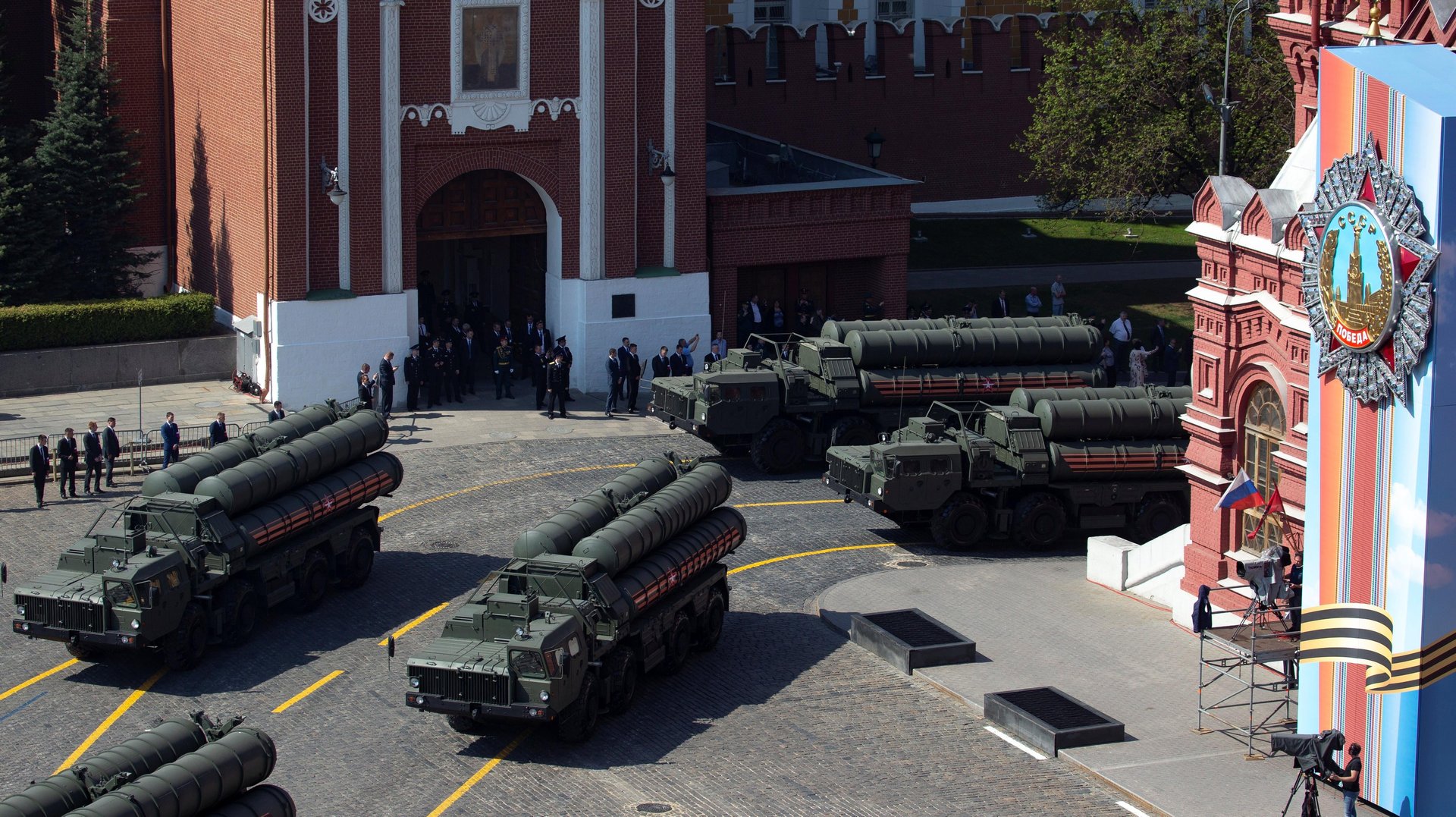
For instance, two S-400 air defense systems India placed an order for in 2018 remain undelivered, according to a bulletin by American Foreign Policy Council.
Spooked by the volatility in rupee-ruble exchange rate, the south Asian power’s largest defence supplier has even stopped a $10 billion line of credit for spare parts.
The sticking point for India is a potential violation of US sanctions if it pays Russia in US dollars. And Russia is unwilling to go by the rupee-trade mechanism as the ruble has risen nearly 8% against the rupee in the past financial year. That means lower earnings for Russia, eroding its competitive advantage over India.
New Delhi’s own rupee-trade mechanism has not found many takers yet.
While India can settle its arms trade in euros and dirhams, which are generally used for discounted Russian oil, that could evoke secondary sanctions from the US. These are aimed at discouraging companies or countries from engaging in specific transactions with countries facing primary sanctions.
Trading in other currencies will also increase India’s costs due to unfavourable exchange rates, officials told Bloomberg.
One of India’s oldest and sturdiest defence trade partners, Russia’s annual arms exports to the country ballooned by more than 450% in fiscal 2023 to $5.08 million, Indian commerce ministry data show.
However, global supply chain disruptions, together with increased tensions along the border with Pakistan and China have, in recent years, fast-tracked India’s efforts to make weapons at home or diversify its sources of supply.
This has led to an 11% drop in its total arms imports during 2017-2022, said the Stockholm International Peace Research Institute (Sipri) in a report last month. “Russia’s position as India’s main arms supplier is under pressure due to strong competition from other supplier states, increased Indian arms production,” the report stated.
India has, meanwhile, been increasingly manufacturing several critical components for foreign companies. In fiscal 2023, its own defence exports hit an all-time high of $1.6 billion.

The Conference Board's Present Situation Index fell for a third consecutive month as views of business and labor conditions softened
The Conference Board's Consumer Confidence Index fell 1.4 points to 90.8 in July, the third consecutive month consumers grew less upbeat about current conditions, the organization said Tuesday.
The Present Situation Index, which tracks consumers' assessments of current business and labor market conditions, dropped 3.6 points to 114.9 — its third straight monthly decline. The Expectations Index, which reflects consumers' six-month outlook for income, business, and labor conditions, held steady at 74.7, remaining in negative territory.
"Consumer confidence moderated slightly in July, continuing a general downward sloping trajectory since late 2021," Dana M. Peterson, chief economist at The Conference Board, said in a statement. "Consumer appraisals of current business conditions and, to a lesser extent, perceptions of the current labor market both softened."
Views of business conditions weakened noticeably. The share of consumers describing conditions as "good" fell to 18.9% from 20.2% in June, while those calling conditions "bad" rose to 17.8% from 16.5%. Net views of business conditions stood at just +1.1%, barely positive.
Labor market perceptions also softened. The share of respondents saying jobs were "plentiful" slipped to 24.6% from 25.5% in June, narrowing the labor market differential — the gap between those describing jobs as plentiful and those calling them hard to find — to +3.1 percentage points. Consumers' write-in responses on economic factors picked up slightly more references to jobs and unemployment during the survey period.
Looking ahead, consumers grew less optimistic about business conditions over the next six months, with net expectations for business conditions dipping to -3.3%. Expectations for labor market conditions improved slightly but remained in negative territory. Peterson noted that consumers anticipate little improvement in business conditions over the next six months, though income expectations stayed optimistic overall.
The survey period ran July 1–22, encompassing ongoing conflict in the Middle East. The Conference Board noted that mentions of war, geopolitics, and conflict eased during the sample period, though recent reacceleration of fighting could lift such references in revised data. References to food and grocery prices increased in frequency.
Consumer confidence ticked up modestly in June to 91.2 as falling oil prices offered some relief from inflation concerns, though that reading fell short of economist forecasts. The Present Situation Index had already dropped 3.0 points that month, reflecting softening views of business and employment conditions even as the Expectations Index climbed. Before June, confidence reversed course in May, when rising energy costs tied to the Middle East conflict weighed on Americans' assessment of current conditions.
The survey, conducted by Toluna, was based on an online sample with a preliminary cutoff date of July 22.
The recall covers 12 levothyroxine sodium tablet packages distributed under the Major and Cardinal brand names since January 2025
Major Pharmaceuticals initiated a voluntary recall of its levothyroxine sodium tablets on July 13 after the Food and Drug Administration determined the pills were subpotent, meaning they deliver less medication than labeled.
The FDA assigned the recall a Class II designation on July 17, a classification that signals the tablets could produce temporary negative health effects. According to the FDA, Major Pharmaceuticals was responsible for packaging and distributing the medication across the country, with Cardinal Health $CAH handling distribution for part of the supply.
Levothyroxine sodium is used to treat hypothyroidism, enlarged thyroid glands, and a type of thyroid cancer, according to the Mayo Clinic.
The recall covers 12 package configurations sold under the Major and Cardinal brand names, according to USA Today. Each package contains either a single 10-tablet blister pack or a carton bundling 10 such packs together for a total of 100 tablets. The recalled tablets span dosage strengths of 25, 50, 75, 88, 112, 125, and 150 micrograms, and their expiration dates fall between July 2026 and January 2027. All recalled packages require a prescription.
In a letter sent to retailers earlier this month, Major Rugby — the pharmaceutical manufacturer behind the products — said taking the recalled medication "is not likely to cause adverse health effects," according to USA Today. The company nonetheless urged consumers to return the tablets to their point of purchase and consult a doctor if they find any affected product.
Distribution of the recalled tablets began in January 2025. The FDA declined to provide a total tablet count for the recall.
Consumers can identify recalled packages by checking the lot numbers listed in the FDA recall notice. Among the affected lots are packages of 25 mcg (lot N02212), 50 mcg (lot N02200), 75 mcg (lots N02172, N02296, and N02288), 88 mcg (lot N02310), 112 mcg (lot N02203), 125 mcg (lot N02266), and 150 mcg (lot N02167).
The hotel company now expects revenue per available room to grow 3% to 3.5% in 2026, up from a prior forecast of 2% to 3%
Hilton Worldwide $HLT Holdings raised its full-year forecast for revenue per available room on Tuesday, citing strong demand trends and an expected boost from the recently concluded FIFA World Cup.
The McLean, Virginia-based hotel company now projects system-wide comparable RevPAR — an industry measure reflecting both occupancy levels and average daily rates — to increase 3% to 3.5% for fiscal 2026 on a currency-neutral basis, an upward revision from its earlier guidance of 2% to 3%, the company said. For the third quarter, Hilton projects RevPAR growth of approximately 4%, reflecting expected benefits from the World Cup held in the U.S., Canada and Mexico.
For the three months ended June 30, system-wide comparable RevPAR rose 3.9% on a currency-neutral basis compared with the same period in 2025, driven by increases in both occupancy and average daily rates. Net income for the quarter was $482 million, up from $442 million a year earlier. Adjusted EBITDA was $1,054 million, compared with $1,008 million in the second quarter of 2025. Total revenue reached $3.34 billion, up from $3.14 billion a year earlier.
Diluted earnings per share came in at $2.10 for the quarter, up from $1.84 a year earlier. Adjusted diluted EPS reached $2.29 for the quarter, up from $2.20 in the second quarter of 2025.
"We delivered strong top and bottom-line results for the second quarter, driven by the continuation of strengthening demand trends and broad-based momentum across our system, which we expect to continue for the remainder of the year and into 2027," President and Chief Executive Officer Christopher J. Nassetta said in a statement.
One drag on results came from the Middle East and Africa region, where RevPAR dropped 29.5% in the second quarter compared with the same period last year, reflecting the impact of ongoing regional conflicts on travel demand.
Looking to the fourth quarter, Hilton said its outlook is tempered by unfavorable calendar shifts and the U.S. midterm elections.
For the full year, the company projects net income between $1,883 million and $1,911 million, and adjusted EBITDA between $4,040 million and $4,080 million. Hilton also expects net unit growth of 6% to 7% in 2026, with the second half of the year expected to outperform the first half. The company's development pipeline stood at 541,300 rooms as of June 30, representing 6% growth from a year earlier.
Hilton repurchased 2.9 million shares of common stock during the second quarter at an average price of $326.99 per share, bringing total capital return including dividends to $966 million for the quarter. Full-year capital return is projected to be approximately $3.5 billion.
The cruise company raised its full-year adjusted EPS guidance to $17.73–$17.87 but cut its revenue growth forecast from ~10% to ~9%
Royal Caribbean $RCL reported second-quarter adjusted earnings of $4.21 per share on Tuesday, topping analyst expectations of $3.98 per share, according to Reuters. The company also lifted its full-year adjusted earnings outlook to $17.73–$17.87 per share, a step up from the $17.10–$17.50 range it had previously guided to.
Royal Caribbean also pulled back its annual revenue growth target to roughly 9% from roughly 10%, pointing to what it described as a softening in demand for certain sailings as a result of ongoing geopolitical tensions, the company said.
For the three months through June 30, revenue climbed to $4.83 billion, a 6% increase from the prior year period. That result narrowly cleared the $4.82 billion analysts had forecast, according to Reuters. Net income attributable to the company came in at $1.13 billion, or $4.20 per share diluted, compared with $1.21 billion, or $4.41 per share diluted, in the same period a year earlier.
Despite the booking pressure on some itineraries, Royal Caribbean said overall demand remained healthy. The company noted it remained booked at record prices and that booking volumes were above last year's levels.
"Consumer demand for our vacation experiences is strong, and guests continue to demonstrate a desire to spend on memorable experiences with us," Chief Financial Officer Naftali Holtz said in a statement. Holtz added that while it is still early, 2027 booking trends are running ahead of historical levels, including for itineraries where geopolitical developments weighed on demand this year.
Second-quarter fuel costs totaled $355 million, surging 27% compared with the same period last year. On the full-year outlook, the company edged its fuel expense estimate down to about $1.34 billion from the roughly $1.35 billion it had previously projected. Royal Caribbean stock was down about 1% in premarket trading.
Royal Caribbean cut its full-year adjusted profit forecast in April, reducing EPS guidance to $17.10–$17.50 from $17.70–$18.10, as higher fuel costs and geopolitical disruptions to Middle Eastern itineraries weighed on the outlook. At the time, first-quarter adjusted EPS of $3.60 had come in well ahead of analyst expectations, and the company said bookings for affected itineraries had recovered and were running above prior-year levels.
For the third quarter, Royal Caribbean expects adjusted EPS in the range of $6.26 to $6.36, with total revenue growth of approximately 8%, the company said.
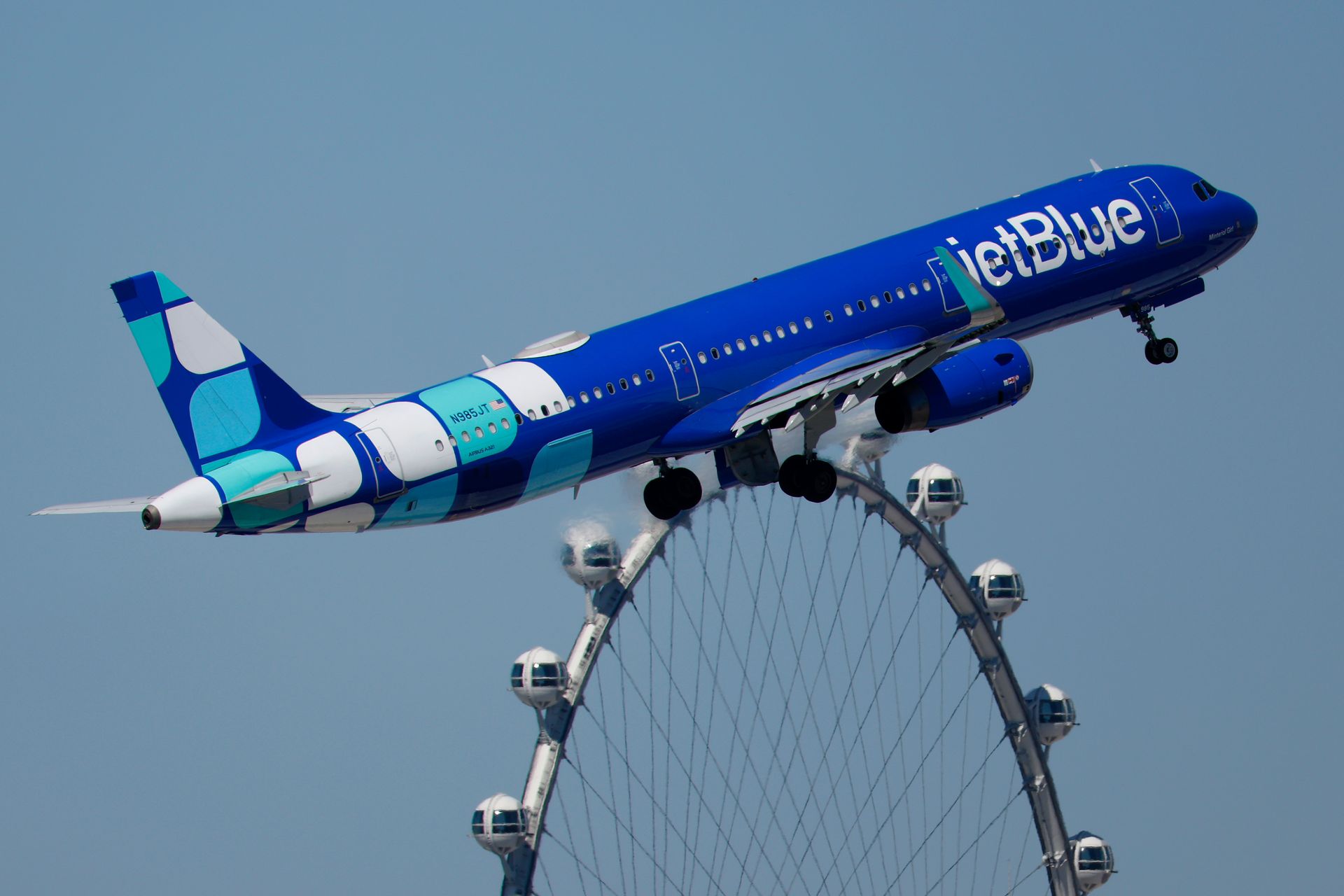
The airline beat Wall Street estimates and reinstated its full-year outlook as demand helped it recover more fuel costs than expected
JetBlue Airways posted a net loss of $247 million in the second quarter of 2026, wider than the $74 million loss it recorded in the same period a year earlier, as a surge in fuel costs outpaced stronger revenue.
The New York-based carrier spent $911 million on jet fuel in the quarter, an increase of nearly 81% compared with the same period a year ago. JetBlue paid an average of $4.23 per gallon of jet fuel, up from $2.40 per gallon a year earlier. Despite the spike, the airline recaptured nearly 50% of its higher fuel costs during the quarter, exceeding its previous expectation of 30% to 40%, the company said.
The airline's total operating revenue climbed to $2.7 billion, a 14.5% gain from the year-earlier period. Revenue per available seat mile grew 10.9% year-over-year. The airline's adjusted loss came in at 66 cents per share. Analysts had expected a loss of 71 cents per share, according to Reuters.
JetBlue also reinstated its full-year 2026 outlook, which it had previously withheld. The company now expects full-year revenue per available seat mile growth of 10% to 12.5% year-over-year and projects paying $3.49 per gallon of jet fuel for the full year. It expects an adjusted operating margin of negative 2% to negative 5% for the year, the company said.
"Our second quarter results demonstrate the progress we're making on the levers within our control," Chief Financial Officer Ursula Hurley said in a statement.
JetBlue also introduced a long-term earnings target of at least $1.00 per share for 2028, premised on continued demand strength and an assumed average jet fuel price of $3.00 per gallon that year.
The results come after JetBlue reported a net loss of $319 million in the first quarter of 2026, wider than the $208 million loss in the same period a year earlier, and missed Wall Street estimates. At that time, the carrier said it projected fuel costs would rise to a range of $4.13 to $4.28 per gallon in the second quarter and flagged plans to cut capacity during off-peak periods. It expected to fully recapture fuel costs by early 2027.
JetBlue's transformation program, called JetForward, has generated $470 million in cumulative incremental earnings before interest and taxes through June 2026, the company said. The program remains on track to deliver $850 million to $950 million in annual incremental EBIT by the end of 2027, with benefits expected to reach approximately $1.2 billion in 2028.
Chief Executive Officer Joanna Geraghty said in a statement that strong customer demand and cost controls enabled the airline to recover fuel costs faster than anticipated.
BlackRock-managed funds will own 80% of the venture, with Meta retaining 20% and leasing back the entire campus
Meta $META Platforms and BlackRock $BLK announced a venture Tuesday to develop and own a data center campus in El Paso, Texas, with total development costs of approximately $14 billion.
Under the agreement, funds managed by BlackRock will control 80% of the venture, with Meta keeping the remaining 20% stake. At financial close, Meta will transfer land and partially built construction assets worth around $2.3 billion into the venture, while BlackRock is set to put in roughly $4.9 billion in cash. Meta will also receive a one-time distribution of approximately $1 billion to align ownership stakes. A portion of BlackRock's investment will be funded through $12.5 billion in debt financing, the company said.
The facility, which is currently being built, will deliver 1 gigawatt of compute capacity when finished. Meta will be the sole occupant upon completion, which is expected in 2028. Meta will enter into lease agreements with the venture for use of the entire campus, with a four-year initial term and four extension options covering a potential 20-year period. The transaction is expected to close in the coming days, the company said.
"Building the infrastructure for superintelligence is key to making sure the benefits of this technology are distributed to everyone," Meta founder and CEO Mark Zuckerberg said in a statement. "Our partnership with Larry and the team at BlackRock allows us to move faster and at greater scale."
BlackRock Chairman and CEO Larry Fink said in a statement that the El Paso campus "will create thousands of skilled jobs and help drive economic growth in the local community."
Meta's investment in the El Paso project exceeds $10 billion, supporting more than 4,000 construction jobs at peak and 300 operational jobs once complete, with over 2,300 workers already on site, the company said. BlackRock's investment in the venture also involves Global Infrastructure Partners and HPS Investment Partners, both part of BlackRock.
The El Paso deal follows the same structure as an earlier arrangement in Louisiana, where Meta sought to sell more than $12 billion in bonds to help finance the campus through a holding company tied to BlackRock's ownership position in the project, named Project Sopaipilla Holdings. That structure mirrors what Meta applied at its Hyperion data center in Louisiana, where a joint venture issued debt to keep liabilities off Meta's books.
Meta has publicly committed to spending $600 billion on data center construction through 2028. Meta stock has fallen about 10% so far this year, with the company scheduled to report second-quarter results on Wednesday.
Meta said Morgan Stanley $MS and J.P. Morgan Securities acted as its financial advisors for the deal.
The deal gives AMD access to more than 500 megawatts of U.S. capacity beginning in 2027, with the option to expand to 2.5 gigawatts
AMD $AMD and Core Scientific announced a partnership on Tuesday under which AMD will secure up to 2.5 gigawatts of data center capacity to support customer deployments of AMD AI products.
The agreement gives AMD access to more than 500 megawatts of U.S. infrastructure beginning in 2027, with the ability to expand to 2.5 gigawatts, the companies said. Under the deal, Core Scientific and AMD will collaborate on physical infrastructure design and the deployment of AMD Instinct GPUs, EPYC CPUs, and ROCm software.
The first phase involves 529 megawatts of U.S. AI capacity committed under 15-year leases, with the company projecting base contracted revenue exceeding $14 billion, according to CoinDesk. AMD itself took on 377 megawatts at Core Scientific facilities in Pecos, Hunt County, Texas, and Muskogee, Oklahoma. A cloud provider whose name was not disclosed signed agreements backed by AMD for 152 megawatts at locations in Auburn, Alabama, and Dalton, Georgia.
AMD also received warrants to purchase Core Scientific common stock, subject to certain commercial conditions, the companies said. AMD received warrants to purchase up to 30 million Core Scientific shares at $23.47 per share, with about 6.5 million vesting when the initial leases were signed.
"Core Scientific's extensive portfolio of AI-ready data centers expands access to the infrastructure our customers need to deploy AMD AI solutions at scale," said Mathew Hein, senior vice president and chief strategy officer of corporate development at AMD, in a statement.
"Our proven execution capabilities and ability to deliver high-density infrastructure at scale position us to support AMD's technology roadmap and grow our relationship meaningfully over time," said Adam Sullivan, chief executive officer of Core Scientific, in a statement.
Core Scientific stock jumped about 6% in premarket trading on Tuesday, while AMD stock was down about 4%.
The deal accelerates Core Scientific's shift away from bitcoin mining toward AI data center hosting. In the second quarter, colocation brought in $136.7 million — representing 83% of Core Scientific's $164.2 million in total revenue — while its self-mining business saw revenue drop 66% to $21.5 million, according to CoinDesk. Separately, Core Scientific unwound its contract with Block $SQ for bitcoin-mining chips, a move that resulted in a $41.9 million charge.
The AMD partnership adds to a string of recent infrastructure commitments for the chipmaker. AMD announced a partnership with Anthropic to deploy up to 2 gigawatts of Instinct MI450 Series GPUs in Helios rack-scale systems, and expanded a partnership with Microsoft $MSFT to deploy its Helios rack-scale AI system on Azure.

The payments company said the cuts will fall on technology and product teams as CEO Ryan McInerney pushes to make the firm more efficient
Visa $V is eliminating roughly 2,600 jobs, or about 7% of its total workforce, as Chief Executive Officer Ryan McInerney moves to make the payments company more competitive. The cuts will fall on technology and product teams, according to Bloomberg, which reviewed a staff memo McInerney sent Tuesday.
"I have deep conviction that we are doing what is right for Visa, our clients and our partners as we continue to focus on driving efficiency across the company in order to reinvest in our highest potential opportunities," McInerney wrote in the memo.
Visa had roughly 34,100 employees at the end of its most recent fiscal year. Freed-up capital is expected to flow back into areas such as consumer payments, commercial and money-movement solutions, and value-added services — a category that spans stablecoin, cross-border, and business-to-business products — according to Bloomberg, which cited a person familiar with the company's reasoning.
Artificial intelligence is playing a role in the transition — streamlining routine tasks and quickening the pace of product development — though it was not the sole reason the company moved forward with the reductions. "AI is also helping to accelerate this evolution and shape the way work gets done at Visa," McInerney wrote.
Visa stock rose about 2.1% in premarket trading Tuesday. The company is scheduled to report quarterly results after U.S. markets close Tuesday.
The layoffs arrive as other payments and fintech companies have also reduced headcount. Earlier this year, Mastercard $MA announced plans to cut 4% of its global workforce, according to Reuters. Block $SQ announced in February that it planned to shed roughly 4,000 positions, representing close to half of its total headcount. PayPal $PYPL Holdings has also announced cuts.
The detention marks the first known instance of authorities taking legal action against an Nvidia employee in a chip smuggling case
Taiwan prosecutors detained an Nvidia $NVDA employee on Tuesday as part of an investigation into the alleged smuggling of AI servers equipped with restricted Nvidia chips to China, expanding a probe that has now ensnared seven people.
The Keelung District Prosecutors Office said investigators searched the home and workplace of a suspect identified only by the surname Chang on July 24. Prosecutors successfully sought Chang's detention, telling the court he could flee the country, tamper with evidence, or coordinate with others involved in the case, according to the prosecutors office. Taiwan's Mirror Media identified the suspect as an Nvidia employee, according to Reuters. Nvidia did not confirm whether Chang is its employee.
As far as is publicly known, no government had previously moved against an Nvidia employee over chip smuggling, making the detention potentially unprecedented, according to Bloomberg. Investigators searched Chang's desk at Nvidia's Taipei office, Bloomberg added, citing unnamed sources. Chang now sits in custody after a court approved the detention request, with forgery and breach of trust among the allegations cited.
Chang came to investigators' attention through material collected in prior operations focused on Super Micro, a source familiar with the case told AFP. According to prosecutors, the defendants falsified paperwork to facilitate the export of around 50 Super Micro servers to China, and an official told AFP that a portion of those units passed through Taiwan customs before continuing on through Japan.
In a statement, Nvidia said: "Smuggling is a nonstarter. We primarily sell our products to well-known partners, including OEMs, who help us ensure that all sales comply with U.S. export control rules. Even relatively small exporters and shipments are subject to thorough review and scrutiny on both sides of the globe, and any diverted products would have no service, support, or updates."
The Taiwan investigation, covering three rounds of raids and detentions, began in May when prosecutors announced they were looking into exports of high-end AI servers to China, Macau, and Hong Kong in violation of U.S. export controls. A second round in late June swept up two Super Micro workers at its Taiwan unit. Tuesday's action marks the third round. Seven people are now in custody, including two Super Micro employees and one employee of Taiwan-listed Albatron Technology.
The Taiwan probe runs alongside a separate U.S. case. Federal authorities charged Super Micro co-founder Yih-Shyan "Wally" Liaw and two others in March with diverting roughly $2.5 billion in Nvidia-equipped servers to China. Prosecutors in Taiwan have said it is too early to determine whether the two investigations are connected.
The United States has barred Nvidia's advanced AI chips from reaching China since 2022, citing fears that the technology could strengthen Beijing's armed forces. Taiwan does not currently have its own restrictions on AI chip sales to China, though President Lai Ching-te's administration is weighing tighter policies.
The deal, awarded by the Space Force's Rocket Systems Launch Program, covers 12 suborbital launches with options for up to 6 more
Rocket Lab Corporation announced Monday it has been awarded a $266 million multi-launch contract with the U.S. Space Force, the largest launch contract in the company's history.
Under the contract, awarded by the Space Force Space Systems Command's Rocket Systems Launch Program, Rocket Lab is tasked with 12 suborbital launches supporting missile defense capabilities, with the option to order as many as six more, the company said. The first launch under the contract is expected no earlier than the end of 2026.
Rocket Lab said the majority of missions will fly from a new facility it is establishing at the Pacific Spaceport Complex-Alaska in Kodiak, Alaska. The company also operates launch sites at Launch Complex 1 in New Zealand and at Launch Complex 2 and Launch Complex 3 in Virginia.
"The size and scale of this contract reflects the Space Force's confidence in our ability to meet their urgent national security demands with speed, responsiveness, and scale, and we're proud to provide the high-frequency launch capacity required to keep the U.S. ahead of global threats," Rocket Lab founder and CEO Sir Peter Beck said in a statement.
Earlier this year, the Pentagon awarded Rocket Lab a $190 million contract tied to hypersonic flight testing, according to the Wall Street Journal. Rocket Lab has also partnered with defense firm RTX on Golden Dome, the proposed U.S. space-based missile-defense architecture.
Rocket Lab's push into national security launches comes as the company has been expanding beyond its launch services roots. Last month, Rocket Lab agreed to acquire Iridium Communications in a cash-and-stock deal valued at approximately $8 billion, which would give it control over Iridium's 66-satellite low-Earth orbit network, globally licensed L-band spectrum, and more than 2.55 million subscribers spanning government, defense, aviation, maritime, and commercial markets. The transaction is expected to close in mid-2027, pending stockholder and regulatory approvals.
The Iridium acquisition would position Rocket Lab to compete more directly with SpaceX and its Starlink unit, which pairs launch services with a satellite communications business. Rocket Lab posted record first-quarter revenue of $200.3 million, a 63.5% increase from a year earlier, and ended the quarter with a backlog of $2.2 billion.
Rocket Lab stock rose 4.74% on Monday.