A little over half a decade ago, the Bhutanese were so reluctant to embrace democracy that their beloved king had to gently goad the tiny Himalayan nation into voting to form their first elected parliament.
A little over half a decade ago, the Bhutanese were so reluctant to embrace democracy that their beloved king had to gently goad the tiny Himalayan nation into voting to form their first elected parliament.
“It was a bit of a shock,” is how Bhutan’s then-chief justice, Lynpo Sonam Tobgye, described the transition in 2008.
Join 500,000+ readers who start their day with Quartz.
By subscribing, you agree to our Terms of Service and Privacy Policy.
Since then, the mostly rural nation of 750,000 people has weathered its democratic evolution with unusual dexterity, especially when you consider that its neighbourhood is overflowing with political basket cases.
The abundance of constitutional chaos in South Asia also means that Bhutan has mostly had only one regional power to help it along during its still-young experiment with democracy, India.
In fact, in 2011, the election commissions of Bhutan and India signed a memorandum of understanding (pdf) for the “promotion of exchanges of knowledge and experience in electoral processes,” among other things. In 2013, India even shipped nearly 2,000 of its electronic voting machines to Bhutan for the country’s second parliamentary election.
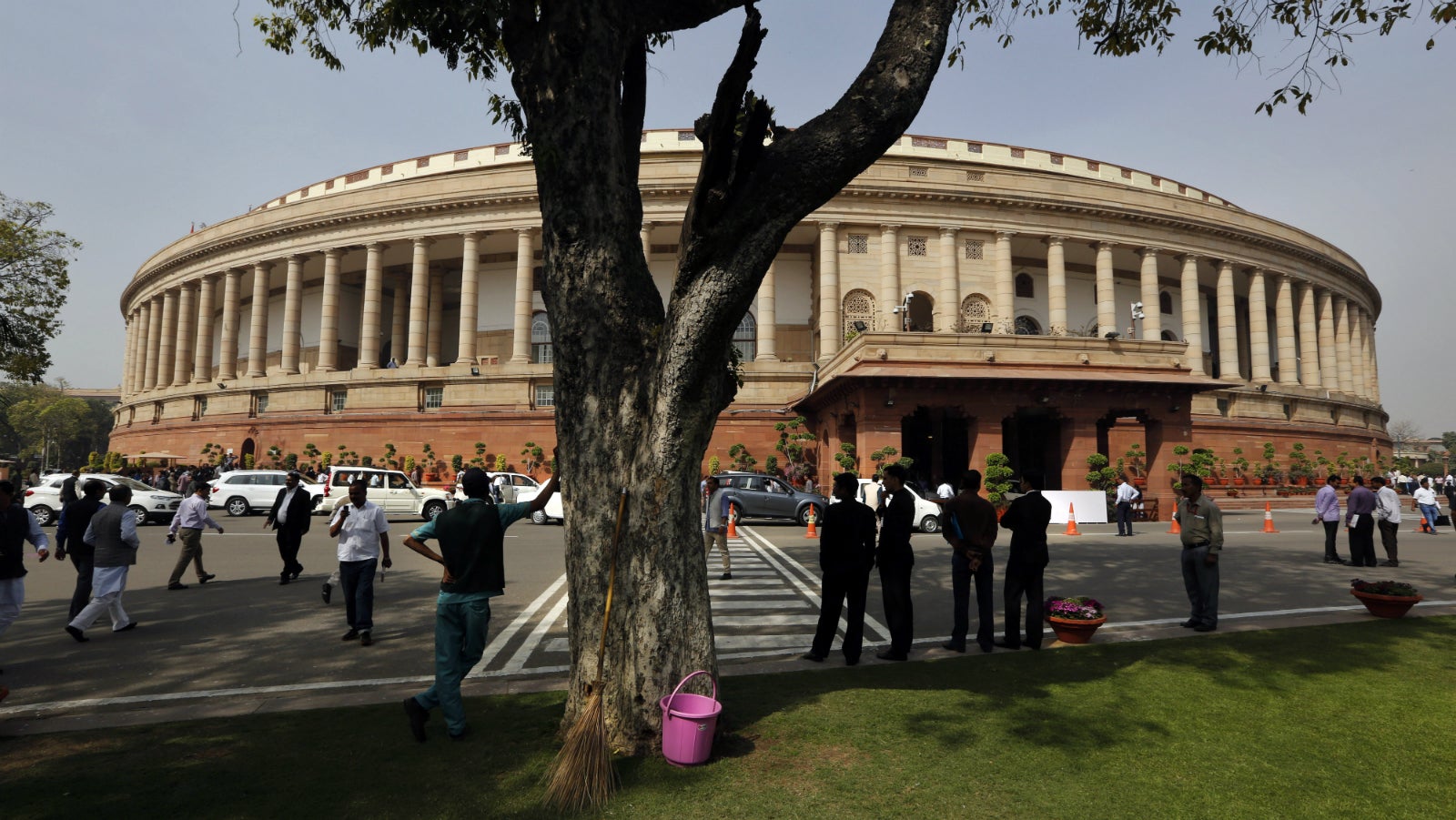
So, it wasn’t without irony that Indian parliamentarians on Aug. 11 provided their Bhutanese counterparts with a stellar performance when the visiting delegation made a stop at the Rajya Sabha.
“We hope that during their stay here they would be able to see and learn more about our parliamentary system,” Rajya Sabha chairman Hamid Ansari hopefully announced, knowing fully well that parliament has been in a gridlock for weeks.
Members of the upper house, as if on cue, burst into laughter, with an unidentified voice even asking: “Why did you add that line, sir?”
The smiling, perhaps embarrassed, delegation of Bhutanese parliamentarians simply looked on from the gallery.
Soon after, the Rajya Sabha swiftly lapsed back into the now-established pattern of disruptions, followed by the cessation of business.
Sadly, since such unfortunate events robbed the visiting Bhutanese delegation of a fine opportunity to learn, Quartz would like to humbly submit five lessons in parliamentary democracy, as practiced by India’s outstanding lawmakers.
We welcome your comments at [email protected].
