
Federal Reserve Chair Kevin Warsh is heading into his first Federal Open Market Committee meeting facing pressure from two directions: a bond market betting that interest rates need to rise and a president insisting they should fall.
Bond markets want the Fed to hike interest rates. The president wants the central bank to slash rates. Kevin Warsh is caught in the middle
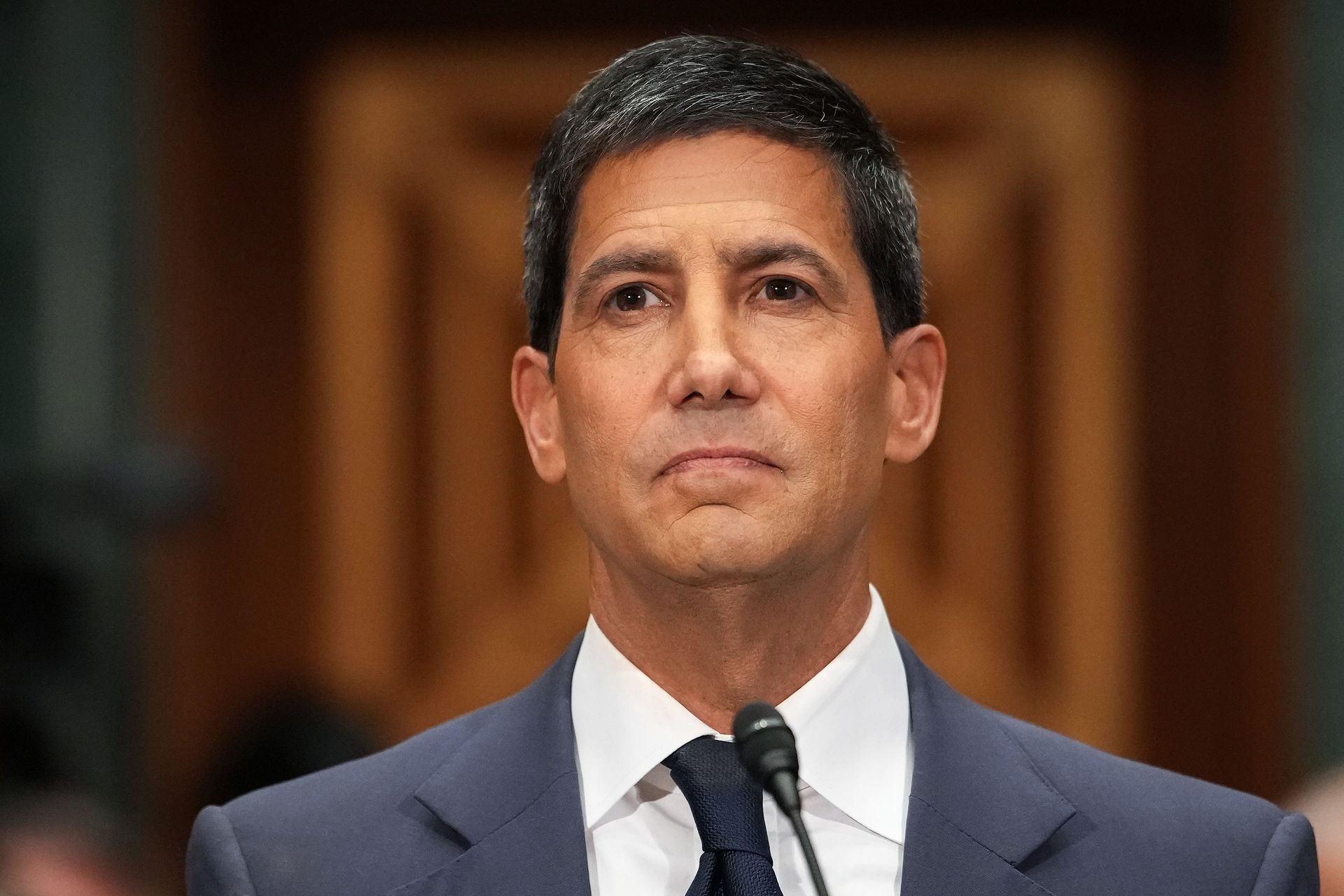
Andrew Harnik / Getty Images
Federal Reserve Chair Kevin Warsh is heading into his first Federal Open Market Committee meeting facing pressure from two directions: a bond market betting that interest rates need to rise and a president insisting they should fall.
Holding the benchmark rate in its current 3.5% to 3.75% range at the June 16–17 meeting is the near-universal expectation on Wall Street, as officials try to gauge how the energy-price fallout from the Iran war is working its way through the broader economy, according to Bloomberg. But Warsh's post-meeting statement and press conference will be parsed closely for signals about where the central bank is headed next.
Markets have shifted sharply in recent weeks. Despite some easing of rate-hike bets after news of a ceasefire deal, options markets were still assigning about an 80% probability to at least one quarter-point increase before year's end, according to the outlet — a recalibration driven by May data showing payrolls beat every analyst estimate at 172,000 and consumer prices rising 4.2% year-over-year, a pace not seen since April 2023. The two-year Treasury yield crossed above 4%, overtaking the Fed's own policy rate, and 30-year bonds touched levels not seen since 2007 in the prior month.
On Sunday, Trump used an NBC appearance to publicly contest the market's rate-hike narrative, declaring that increases would be "the wrong thing to do" and calling instead for the central bank to cut. "I'm living with Kevin," Trump said, referring to Warsh. "I have a lot of respect for him, but my feeling is that when a country is doing well, they shouldn't be penalized by immediately raising interest rates," Trump told NBC's Meet the Press.
The Fed's meeting in April produced three dissenting votes — the highest count on a Fed policy statement since 1992 — from officials who wanted the committee to stop telegraphing a preference for lower rates. According to the outlet, minutes from that April gathering showed a broad swath of officials signaling they could be compelled to tighten policy if inflation failed to retreat, and expressing a desire to shed the statement language favoring additional easing.
A closely watched decision at this meeting is what Warsh does with the so-called easing bias — a phrase embedded in the FOMC's statement that communicates an inclination toward further rate reductions. Dropping it would be consistent with Warsh's stated ambition to pull the Fed back from the practice of heavily pre-signaling its next steps. JPMorgan $JPM's chief economist Michael Feroli told CNBC that an explicit embrace of rate hikes from Warsh seems unlikely, though "I could see him saying he can't rule it out."
Since taking the oath of office, Warsh has offered virtually nothing in the way of public comment on interest-rate policy, a silence that has left investors with little to work with as the meeting approaches.
Join 500,000+ readers who start their day with Quartz.
By subscribing, you agree to our Terms of Service and Privacy Policy.