
While much of the attention was focused on the beating taken by stocks Thursday, a few that escaped unscathed. After all, tariffs have an unequal effect, hitting some businesses harder than others.
While most stocks were getting pummeled Thursday, some sectors fared relatively well
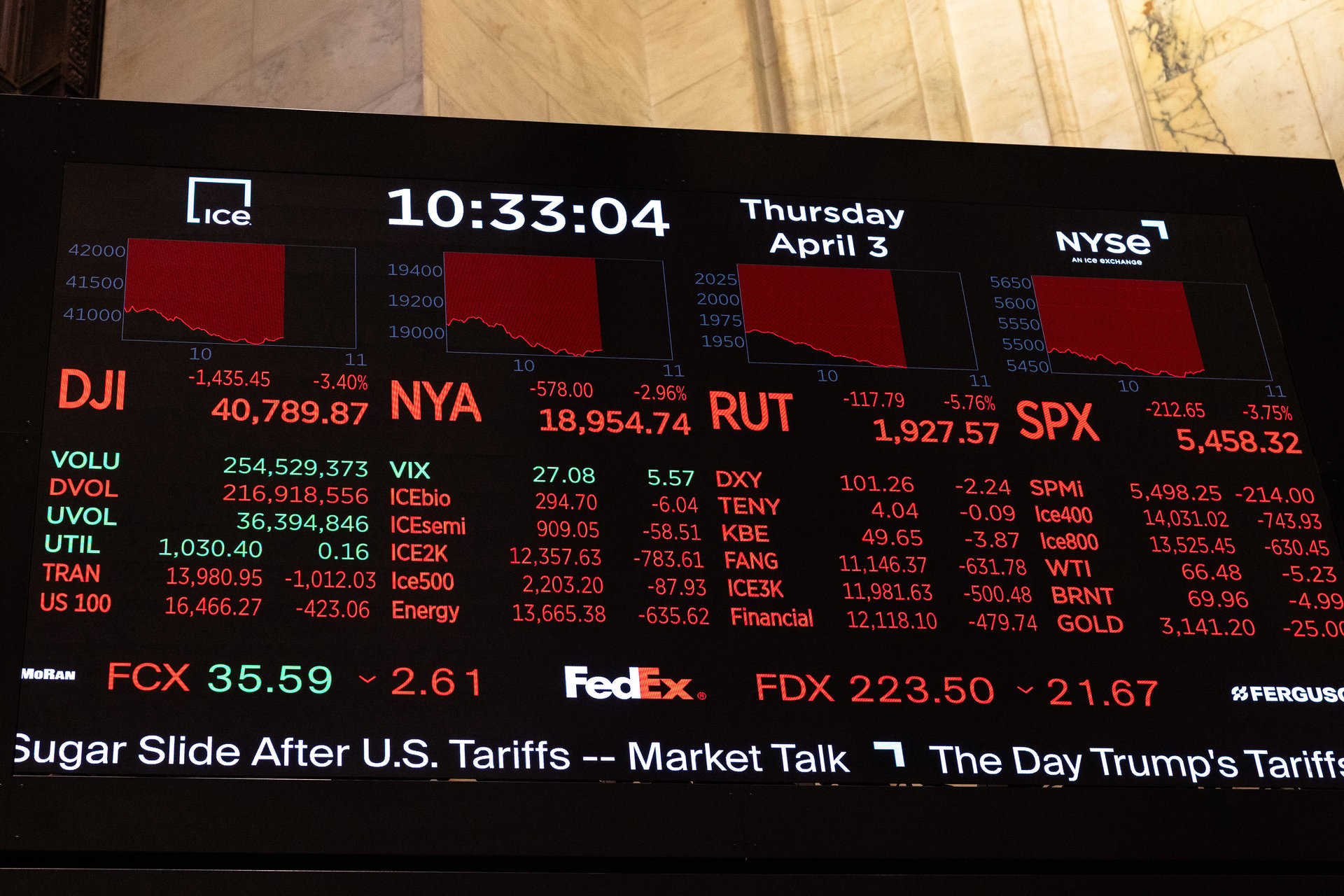
While much of the attention was focused on the beating taken by stocks Thursday, a few that escaped unscathed. After all, tariffs have an unequal effect, hitting some businesses harder than others.
Bentley University Economics Professor Dave Gulley said being a “winner” in a tariff war might be a relative term and that it comes down more to which companies are hit the least.
“Utility companies are usually good defensive plays, especially those where energy demand for data centers is strong,” Gulley said.
“And grocers, especially bigger ones, may also have somewhat less exposure to tariffs. Kroger (KR) might be a good example here,” Gulley said. (He noted that he isn’t recommending stocks, but commenting on which sectors might do the best.)
Winners in healthcare were the drug distributors and insurers, which are generally U.S.-based. Cencora and McKesson $MCK, two primary drug distributors, were up Thursday, Cencora (COR) by 3% and McKesson (MCK) by 3.2%. Health insurance giant UnitedHealth $UNH Group was up 3%, while HCA Healthcare $HCA Inc (HCA), the nation’s largest hospital chain was up .63 %
Kroger was up 5 percent as shareholders shrugged off the tariffs. Koninklijke Ahold Delhaize, which owns Hannaford’s, the largest grocery store chain in Maine, was up 3 percent. Albertson’s (ACI) was up over 2 percent Thursday.
Mobile networks generally brushed off bad tariff news today. Verizon $VZ (VZ) was up 2 percent, while T-Mobile $TMUS (TMUS) climbed 1.2 percent.
But Ram Ganeshan, professor of operations and supply chain at the Raymond A. Mason School of Business at William & Mary College says that any bounce today could be fleeting.
“Companies with primarily U.S.-based supply chains could benefit. However, examples of large domestic manufacturers like Tesla $TSLA (TSLA) — still reliant on imported parts and rare earth metals — show how difficult it is to operate entirely domestically,” Ganeshan said, adding that, eventually, all businesses will feel the impact.
“Ultimately, there is nowhere to hide,” Ganeshan says.
Join 500,000+ readers who start their day with Quartz.
By subscribing, you agree to our Terms of Service and Privacy Policy.