
Quartz
Subscribe
Quartz
Subscribe
Edition
Business News
A.I.
Technology
Money & Markets
Leadership
Lifestyle
Latest

Get Quartz in your inbox

Free daily briefing on global business news.

Business News
AirlinesAutomobilesFoodPharmaceuticalsPolitics & GovernmentRetail & EcommerceSpace & AerospaceEarnings
Technology
A.I.ComputingConsumer TechSpace & AerospaceEarnings
Money & Markets
Economic IndicatorsMarketsPersonal FinanceEarnings
Lifestyle
Cars & BikesCollectingEntertainmentFood & Fine DiningHealth and FitnessReal EstateTravel
Quartz

Global business news for a smarter world

Topics

  • Business News
  • Money & Markets
  • Tech & Innovation
  • Generation A.I.
  • Lifestyle
  • Leadership

Products

  • Daily Brief
  • Weekly Digest
  • Member Benefits
  • Quartz Pro

Legal

  • Sitemap
  • About
  • Accessibility
  • Privacy
  • Terms of Service
  • Advertising

© 2026 Quartz Media, Inc. All rights reserved.

News

The Supreme Court won’t decide Big Tech's free speech fight with Florida and Texas

Social media trade group NetChoice called the move a win for online platforms

By Laura Bratton·2 min read·Updated August 6, 2024
Add QZ to Google

The Supreme Court isn’t going to rule on a case that could fundamentally change how we think about the First Amendment as it applies to the internet. But within its indecision came one decision: Social media has at least some First Amendment protections, the court said.


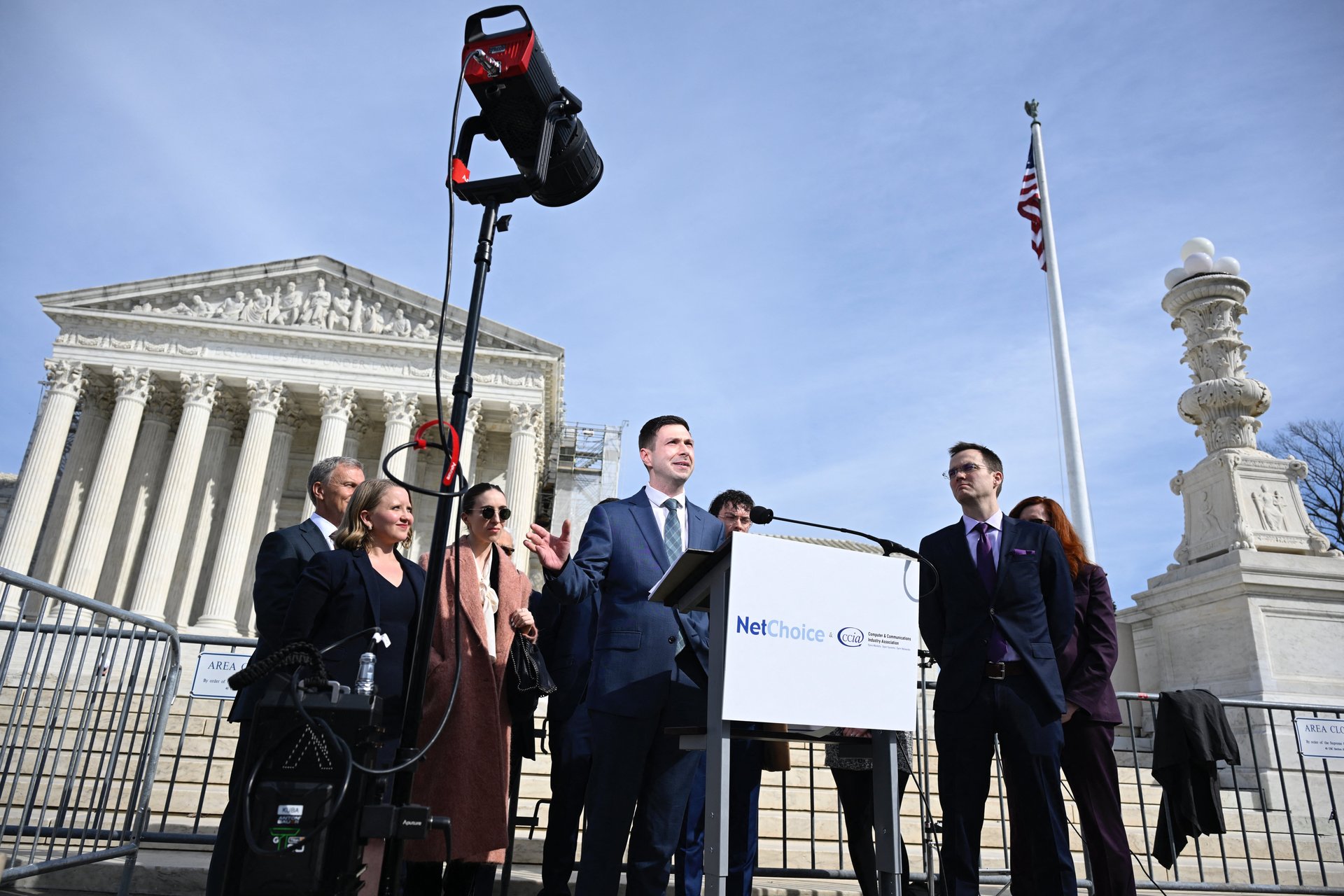
The high court on Monday sent two cases brought by a social media trade group against Texas and Florida back to lower courts. The two states passed similar laws in 2021 prohibiting social media companies from removing user-generated content based on “political viewpoints.” NetChoice, an industry trade group that represents companies such as Meta $META and TikTok, and the Computer & Communications Industry Association (CCIA) sued both states over the laws, saying they force companies to host speech on their platforms against their will. The cases made their way to the Supreme Court in February.

But the justices on Monday vacated lower courts’ rulings and sent the cases back for reconsideration. Those courts had handled each case differently, upholding the Texas law and striking down key parts of the Florida law. The Supreme Court said the lower courts didn’t do a good enough job analyzing the cases.

Justice Elena Kagan said in her opinion that “the question in such a case is whether a law’s unconstitutional applications are substantial compared to its constitutional ones.”

“To make that judgment,” she wrote, “a court must determine a law’s full set of applications, evaluate which are constitutional and which are not, and compare the one to the other. Neither court performed that necessary inquiry.”

NetChoice saw the ruling as a win. That’s because, in sending the cases back to the lower courts, the justices also said that social media companies have First Amendment rights. Lawyers for Texas and Florida had argued that the sites did not have such protections.

“Today’s ruling from the Supreme Court is a victory for First Amendment rights online,” Chris Marchese, director of NetChoice’s litigation center, said in a statement. “As our cases head back to the lower courts for consideration, the Supreme Court agreed with all our First Amendment arguments…we are gratified to see the Supreme Court acknowledge the Constitution’s unparalleled protections for free speech, including the world’s most important communications tool, the internet.”

Kagan said that, “to the extent social media platforms create expressive products, they receive the First Amendment’s protections. And although these cases are here in a preliminary posture, the current record suggests that some platforms, in at least some functions, are indeed engaged in expression.”

Zephyr Teachout, a Fordham law professor, wrote in The Atlantic in February that “a platform’s decision to ban a certain user or prohibit a particular point of view can have a dramatic influence on public discourse and the political process.

“Leaving that much power in the hands of a tiny number of unregulated private entities poses serious problems in a democracy,” Teachout added.

Daily Brief

The essential business news, delivered fresh every morning.

Join 500,000+ readers who start their day with Quartz.

By subscribing, you agree to our Terms of Service and Privacy Policy.

Related

Business NewsDisney is cutting several hundred jobs, with ESPN layoffs tied to NFL Network integration
Politics & GovernmentBessent is threatening to sanction China for stealing U.S. AI model capabilities
A.I.China's Moonshot AI is seeking a $50 billion valuation in pre-IPO funding talks
Business NewsAmazon Prime members have one week left to claim up to $51 from the $2.5 billion FTC settlement
Emerging TechnologiesGE Aerospace pulled off the world's first hybrid-electric flight at altitude