
President Donald Trump said Wednesday that he has instructed the Justice Department to investigate oil companies for not lowering gasoline prices at the pump in proportion with falling crude oil costs, accusing the industry of "gouging" customers.
The president accused companies of "gouging" consumers as crude oil fell below $70 a barrel for the first time since early March
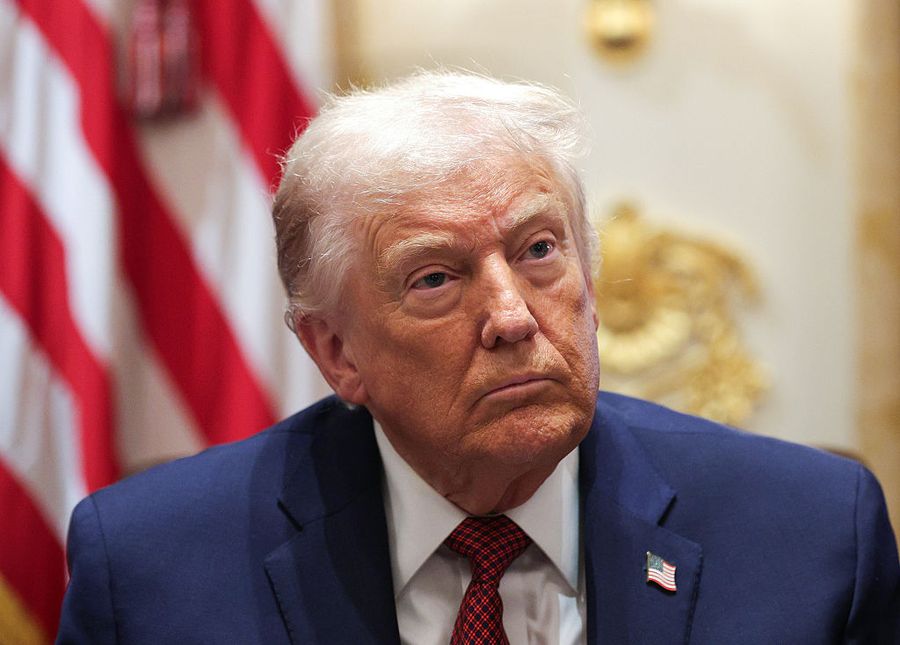
Alex Wong/Getty Images
President Donald Trump said Wednesday that he has instructed the Justice Department to investigate oil companies for not lowering gasoline prices at the pump in proportion with falling crude oil costs, accusing the industry of "gouging" customers.
"The big Oil Companies are not dropping their price at the pump commensurate with the sharply lower prices they are paying for Oil. Those prices are dropping like a rock!," Trump wrote in a Truth Social post. "In other words, customers are being 'gouged.' I have instructed the DOJ to immediately start looking into this. Gasoline prices better start going down a lot faster than what I'm seeing!"
Trump did not name any specific companies. The DOJ did not respond to requests for comment.
The American Petroleum Institute, which represents major U.S. oil and gas companies, pushed back. "Gasoline prices don't move in lockstep with crude oil, especially during a major global disruption that is still affecting supply, refining and inventories," API spokesperson Bethany Williams said.
Karen Young, a senior research scholar at the Columbia University Center on Global Energy Policy, called Trump's post "political theater," telling CNBC that it takes a couple of weeks before crude price declines work their way through refiners and on to consumers. "There are state and local taxes, which are applied to the price of gas at stations in the United States," she added.
Trump's directive came as WTI crude touched $69.63 per barrel at its lowest point on Wednesday — marking the contract's first sub-$70 price since March 2 — and closed around $70.22, a decline of roughly 4%. The international benchmark Brent crude also declined, dropping 4.2% to close at $73.83 per barrel — a price last seen before American and Israeli forces struck Iran in February.
The drop in crude prices was driven in part by signs that maritime traffic through the Strait of Hormuz may be returning to normal. After obtaining safety guarantees, the International Maritime Organization announced that roughly 11,000 crew members who had been trapped in the Persian Gulf were cleared to transit the strait. IMO Secretary-General Arsenio Dominguez said in a statement: "We have secured the necessary safety guarantees and have thoroughly verified the conditions for safe navigation."
GasBuddy figures put the nationwide average pump price at about $3.906 per gallon on Wednesday morning, a figure more than 14% below the May high. AAA data shows that is still substantially higher than the $3.22 per-gallon average recorded a year earlier.
Heading into Wednesday, pump prices had now declined for six consecutive weeks, a run of consumer relief tied to easing tensions between the U.S. and Iran over access to the Strait of Hormuz, a chokepoint that handles roughly one-fifth of global seaborne oil. The war and subsequent closure of the waterway had pushed crude above $120 per barrel earlier this year. Even so, crude oil prices entering Wednesday remained roughly a quarter above their level at the start of 2026.
With midterm elections approaching in November, elevated energy costs have become a political liability for Trump and congressional Republicans, who hold narrow majorities in both chambers.
Join 500,000+ readers who start their day with Quartz.
By subscribing, you agree to our Terms of Service and Privacy Policy.