
With a few minor exceptions, there are really only two ways to say “tea” in the world. One is like the English term—té in Spanish and tee in Afrikaans are two examples. The other is some variation of cha, like chay in Hindi.
With a few minor exceptions, there are really only two ways to say “tea” in the world

With a few minor exceptions, there are really only two ways to say “tea” in the world. One is like the English term—té in Spanish and tee in Afrikaans are two examples. The other is some variation of cha, like chay in Hindi.
Both versions come from China. How they spread around the world offers a clear picture of how globalization worked before “globalization” was a term anybody used. The words that sound like “cha” spread across land, along the Silk Road. The “tea”-like phrasings spread over water, by Dutch traders bringing the novel leaves back to Europe.
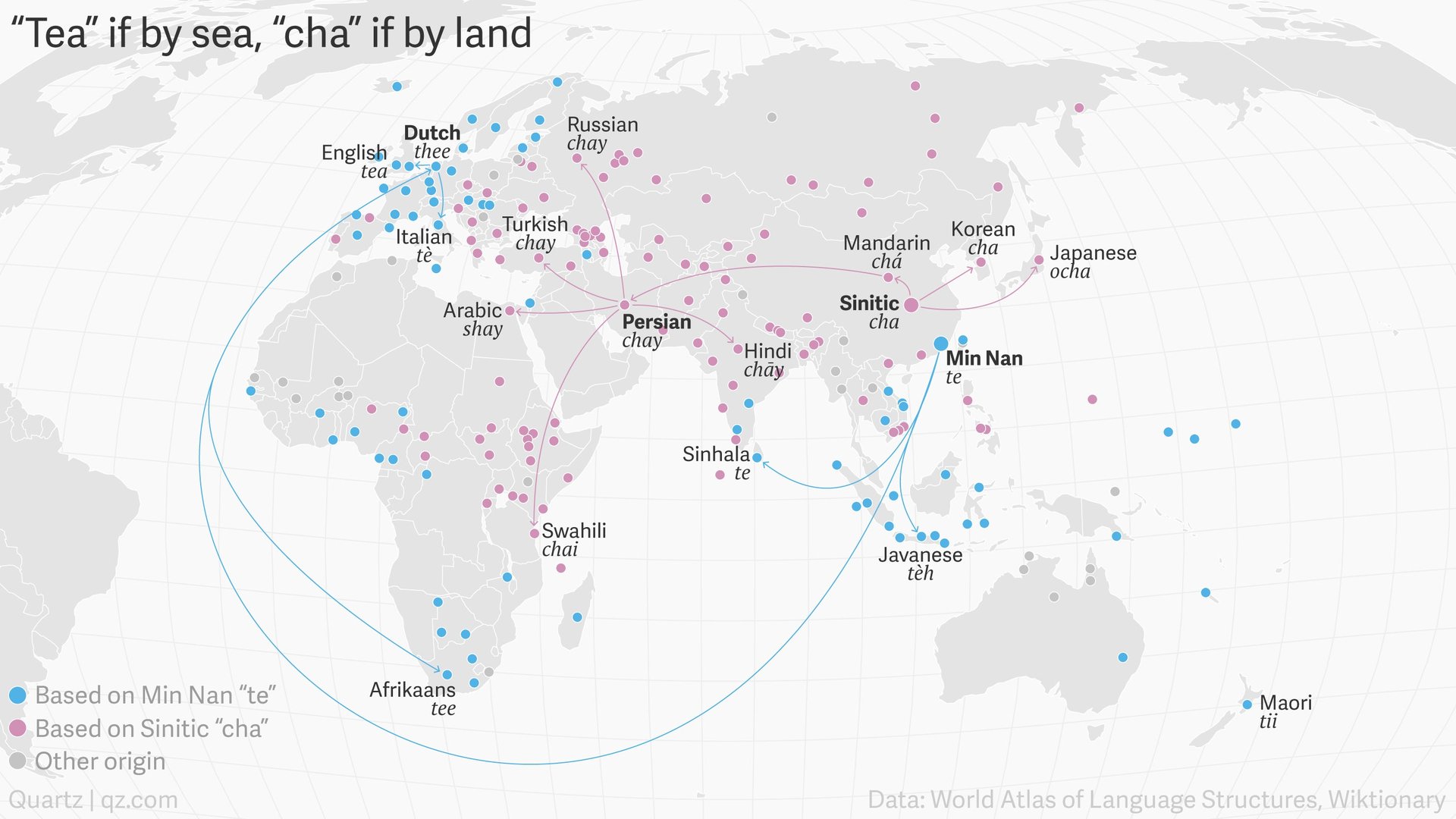
The term cha (茶) is “Sinitic,” meaning it is common to many varieties of Chinese. It began in China and made its way through central Asia, eventually becoming “chay” (چای) in Persian. That is no doubt due to the trade routes of the Silk Road, along which, according to a recent discovery, tea was traded over 2,000 years ago. This form spread beyond Persia, becoming chay in Urdu, shay in Arabic, and chay in Russian, among others. It even made its way to sub-Saharan Africa, where it became chai in Swahili. The Japanese and Korean terms for tea are also based on the Chinese cha, though those languages likely adopted the word even before its westward spread into Persian.
But that doesn’t account for “tea.” The Chinese character for tea, 茶, is pronounced differently by different varieties of Chinese, though it is written the same in them all. In today’s Mandarin, it is chá. But in the Min Nan variety of Chinese, spoken in the coastal province of Fujian, the character is pronounced te. The key word here is “coastal.”
The te form used in coastal-Chinese languages spread to Europe via the Dutch, who became the primary traders of tea between Europe and Asia in the 17th century, as explained in the World Atlas of Language Structures. The main Dutch ports in east Asia were in Fujian and Taiwan, both places where people used the te pronunciation. The Dutch East India Company’s expansive tea importation into Europe gave us the French thé, the German Tee, and the English tea.
Yet the Dutch were not the first to Asia. That honor belongs to the Portuguese, who are responsible for the island of Taiwan’s colonial European name, Formosa. And the Portuguese traded not through Fujian but Macao, where chá is used. That’s why, on the map above, Portugal is a pink dot in a sea of blue.
A few languages have their own way of talking about tea. These languages are generally in places where tea grows naturally, which led locals to develop their own way to refer to it. In Burmese, for example, tea leaves are lakphak.
The map demonstrates two different eras of globalization in action: the millenia-old overland spread of goods and ideas westward from ancient China, and the 400-year-old influence of Asian culture on the seafaring Europeans of the age of exploration. Also, you just learned a new word in nearly every language on the planet.
Join 500,000+ readers who start their day with Quartz.
By subscribing, you agree to our Terms of Service and Privacy Policy.