Donald Trump’s canceled trip to the World Economic Forum in Davos, Switzerland in January still left US taxpayers on the hook for at least $3.2 million in car rentals and unused hotel rooms, according to an analysis of federal spending data by Quartz.

Donald Trump’s canceled trip to the World Economic Forum in Davos, Switzerland in January still left US taxpayers on the hook for at least $3.2 million in car rentals and unused hotel rooms, according to an analysis of federal spending data by Quartz.
Trump announced he was canceling the trip on Jan. 17, less than two weeks before the conference was to start. At the time, his administration was in the midst of what turned out to be the longest government shutdown in US history.
Join 500,000+ readers who start their day with Quartz.
By subscribing, you agree to our Terms of Service and Privacy Policy.
Most acting US presidents have skipped the exclusive conference in Switzerland, but this year Trump had planned to bring six cabinet members, dozens of officials and aides, and his daughter Ivanka, after fronting a huge delegation in 2018.
At the time Trump canceled the trip, the estimated cost of hotels and rental cars amounted to at least $3.6 million, which did not include the cost of flying the president to Switzerland aboard Air Force One.
The government was able to get some of its money back. Various adjustments and refunds since have brought the amount it owes for lodging and transportation (as well as one relatively small charge for communications services) down to about $3.2 million.
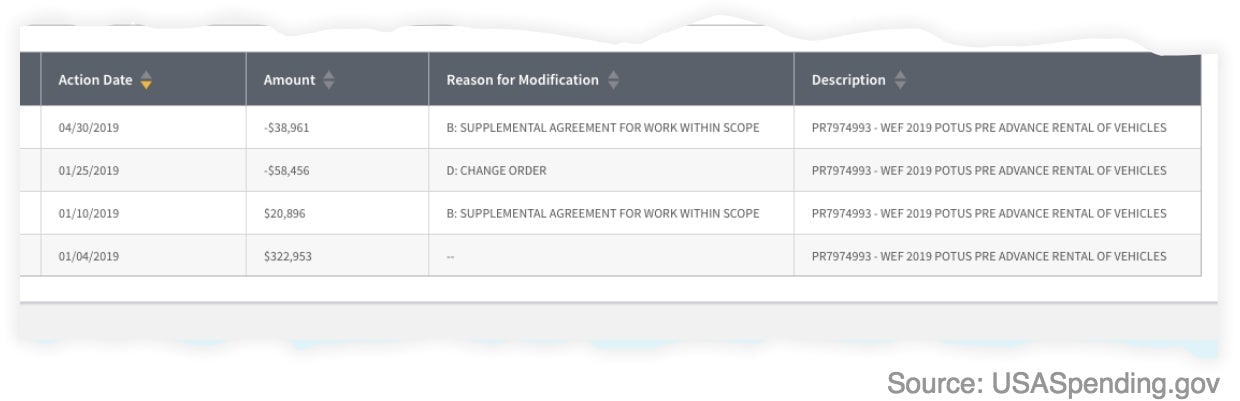
For example, one expenditure labeled “WEF 2019 POTUS PRE ADVANCE RENTAL OF VEHICLES” and classified under the government billing code for “Limousine Service” came to $246,433. But two partial refunds, issued at the end of January and April, knocked 28% off the original $343,849 that had been allocated.
The administration was unable to get a full refund because of the way certain types of federal purchases are made, Craig Holman, government affairs lobbyist at Washington, DC watchdog Public Citizen, tells Quartz. This one involved a fixed contract, presumably for multiple vehicles, that could not be canceled without incurring substantial penalties, he says.
The US delegation was to be led by Treasury secretary Steven Mnuchin, and spanned multiple government agencies. Some made out better than others. A partial list:
As for housing, the results were also mixed. Some notable instances:
Refunds can sometimes occur months or even years after the fact, Nick Schwellenbach, director of investigations at the nonpartisan Project on Government Oversight, tells Quartz, and says they might be triggered by things like audits that find overpayments or some other reason by which it would be appropriate to try claw back some of the money.
The State Department did not respond to a request for comment.
