The good news: the gender wage gap has been decreasing in the US, with women in 2013 making 78.3 cents for every dollar earned by men, up from 60.2 cents in 1980.

The good news: the gender wage gap has been decreasing in the US, with women in 2013 making 78.3 cents for every dollar earned by men, up from 60.2 cents in 1980.
The bad news: At this rate, women won’t see equal pay for another 43 years.
The stats come from a new report (pdf) by the Institute for Women’s Policy Research. The researchers used (pdf, p. 40) to determine the female-to-male earnings ratio over time. They used the rate of progress to determine when women would reach parity with men.
Join 500,000+ readers who start their day with Quartz.
By subscribing, you agree to our Terms of Service and Privacy Policy.
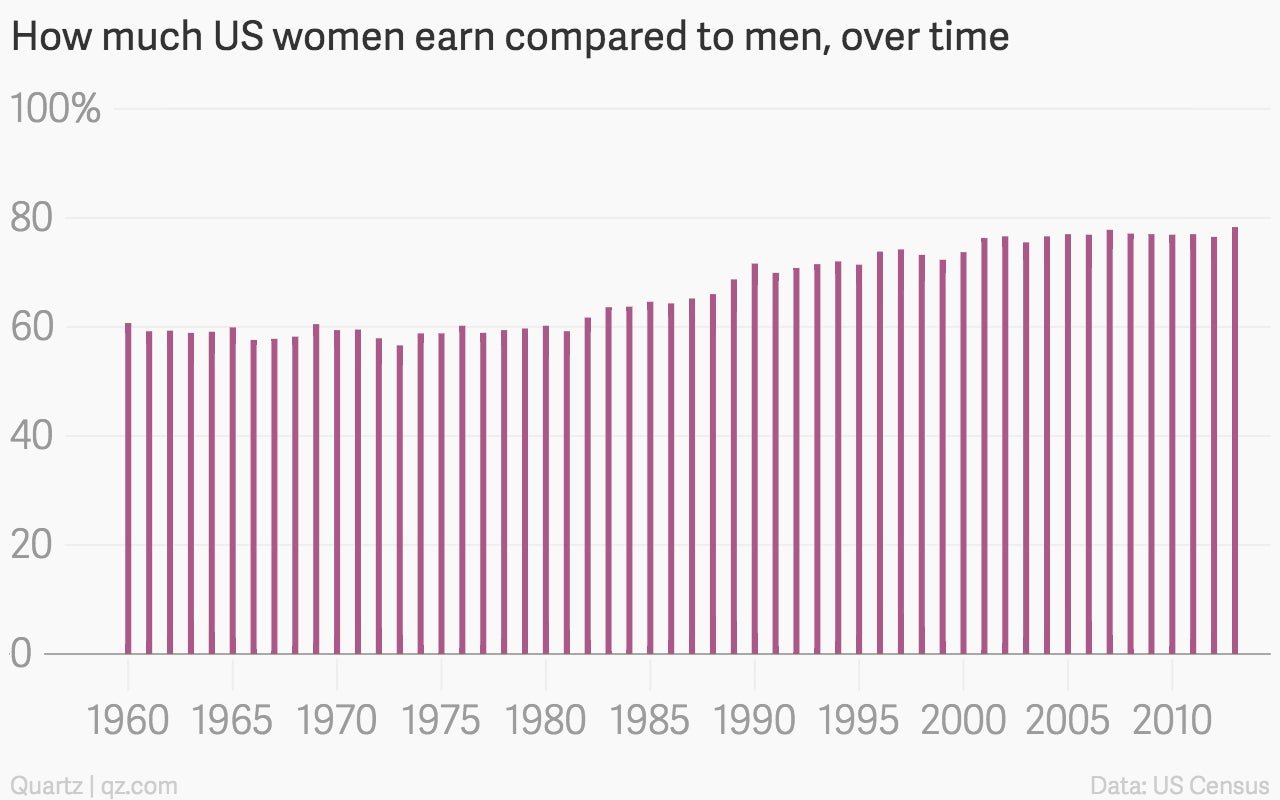
The paper notes that from the 1980s through 2000, women began to catch up mainly because they were earning more than before, while real wages for men didn’t change much. But since the early 2000s, wages have stagnated both for women and men, hence the slower progress in closing the gap.
Not everyone around the US will be seeing parity by 2058—and others will see it sooner. As noted in the Daily Beast, the target date in fact varies greatly by state, job sector, education level, and race.
In five states, women will be waiting until the next century for a comparable paycheck unless the pace of progress picks up soon. Ladies of Wyoming, who earn 67.9 cents for every dollar a man earns, might want consider that parity there won’t arrive until 2159—too late for them, but perhaps in time for their great-granddaughters. They might be better off moving to New York, which currently has the smallest wage gap of any state; women there are making 87.6% of what men make. Their daughters might want to head to Florida, where women who are employed full-time are projected to get fair paychecks in 2038, earlier than any other state.
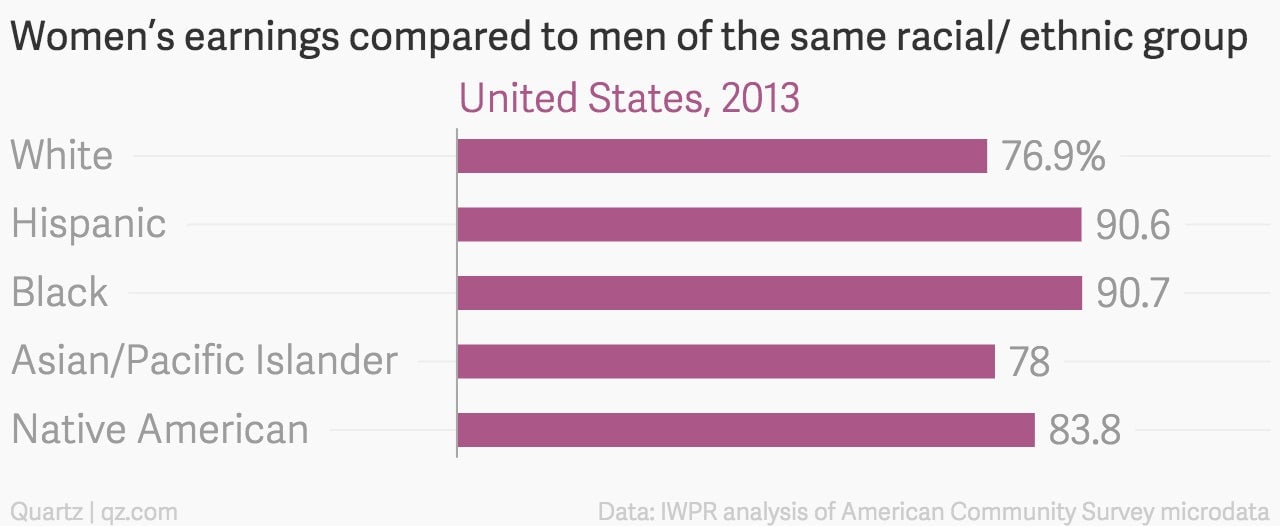
Another big variable in the statistics: ethnicity. Using the earnings of white men as a base line, the researchers found that among females in the US, Hispanic women are the furthest away from parity, getting paid only 53.8% as much as the average white male. (Even here there are important distinctions, with Hispanic women of Argentinian and Spanish descent out-earning women of Honduran or Guatemalan descent, for example.)

Asian women come the closest to parity, earning 88.5 cents for every dollar earned by the average white male. But when you compare these women’s earnings with those of Asian and Pacific Islander men in the US—the only group, according to the study, to out-earn white men—the gap widens, and the ratio drops back down to 78%.
Examining workers by their level of education, the researchers found that women with associate’s degrees are the closest to their male counterparts, earning 80% as much as the men.
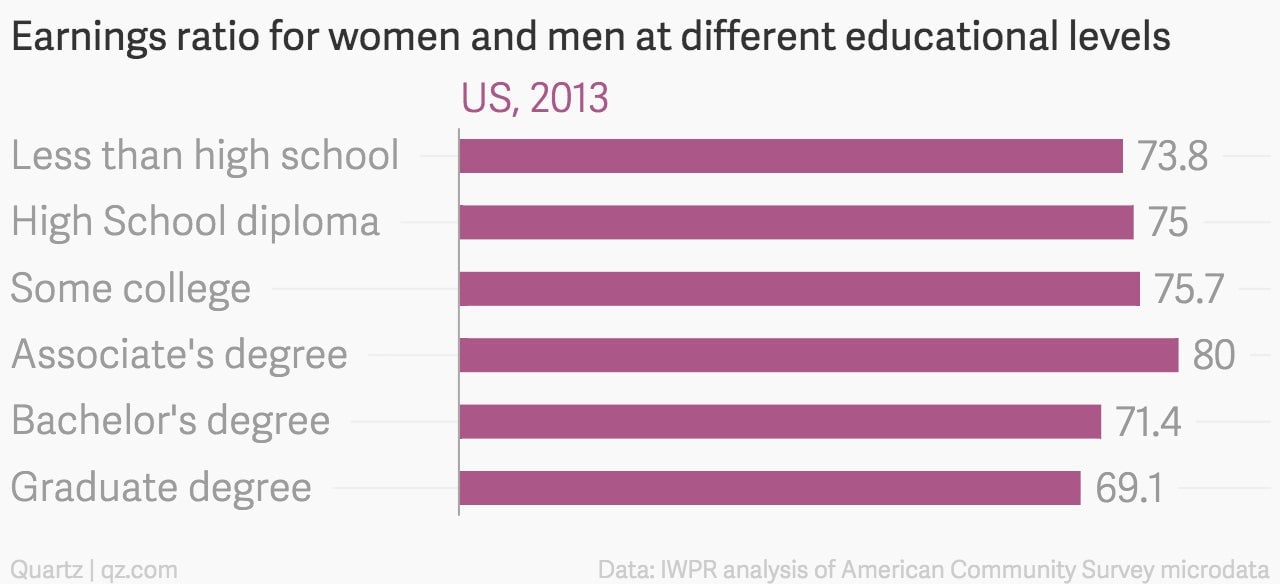
On average, women need a graduate degree to surpass the earnings of men with associate’s degrees, the study found.
