On this day four years ago, Barack Obama had just scored a comfortable electoral vote victory (332 to 206) over Mitt Romney. Reflecting on what felt like a slightly bonkers election cycle at the time, I put on my speculative hat as a futurist and penned a list of the 10 things that might get even weirder in the 2016 election.
On this day four years ago, Barack Obama had just scored a comfortable electoral vote victory (332 to 206) over Mitt Romney. Reflecting on what felt like a slightly bonkers election cycle at the time, I put on my speculative hat as a futurist and penned a list of the 10 things that might get even weirder in the 2016 election.
How young and naive Americans were back then. We had no idea—none of us—of the weird depths we would eventually plumb in 2016. Herman Cain’s “9-9-9” tax plan, Rick Perry’s debate meltdown, Romney’s binders, Michele Bachmann’s , : Even weird was simpler in 2011.
Join 500,000+ readers who start their day with Quartz.
By subscribing, you agree to our Terms of Service and Privacy Policy.
Although the top 10 list was meant to be only semi-serious, it turns out some predictions weren’t far off. To wit, some of the key forecasts from 2012:
Five out of 10 ain’t bad. But where do we go from here?
It’s doubtful that much of what’s happened in 2016 can be put back in the bottle, no matter how chastened we may feel as a country after Donald J. Trump’s win last night. Not only has the so-called Overton Window constituting acceptable political discourse been expanded to IMAX proportions, we may never actually see a “normal” election again in our lifetimes.
The cast of characters may vary in outlandishness. But since the end of the 1950s, each US successive presidential campaign seems to have gotten more bizarre, helped along by the intertwining politics of individualism, advances in technology, and stakes of winning. It would be nice—no, healthy—for America if we could return to a more civil, civic, and substantive approach to choosing our leaders. But from here, with the dust still settling after a campaign that has left most Americans “disgusted,” it’s hard to see how this will happen.
Here are three areas that, to borrow a phrase, may get weirder by the 2020 election:
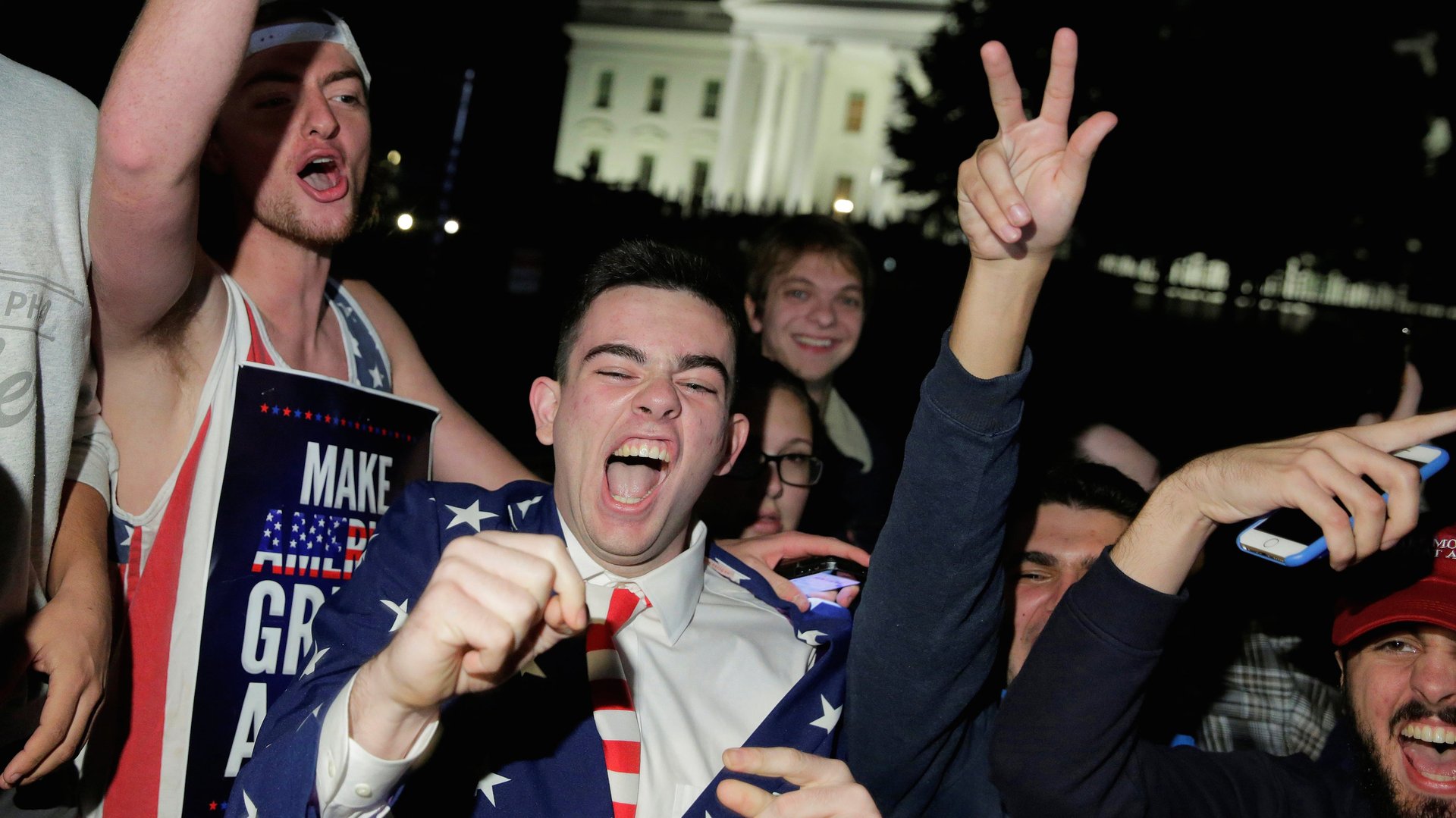
“Red” and “blue” America will fragment further into self-contained worlds of fan fiction. At time, the worlds of #MAGA Trump fans and #ImWithHer Hillary supporters seemed so different as to be from separate planets, let alone parties. Technology and a heavily balkanized media have enabled these and other political camps to live and thrive within their own self-sustaining filter bubbles. At the same time, our ability to construct full-blown mythologies and fan theories about mundane TV shows and pop culture characters is fusing with our political, economic, and social separation. Unless something meaningful snaps us out of it, the next election may feel more like the sealed tribal narratives of Game of Thrones or Westworld than the selection of actual political leadership.
The uncanny valley will meld with campaigning. A new study estimates some 20% of all election-related messages on Twitter $TWTR in this US election have been fake, generated by so-called Twitter bots. Again, this is not a new phenomenon, having been a feature of recent elections in Mexico, Russia, and elsewhere in the world. Today, bots are generating a fair amount of US news coverage. Artificial intelligence is stepping up its game in interacting with humans, faking sounds, and soon, treating speech like a Photoshopped photo, putting artificial words into real mouths. Given our already heightened disorientation, we may have a much harder time even telling what’s bot and what’s not in a future presidential race. How do you score the truth if you’re not sure if a real person even said it?
Email is so yesterday—personal data is the way of the future. Much to her supporters’ frustration, Hillary Clinton’s emails have been an outsized feature of the 2016 campaign, right up until the final days. The FBI’s crawl through her so-called metadata—data about hers’ and others’ correspondence—as well as Wikileaks’ trafficking in thousands of other hacked emails, will seem quaint in 2020. Already, technology carried by future candidates, their families, and anyone within their extended social, political or professional sphere is generating terabytes of data—data that can be stolen, revealed, and even sold to the highest bidder. Google $GOOGL searches, Fitbits, voice interactions with phones or home devices, CCTV, GPS, walking patterns, emotion data—the amount of data attached to future political aspirants is immense and growing. In order to keep up with the times, NSA-level data hacking will become a prime trait required for any future political operation. Candidates and those around them will lose any form of data intimacy. Someone, somewhere is probably already building a data dossier on 2020 contenders. We’ll long for the days of a leaked email asking someone to bring some milk.
With any luck, America will be able to recover and heal from this electoral ordeal in the coming months. Heaven knows we deserve a break. But as the posturing begins, even now, for the next go-round, be prepared to buckle up. This year was weird. But 2020 may push boundaries we didn’t know existed.
