The reality of the Holocaust, one of the world’s worst historical cases of racial genocide, is not up for debate.

The reality of the Holocaust, one of the world’s worst historical cases of racial genocide, is not up for debate.
Except, there are a handful of people that to this day continue deny the Nazi execution of Jews during World War II and perpetuate anti-semitic stereotypes by blaming Jews for fabricating or exaggerating the traumatic event. Unfortunately, these groups have a larger voice that you might imagine—in part thanks to Google $GOOGL.
Join 500,000+ readers who start their day with Quartz.
By subscribing, you agree to our Terms of Service and Privacy Policy.
The first article that pops up when you search for “did the holocaust happen” on the world’s largest search engine is this: ‘Top 10 reasons why the holocaust didn’t happen.”
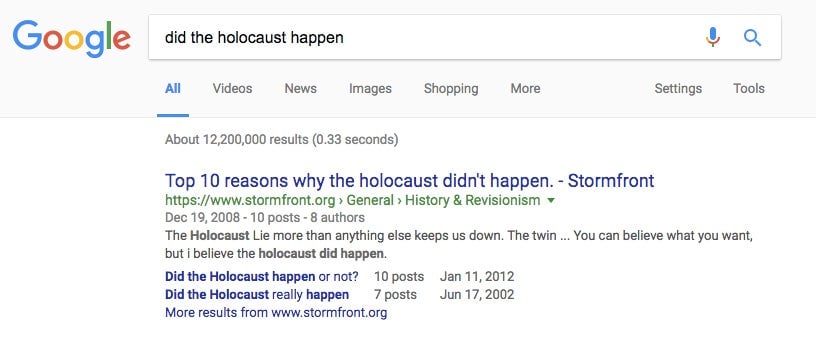
The article lives on the US-based neo-Nazi and white supremacist site Stormfront.org, which has earned the notorious reputation of being the Internet’s first major hate site since its founding by Alabama Ku Klux Klan leader Don Black in 1995. It doesn’t get more in-your-face than that.
The Guardian reported on the search result on Dec. 11 and the top link remained unchanged two days later, on Dec. 13.
“We are saddened to see that hate organizations still exist. The fact that hate sites appear in search results does not mean that Google endorses these views,” a Google spokesperson told Quartz, explaining that search is a reflection of the information available on the Internet and a page is ranked according to its relevance to a given query by algorithms.
One user on Stormfront’s forum says, “the most compelling evidence for the holocaust being a lie is the fact there were survivors, period.” Even sites that propagate gross misinformation like this, Google says, are outside their purview.
“We do not remove content from our search results, except in very limited cases such as illegal content, malware, and violations of our webmaster guidelines,” the spokesperson said.
The article itself isn’t the only concern. With Stormfront appearing so high in Google search results, the racist organization is likely gaining more and more followers and readers, which in turn will keep the site highly “relevant” in future search queries.
The issue again raises the question of whether powerful tech organizations like Google should actively be keeping such misinformation from being spread. As many Google users have pointed out, if Facebook $META can’t escape the responsibility of fostering fake news on its site and Twitter $TWTR can’t shirk the blame for breeding trolls, then the search giant can’t wipe its hands of the lying content on its site, either.
