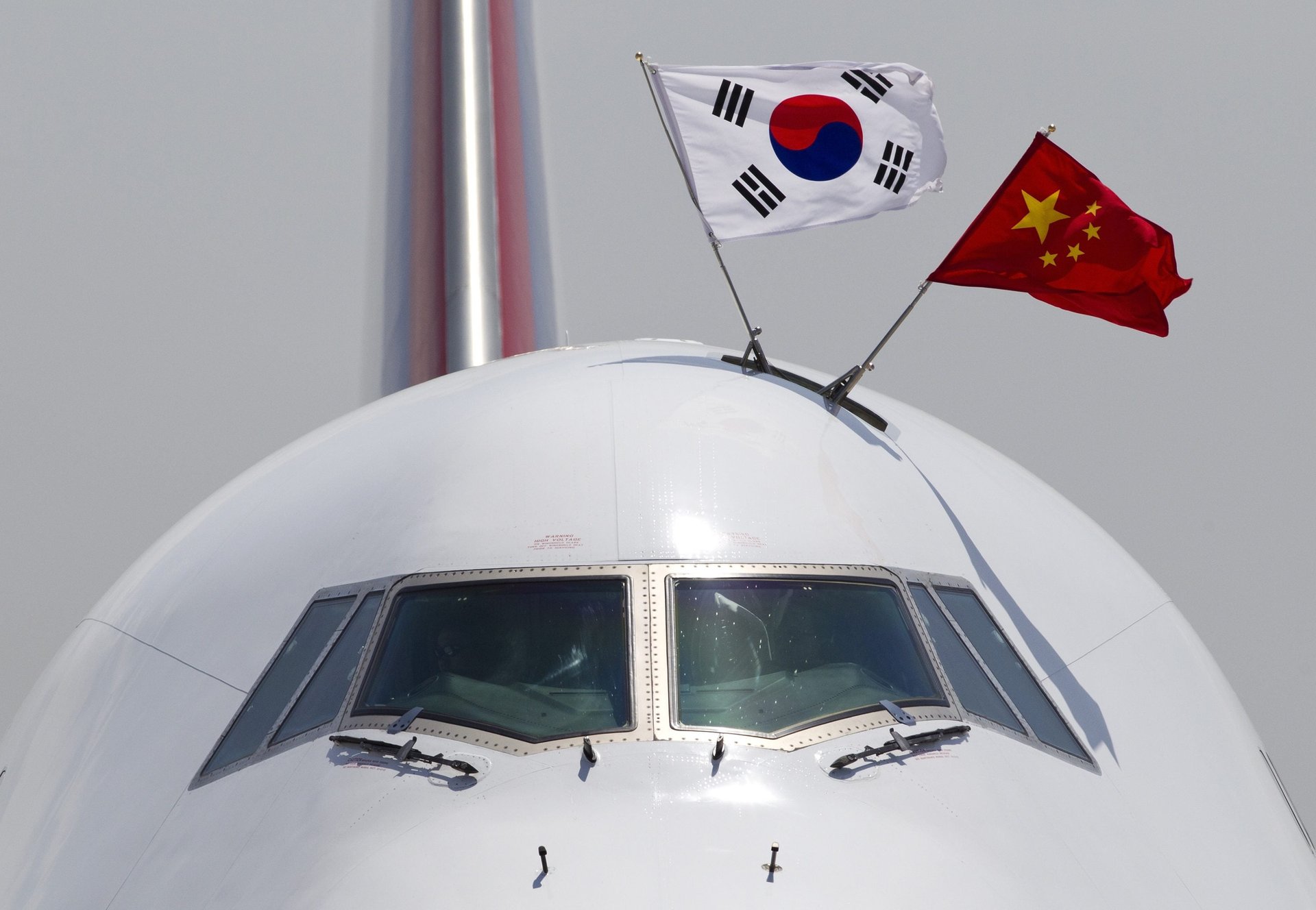
It’s an open secret China isn’t very happy with South Korea at the moment.
It’s an open secret China isn’t very happy with South Korea at the moment.
Since South Korea announced in July that it would let the US deploy a missile-defense system in the country—which Beijing views as a threat to its national security—China has begun a passive-aggressive campaign retaliating against its neighbor. Reports coming from South Korea suggest China is responding economically with moves harming key Korean industries, but it has denied its recent actions are a response to the missile-defense system. Korea, though, is hoping to hash things out, sending eight lawyers today (Jan. 4) to China to begin discussions about its “retaliatory moves.”
The alleged retaliation started as early as August, when China began cracking down on Korean dramas and pop music, denying applications from Korean stars to perform in the country and refusing to screen Korean movies in the country. In November, China’s foreign ministry spokesperson Geng Shuang said he had “never heard about any restriction on the Republic of Korea.”
This past week, it made two additional moves impacting Korea’s tourism and consumer electronics industries.
On Jan. 1, it came to light that eight charter flights bound for mainland China in January were rejected by Chinese aviation authorities without offering specific reasons, according to the Korea Times. Kim Jung-hee, director of international air transport at the Ministry of Land, Infrastructure, and Transport, called it an “unprecedented” move, noting it would significantly impact the country’s tourism industry as Chinese tourists make a big portion of Korea’s visitors.
And on Jan. 2, local newspaper Chosun reported that Beijing reversed a decision to offer subsidies for eco-friendly cars. On Dec. 29, hours after it released a list of vehicles that would qualify for subsidies, it removed five models with batteries (link in Chinese) from Samsung and LG from it.
The response from Chinese netizens suggest they view China’s recent actions as just. On Weibo, China’s Twitter $TWTR-esque social network (links in Chinese, registration required), one user said: ”You earn money from doing business with China but you choose to slap my face. It’s time for Korea to know their neighbors who provide their living, one must know who your father is.” Another added: ”In the past China only condemned [bad] things that happened to us because we were not strong enough to do concrete things. But from now on, things will be different. For whoever hurts Chinese interests, there will be bigger consequences.”
Join 500,000+ readers who start their day with Quartz.
By subscribing, you agree to our Terms of Service and Privacy Policy.
