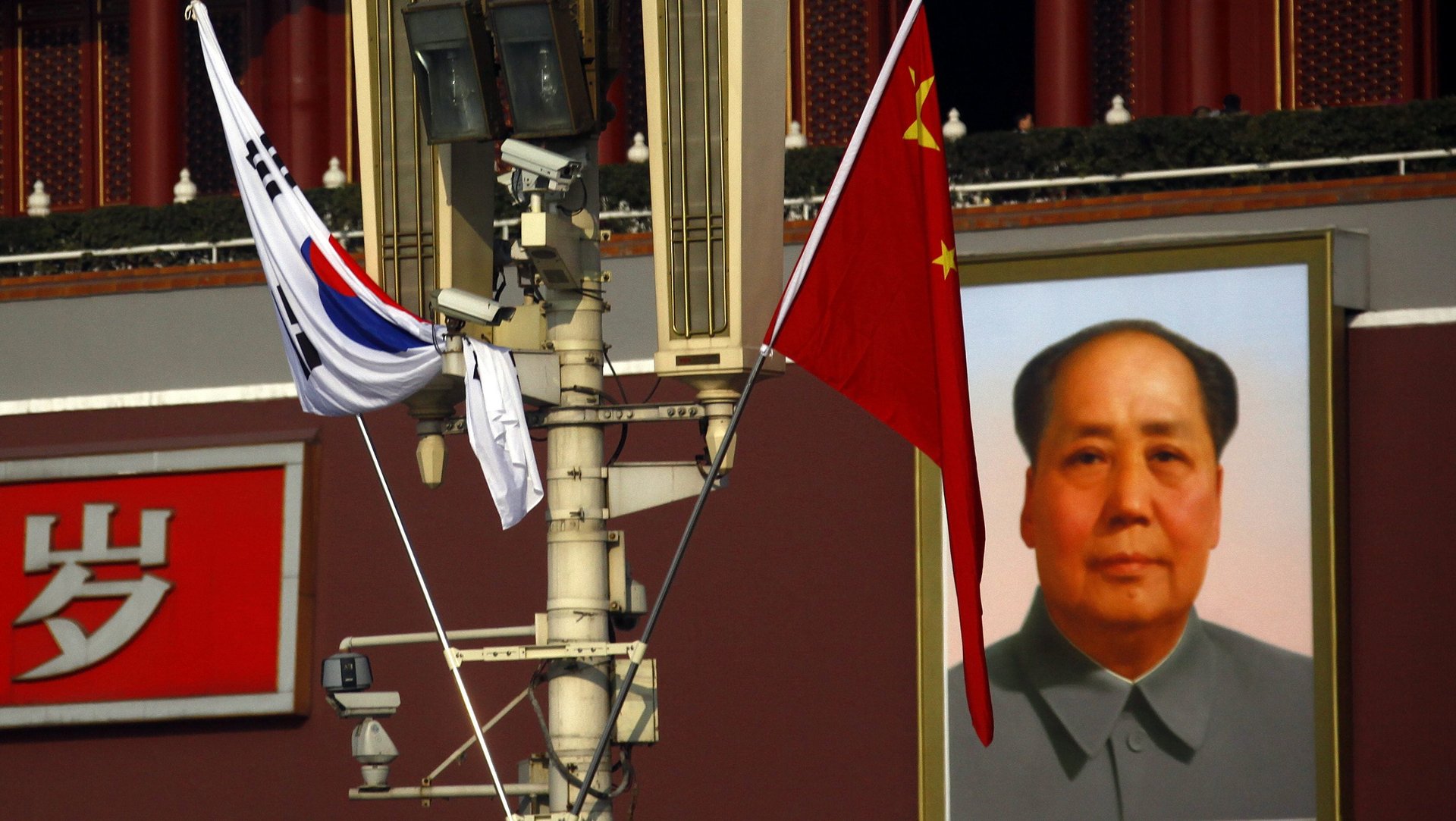
Relations between China and South Korea have been icy of late, to say the least.
Problems began last July, when Korea agreed to let the US deploy an antimissile defense system within its borders. The planned Terminal High Altitude Area Defense (THAAD) shield will counter the growing military threat from North Korea. But China fears it could also be used against its own systems, and argues it will destabilize regional security. Since Beijing can’t force Seoul to renege on its agreement with the US, it’s gone the passive-aggressive route to hurt Korea in other ways.
One of the earliest sectors to take a hit was entertainment. China, among the biggest overseas markets for K-pop, kept Korean stars out of the country by turning down applications to perform. It unofficially banned screenings of movies with Korean stars. It also targeted Korea’s tourism, car, and cosmetics industries. There were over 40 such cases of retaliation from last August to early February, according to Korean news agency Yonhap.
Some other ways China has increased the pressure lately:
China maintains that none of its actions is a response to THAAD.
“If China officially takes unfair action against South Korea we would openly move against it, but as long as China says its moves are not related to THAAD and rather, local measures at home, the South Korean government cannot accuse China of retaliating,” Korean finance minister Yoo Il-ho told legislators earlier this month.
“There’s nothing much South Korea can do other than take the hit,” said David Zweig, a professor at the Hong Kong University of Science and Technology. “If you are deeply engaged with China and then do things that China doesn’t like, China will use its trade advantage [as] leverage against you.”
