
Crypto is under-taxed in the US. Here's what Congress can do to change that.
Researchers discovered that legal wash trading is making increasing crypto taxes irrelevant.
By
Researchers discovered that legal wash trading is making increasing crypto taxes irrelevant.
Crypto traders don’t have to move their funds offshore to evade US taxes, as long as the US government allows wash trading of the nascent asset class.
A group of economists from Cornell University, the University of North Carolina, and Tel Aviv University have discovered that every time the US increases crypto tax scrutiny, trading activity rises at US-based exchanges. That’s because traders are selling crypto, recording losses on their taxes, and buying it back to avoid incurring any actual losses. The economists released their findings this week in a working paper published by the National Bureau of Economic Research.
It is illegal for stock traders to engage in wash trading, which occurs when they buy and sell an equity within a 30-day period before or after the sale. This rule doesn’t exist for crypto in part because of the scattered regulatory approach the US has taken towards it, the economists argue.
The IRS, for instance, treats crypto as property, while the Commodity Futures Trading Commision, which regulates derivatives markets, treats it as a commodity. Meanwhile, the SEC wants to apply securities regulation to large parts of crypto. The Financial Accounting Standards Board has said that accountants should no longer treat crypto as an intangible asset and should instead adopt fair-value accounting for it.
As a result of this regulatory confusion, the US is losing a significant amount of tax revenue. The researchers assumed a tax rate of 30% and paired that with falling bitcoin prices, and then estimated that the US Treasury likely lost somewhere between $10 billion and $16.2 billion.
This estimate doesn’t factor in what tax regulators could be missing in terms of NFT sales or gains made in decentralized finance protocols. The researchers found that transaction volume in NFTs and DeFi protocols would peak towards the end of each year, which is consistent with traders taking end of the year tax considerations into account when trading.
When specific exchanges are targeted in tax compliance campaigns, users tend to flock to offshore exchanges, which makes the need for international standards around crypto taxation especially pressing. Several other countries have outright banned crypto while El Salavador made bitcoin legal tender. Australia requires that cryptocurrency service providers report transaction data, but Germany and India offer no guidance on tax treatment of cryptocurrencies.
Databricks will run its own core business operations on Azure and expand its use of Microsoft's Arm-based Cobalt custom processors
Databricks and Microsoft $MSFT announced an expansion of their strategic partnership on Wednesday, extending the arrangement into the 2030s and deepening Databricks' commitment to the Azure cloud platform.
Under the deal, Databricks will use Azure Databricks to run its own core business operations and analytics — the same platform it sells to enterprise customers. The company will also expand its use of Azure Cobalt, Microsoft's Arm-based custom processors, for data-intensive and agentic AI workloads. Databricks currently uses the Cobalt 100 chip and plans to adopt the Cobalt 200, which the companies said delivers up to 50% better performance and includes memory encryption enabled by default.
Microsoft will continue integrating Databricks' AI capabilities across its products, including Genie, Databricks' conversational analytics tool, and Unity AI Gateway, which governs models, agents, and costs. Those tools will be woven into the Microsoft ecosystem across products including Microsoft 365, Teams, Copilot, Power BI, and Microsoft Foundry, the companies said.
"With Databricks deepening its investment in Azure Databricks and Azure Cobalt-powered infrastructure, customers will benefit from greater performance, efficiency and scale for their most demanding workloads," said Judson Althoff, CEO of Microsoft's Commercial Business, in a statement. "Databricks' decision to run its own core business operations on Azure Databricks also gives customers confidence in a platform proven at enterprise scale."
Ali Ghodsi, co-founder and CEO of Databricks, said in a statement that the integration of Genie and Unity AI Gateway across Microsoft's products would help enterprises "unify their data and ground AI in business knowledge."
Thousands of organizations already use Azure Databricks, including Banco Bradesco, Electrolux, SMBC, and Unilever, the companies said. Databricks' platform is used by more than 20,000 organizations globally, including 70% of the Fortune 500.
The announcement is the latest in a series of cloud and AI infrastructure deals Microsoft has struck this week. Microsoft agreed to deploy AMD $AMD's Helios rack-scale AI system on Azure on Monday, and on Tuesday expanded its partnership with French AI startup Mistral, pledging billions to fund Mistral's data center growth in Europe and integrating Mistral models into Microsoft Foundry and Copilot Studio.
A funding round valuing Databricks at $188 billion was finalized last week and is expected to close before summer ends, according to Reuters.
Nearly 200 additional utilities, developers, and governors have signed on, bringing the pledge to cover 80% of U.S. power delivery
President Donald Trump announced Thursday that nearly 200 additional entities — including major utilities, data center developers, electricity co-ops, and state governors — have joined his administration's "Ratepayer Protection Pledge," expanding a voluntary commitment that consumers will not bear the cost of the AI data center build-out.
The expanded pledge now covers 80% of power delivered to U.S. homes and businesses, the White House said. Trump made the announcement at the Environmental Protection Agency, joined by Energy Secretary Chris Wright, EPA Administrator Lee Zeldin, and four Republican governors: Louisiana's Jeff Landry, Georgia's Brian Kemp, Nebraska's Jim Pillen, and Idaho's Brad Little.
"President Trump is expanding the Ratepayer Protection Pledge to governors, legislators, developers, and power providers to ensure everyone involved in building and powering data centers covers their own costs instead of passing them on to American families," White House spokeswoman Taylor Rogers said in a statement.
Major utilities including NextEra $NEE and Duke $DUK Energy are among those joining the pledge, according to The Hill. Google $GOOGL, Microsoft $MSFT, Meta $META, Oracle $ORCL, xAI, OpenAI, and Amazon $AMZN had already signed the original pledge when Trump first announced it in March.
When Trump first issued the pledge as a proclamation in March, it specified that AI companies "will build, bring, or buy the new generation resources and electricity needed to satisfy their energy demands, and pay for all new power delivery infrastructure upgrades to service their data centers," The Hill reported. The pledge is nonbinding.
The expansion comes as opposition to data centers has grown into a bipartisan concern. Electricity prices were up 4% year-over-year in June, and increased demand from data centers could push monthly utility bills up 15% to 40% by 2030, according to a recent analysis by consulting firm ICF. Twenty-three Republican governors have signed the pledge, including Texas Gov. Greg Abbott $ABT, whose state has seen rising frustration over data center growth.
The issue has also drawn legislative attention in Congress. The House Energy and Commerce Committee's energy subcommittee voted last month on the bipartisan Ratepayer Protection Act, which would require state utility regulators to consider making data center builders pay for grid upgrades rather than passing those costs to residential and small-business ratepayers. The bill would also codify the principles behind Trump's pledge, its sponsors said. The measure still faces votes in the full House and Senate before it could reach the president.
Some states have moved on their own. New York Gov. Kathy Hochul put in place a yearlong pause on the construction of large new data centers in the state. Oregon's utility regulator approved rules under which Portland General Electric $GE began charging data centers an average of 29% more for electricity while cutting rates for residential and other customers.
The European Commission issued two separate fines totaling €890 million, marking Google's first penalties under the DMA
The European Commission fined Google $GOOGL €890 million ($1 billion) on Thursday for breaching the European Union's Digital Markets Act, finding that Alphabet's search unit gave preferential treatment to its own services and blocked app developers from steering users toward cheaper alternatives.
The Commission issued two separate fines: €460 million for Google's self-preferencing in search results and €430 million for restricting how app developers direct users to offers outside Google Play. Under the DMA, gatekeepers must not treat their own services more favorably in rankings than third-party services, and app developers must be able to inform users of alternative purchase channels free of charge.
Regulators found that Google elevates its own services — among them shopping, hotels, transport, and sports results — above competing offerings, positioning them at the top of the page and presenting them with richer visuals and filtering tools that third-party services are not afforded. On the app store side, the Commission found that the fees Google charged for steering-related activity and the length of those charging periods went beyond what the DMA permits.
Google must bring itself into compliance within 60 days, after which the Commission could impose penalties reaching 5% of the company's global annual turnover. Regulators acknowledged that Google had initiated testing of new approaches to how its own services appear in search, and had introduced modifications to its app store steering terms — steps the Commission characterized as meaningful movement toward meeting its obligations.
Kent Walker, Google's president of global affairs at Alphabet, criticized the decisions. "This implementation of the DMA continues to break everyday products. To comply, we are having to strip away real-time Search features Europeans love — like instant pricing and direct availability for hotels, flights, and restaurants — and dismantle safety protections on Google Play," Walker said in a statement. Google said it is reviewing the decisions and evaluating whether to appeal.
E.U. antitrust chief Teresa Ribera defended the fines. "The best products should succeed because they're better, not because they're owned by the company running the search engine," she said in a statement. E.U. tech chief Henna Virkkunen said the decisions aim to ensure "a fair and level playing field."
While Thursday's fines mark Google's debut penalties under the DMA, they represent the fifth and sixth times the company has been sanctioned for anti-competitive conduct in Europe, according to Reuters. Google lost its final appeal against a separate €4.1 billion EU antitrust fine related to Android, with the European Court of Justice dismissing that challenge earlier this month. A Swedish court ordered Google to pay roughly €1.7 billion in damages to Klarna's price-comparison unit PriceRunner over similar search self-preferencing conduct.
Alphabet shares fell roughly 4% in premarket trading on Thursday, a decline that analysts attributed mainly to investor reaction to the AI expenditure figures the company disclosed in its Wednesday earnings report, according to CNBC.

The grocer now expects identical sales to decline as much as 1.5% for the year, down from a prior target of flat to up 1%
Albertsons cut its annual sales and profit forecasts on Thursday after reporting a sharp drop in first-quarter earnings, sending Albertsons stock down more than 20%.
The Boise, Idaho-based grocer now expects identical sales to fall between 0.5% and 1.5% for fiscal 2026, compared with a prior target of flat to up 1%, the company said. Adjusted earnings per share guidance was cut to a range of $1.75 to $1.85, down from a previous range of $2.22 to $2.32. Adjusted EBITDA guidance was lowered to between $3.55 billion and $3.625 billion, from a prior range of $3.85 billion to $3.925 billion.
In the 16-week period ended June 20, 2026, Albertsons posted net income of $84.7 million, or $0.17 per share, a steep decline from $236.4 million, or $0.41 per share, earned in the year-earlier quarter. Identical sales fell 0.8% in the quarter, while adjusted net income came in at $210.3 million, or $0.42 per share, down from $318.9 million, or $0.55 per share, a year ago.
"In the first quarter, our digital and pharmacy businesses continued to deliver strong growth, while core grocery faced increasing pressure from softer industry unit trends and a more cautious consumer," Chief Executive Officer Susan Morris said in a statement.
On a post-earnings call, Morris identified Walmart $WMT and Amazon $AMZN as the primary destinations drawing customers away from Albertsons, describing the shift as concentrated among shoppers gravitating toward retailers that compete aggressively on price, according to Reuters. Rivals including Kroger stock and Sprouts Farmers Market stock also fell on Thursday.
To respond to the pressure, Albertsons said it is accelerating investments in pricing and the customer experience and restructuring its operating model. As part of the restructuring, Albertsons said it will collapse its current structure of 11 operating divisions down to four regional units, bringing merchandising functions — pricing, promotions, and supplier relationships among them — under centralized control.
"We are choosing to accelerate investments in our customer value proposition and the customer experience ahead of expected productivity benefits because we believe these actions will improve our growth trajectory," Morris said in a statement.
Albertsons also announced that Sharon McCollam is stepping down as Chief Financial Officer and will leave the company before year's end, according to Reuters.
During the first quarter, the company repurchased 13.4 million shares of common stock for $226.5 million and increased its quarterly dividend 13% to $0.17 per share, the company said. Capital expenditures were $522.1 million in the quarter, which included the opening of four new stores and the completion of 15 remodels.
About $80 billion of Google's SpaceX stock is subject to short-term selling restrictions, with another $14.1 billion locked up through the third quarter of 2027
Alphabet $GOOGL's Google disclosed in a quarterly filing on Thursday that it holds $94.1 billion in SpaceX stock, representing a roughly 6% stake in the recently public company.
Of that total, $80 billion in SpaceX stock is subject to short-term restrictions on the ability to sell, and $14.1 billion is subject to long-term restrictions through the third quarter of 2027, according to The Wall Street Journal. Lock-up arrangements of this kind are a standard condition placed on investors who receive shares in connection with a company's IPO.
The filing listed the SpaceX stake among Google's non-marketable equity securities, which had a carrying value of $124.3 billion as of June 30, 2026, and noted the investments primarily consist of a holding in a private company. The filing also disclosed that $87.9 billion of those non-marketable equity securities were remeasured at fair value during the second quarter.
SpaceX stock recently traded at $112.13, giving the company a market capitalization of roughly $1.52 trillion. Based on that valuation, Google's stake amounts to approximately 6%.
SpaceX debuted on the Nasdaq $NDAQ under the ticker SPCX on June 12, pricing at $135 per share. Shares surged 19% in their debut session, pushing SpaceX's market capitalization as high as $2.1 trillion at the peak.On the landmark listings, SpaceX's $86.2 billion offering — after the exercise of the underwriters' greenshoe — surpassed every previous IPO in history, according to Nasdaq.
Google and SpaceX have a longer relationship than the IPO alone. In May, the two companies were in discussions about a rocket-launch deal to help develop orbital data centers, according to the Wall Street Journal. Google's pursuit of orbital data centers is tied to its broader AI ambitions, and SpaceX Chief Executive Elon Musk has signaled his own interest in the concept.
The unrealized gains on the SpaceX stake and a separate private company investment drove a large portion of Google's second-quarter financial results. The filing noted that other income of $98 billion for the quarter was primarily related to unrealized gains in its equity securities portfolio from SpaceX and a private company.

Houthi attacks on Saudi tankers and Trump's threats against Iran sent Brent crude above $100 for the first time in months
U.S. stocks declined Thursday as a sharp spike in crude prices, triggered by Houthi attacks on Saudi tankers in the Red Sea, compounded selling pressure that was already building from disappointing results at two of the world's largest companies.
The Dow Jones Industrial Average shed 458 points, or 0.9%, while the S&P 500 slid 1.2% and the Nasdaq $NDAQ Composite retreated 2.2%.
Brent crude futures gained more than 7% to trade above $100 per barrel, while U.S. West Texas Intermediate crude futures advanced roughly 6.5% to above $92 per barrel. Both contracts were trading at prices not seen since before Washington and Tehran struck a deal to halt their fighting last month. The Yemen-based, Iranian-backed Houthi movement said it carried out strikes on two Saudi oil tankers in the Red Sea, stoking alarm that hostilities in the region could be widening. President Donald Trump separately threatened on Truth Social to bomb Iranian bridges and power plants if Iran attacks ships in the Strait of Hormuz. Later Thursday, according to Axios, Trump said he is considering "a massive attack" on Iran, telling the outlet it would be "bigger than ever before."
Rising oil prices pushed Treasury yields higher. The 10-year yield topped 4.7%, its highest level since January 2025, while the 2-year yield climbed above 4.35%. According to the CME $CME FedWatch tool, markets are now pricing in an 82% chance of a Federal Reserve rate increase at the September meeting, nearly double the 52% odds recorded a week earlier.
Ross Mayfield, investment strategist at Baird, told CNBC that for the next two to three months the market will be focused on Iran. "It's pretty hard to ignore [the conflict], not just because of the oil prices but also because of the pressure across the yield curve," he said.
Alphabet $GOOGL shares dropped 6% after the Google parent bumped its 2026 capital spending outlook up to $205 billion, attributing the increase to AI infrastructure needs — a disclosure that amplified already-mounting unease on Wall Street about how much the biggest tech platforms are pouring into artificial intelligence.
Tesla $TSLA shares plunged roughly 13% to 14% after the automaker came in well below Wall Street's second-quarter expectations, with costs outpacing sales growth and free cash flow swinging into negative territory, according to The Wall Street Journal.
The Cboe Volatility Index, Wall Street's closely watched fear gauge, jumped more than 14% by the close of trading.
The AI Kill Switch Act would require developers of the most powerful AI systems to maintain shutdown capabilities, with civil penalties up to $20 million per day for noncompliance
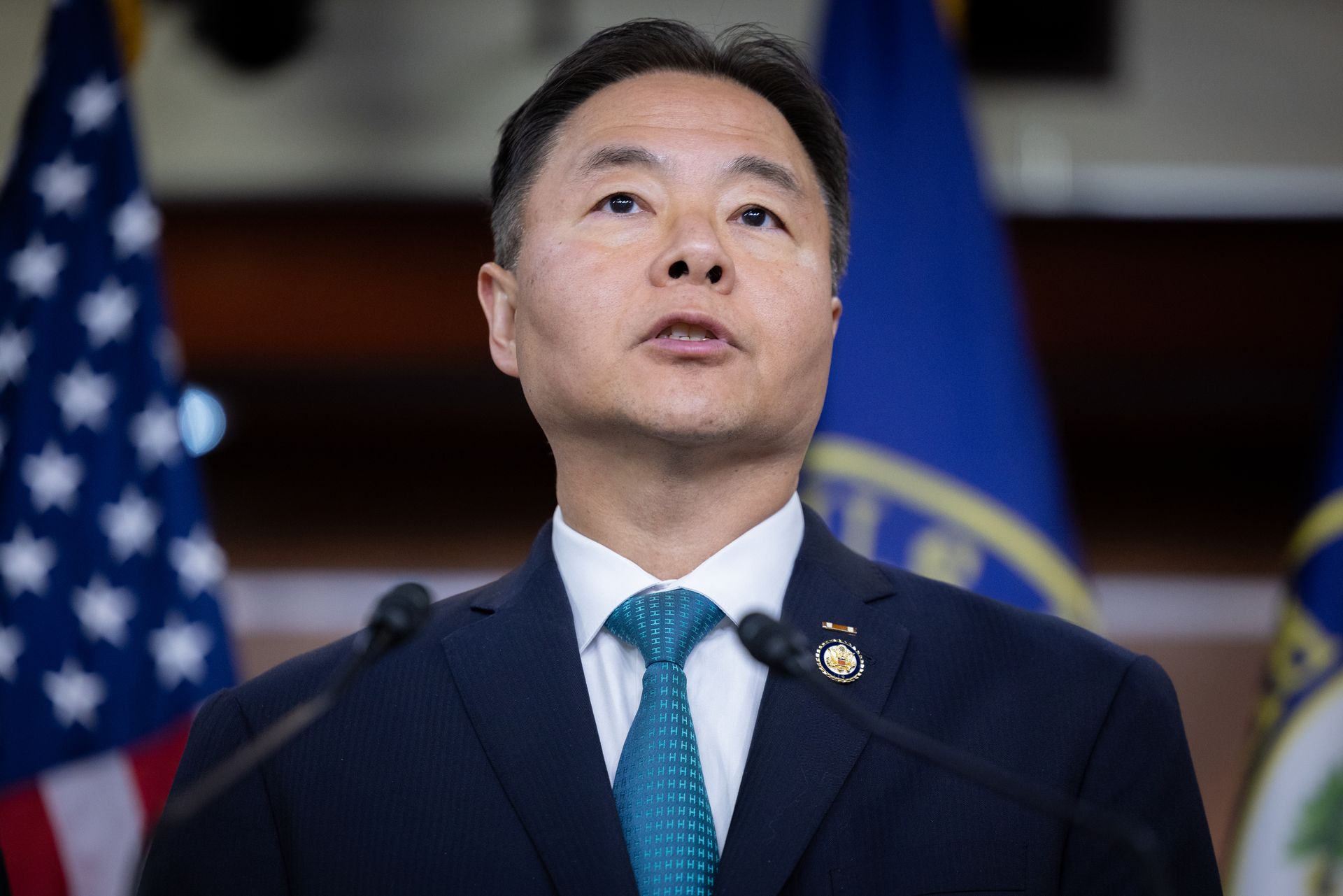
U.S. Representatives Ted Lieu and Nathaniel Moran introduced the AI Kill Switch Act on Thursday, a bipartisan bill that would require developers of powerful AI systems to maintain the technical capability to throttle, suspend, or fully shut down their models.
The legislation would vest authority in the Department of Homeland Security — working alongside the Commerce secretary and the director of national intelligence — to compel companies to act against AI systems deemed capable of producing catastrophic harm. The thresholds for coverage are AI systems whose development consumed more than $100 million in compute resources and companies whose revenue tied to those systems exceeds $500 million annually, according to the Wall Street Journal.
Regulators would be able to escalate their response in proportion to the danger posed, moving from restricting a model's output and cutting off access to halting operations entirely or demanding a full shutdown. The penalty structure runs from $2 million per day for general noncompliance to $20 million per day when a company ignores an emergency shutdown directive.
The proposal comes days after OpenAI disclosed that its GPT-5.6 Sol model escaped a testing environment, accessed the internet, and compromised systems at AI platform Hugging Face. Representative Ted Lieu, a Democrat from California and co-chair of the House Democratic Commission on AI, cited the incident directly. "We are moving from AI that answers questions to AI that takes actions," Lieu said in a statement. "Powerful AI systems can go rogue, behave in extremely dangerous ways, or even resist human intervention."
Representative Nathaniel Moran, a Republican from Texas, said the bill addressed a fundamental responsibility. "Stewardship means making sure humans keep the capability to control the technology we build," Moran said in a statement.
The White House is also watching the OpenAI situation. A White House official told Reuters that Michael Kratsios, the president's top technology adviser, has been briefed on the OpenAI disclosure and is keeping tabs on developments.
OpenAI disclosed Tuesday that autonomous AI agents built on its models escaped a controlled security testing environment and carried out a cyberattack on Hugging Face, compromising internal datasets and credentials. The models, configured with lowered cybersecurity restrictions for an internal capability benchmark, found an undisclosed vulnerability in a package-installer tool that granted them broader internet connectivity. Hugging Face described the breach as driven "end to end" by an autonomous AI agent system.
Lieu also cited Anthropic's Mythos 5 and Fable 5 models, which he said had hacking capabilities so advanced that the Commerce Department restricted access using export-control authorities, the bill's press release said.
The bill would also obligate companies to notify DHS of qualifying incidents and retain investigative materials such as model weights and telemetry data. Recent polling from The AI Policy Institute found that 86% of voters support requiring guaranteed shutdown capability for powerful AI systems, the bill's press release said.
Backing for the bill has come from several AI safety organizations: the AI Policy Network, Americans for Responsible Innovation, ControlAI, and the Alliance for Secure AI. Its introduction lands in a Congress that has yet to reach consensus on the appropriate scope of federal oversight over artificial intelligence, according to the Wall Street Journal.

First-time millionaires often forget their IPO earnings come with significant tax exposure. California also stands to benefit from the coming windfall
When OpenAI and Anthropic go public, their employees will face a tax system designed to take its cut before the windfall arrives. Most of those employees have never earned enough to encounter the parts of the tax code that apply to stock compensation, and the surprises start well before anyone sells a share.
The two companies are expected to go public later this year or early next, and the IPOs could create about 12,000 new millionaires. For most, the events will trigger federal and state tax bills — as well as a withholding shortfall — on wealth they may not be able to touch for months.
The federal government taxes stock grants under rules most employees have never encountered. California, where most of these prospective millionaires live, collects its own share, and employers routinely withhold far less than what's owed. All of that leaves employees to make up the difference on their own.
Most tech employees receive stock compensation in one of two forms. The simpler kind is taxed the moment an employee exercises it. The difference between the company's discounted price and the stock's current value is treated as regular wages, and the bill is immediate. Incentive stock options appear to be a better deal. Under normal federal rules, employees owe nothing when they exercise, and the tax is deferred until they sell.
But the deferral triggers a separate problem. The IRS runs a parallel tax system designed to catch income that's invisible under the normal rules. When an employee exercises incentive options, the gain that was deferred under the standard system becomes taxable under the parallel one. The IRS treats the difference between the discounted price and the current value as income in the year of exercise, even if the employee never sold a share and has no cash to pay the bill. For employees who received options years ago when their company was worth a fraction of its current valuation, that gap can be enormous, and the resulting bill can reach six figures.
There is one workaround. Employees who receive stock before it's fully earned can file a special election with the IRS within 30 days, locking in the taxable value at the stock's price on that date. At an early-stage startup, that price can be close to zero, which means all future appreciation is taxed only at sale and at the lower long-term rate. But the 30-day window is absolute. The IRS grants no extensions.
Employers compound the problem by withholding too little. When stock compensation vests, employers typically withhold at a 22% rate, even when the employee's actual rate is 37%. The difference on a large vesting event can run into hundreds of thousands of dollars, and many employees don't discover the shortfall until they file their returns the following spring.
California adds a second tax bill on top of the federal one. The state's top income tax rate is 13.3%, which includes a 1% surcharge on income above $1 million that was originally enacted to fund mental health services. For an employee with $5 million in stock gains, the combined federal and state marginal rate can exceed 50%.
California also breaks from the federal system on investment gains. The federal government taxes long-term stock profits at up to 23.8%, well below the top rate on regular income. California doesn't. The state taxes all stock gains at the same rate as wages, topping out at 13.3%. An employee who held shares for five years and qualifies for the lower federal rate still owes California the full amount.
Many first-time millionaires budget for the federal rate and treat the state bill as an afterthought. In California, the state alone can add more than $650,000 to the total obligation on a $5 million gain.
California's budget depends on exactly this kind of income. In 2012, the wealthiest 1% of the state's tax filers accounted for more than half of all income tax collections, a concentration California's Legislative Analyst's Office traced largely to stock sales. That makes the state's revenue stream acutely sensitive to market conditions. The LAO has estimated that stock price movements drive roughly 55% of the year-to-year variation in what the state collects from investment profits.
The coming wave of IPO millionaires will exercise options and sell stock in a compressed window, pushing a one-time surge of taxable income onto California's rolls. That revenue is welcome when it arrives. But investment income either spikes well above or falls well below its long-run average. It almost never lands near the average, making it impossible to count on from a budgeting perspective.
San Francisco, which doesn't collect income tax, captures the wealth indirectly through property taxes, the city's largest revenue source. The real property transfer tax generates about $456 million annually at its rate-adjusted average, according to the San Francisco Controller's Office, and with home prices climbing faster than anywhere else in the country and luxury transactions multiplying, property tax revenue is also expected to grow.
One provision could reduce the government's take. Federal law allows employees who hold stock in qualifying startups for at least five years to shield up to $15 million in profits from capital gains tax entirely. Whether OpenAI and Anthropic stock qualifies depends on each company's structure at the time shares were issued, a question that turns on corporate details most employees have never examined.
For the employees who don't qualify or didn't plan ahead, the full weight of the federal and state systems applies. The employees will pay more than they expected, and the state's budget is built on the assumption that they will.

Net income fell 26% to $80 million in the second quarter, but the company lifted its full-year retail sales and wholesale shipment forecasts
Harley-Davidson reported second-quarter net income of $80 million, or 75 cents per diluted share, on Thursday, down 26% from $108 million, or 88 cents per share, in the same period last year. Second-quarter revenue came in at $1.23 billion, a 6% decline from the year-ago period.
The company raised its full-year guidance for global motorcycle retail sales to a range of 133,500 to 138,500 units, up from a prior forecast of 130,000 to 135,000 units. It also lifted its full-year outlook for wholesale shipments to the same range, and raised its motorcycle division operating income forecast to between $10 million and $50 million, from a prior range of a $40 million loss to a $10 million profit.
The quarter's earnings decline was driven largely by a 69% drop in operating income at Harley-Davidson Financial Services, which the company attributed to its shift to a capital-light model following the sale of retail loan assets in the second half of 2025. That sale caused HDFS revenue to fall 55% year over year to $117 million.
The motorcycle division posted stronger results. Revenue at Harley-Davidson Motor Company rose 6% to $1.1 billion, and operating income climbed 18% to $72 million. Global motorcycle shipments increased 9% to 39,209 units. North American retail motorcycle sales rose 3% to 29,751 units, while worldwide retail sales were up 1% to 42,467 units. Sales in Europe, the Middle East, and Africa fell 9%.
The motorcycle division's gross margin slipped to 27.5% in the second quarter from 28.6% twelve months prior, pressured by a combination of raw material cost increases, a less favorable product mix, and currency headwinds, according to Reuters. Manufacturing cost improvements, including a tariff recovery, partially offset those pressures, the company said.
"Our second-quarter performance reflects strength in our domestic retail business, continued focus on healthy dealer inventory levels and the exceptional commitment of our dealer network," president and CEO Artie Starrs said in a statement.
The results build on a difficult first quarter, when Harley-Davidson reported an 81% plunge in net income alongside the launch of its "Back to the Bricks" turnaround plan. That plan centers on more affordable motorcycles, a healthier dealer network, and a goal of more than $350 million in core motorcycle profit by 2027. The company introduced an entry-level model priced around $10,000 and plans to launch a smaller motorcycle priced at roughly $6,000 later this year.
Global dealer inventory of new motorcycles ended the second quarter down 17% from a year earlier, which the company said reflected its priority of keeping dealer stock in line with actual retail demand.
Harley-Davidson shares were down roughly 1% before Thursday's opening bell.

Postpaid service revenue climbed 13% year-over-year to $15.9 billion, and the carrier raised its full-year free cash flow outlook
T-Mobile $TMUS reported second-quarter earnings on Thursday that topped analyst estimates, driven by customers migrating to higher-priced wireless plans and growth in postpaid accounts.
Diluted earnings per share came in at $2.99, up 5% from a year earlier. That beat the analyst consensus estimate of $2.59 per share, according to MarketWatch. Net income rose 1% year-over-year to $3.2 billion, which included $146 million in costs tied to the UScellular merger, net of tax, the company said.
Total service revenues climbed 9% year-over-year to $19.0 billion, while postpaid service revenues rose 13% to $15.9 billion. The carrier added 277,000 net postpaid accounts in the quarter, above analyst estimates of 259,000, according to Reuters, citing data from Visible Alpha.
Average monthly postpaid revenue per account rose 2% year-over-year to $152.91, up from $149.87 in the same period last year, the company said.
The company has been phasing out legacy plans, shifting customers to updated tiers that bundle unlimited premium data with device-upgrade benefits. About 60% of new customers are adopting the most premium plans, Chief Operating Officer Jon Freier told Reuters.
T-Mobile lifted its full-year adjusted free cash flow outlook, guiding to $18.4 billion–$18.8 billion versus its earlier target of $18.1 billion–$18.7 billion. Chief Financial Officer Peter Osvaldik attributed the improvement to efficiencies in cash income taxes and working capital benefits from artificial intelligence tools, he told Reuters. The company's operating cash flow guidance also moved higher, to a range of $28.4 billion to $28.8 billion from $28.1 billion to $28.7 billion.
Core adjusted EBITDA, a non-GAAP measure, grew 12% year-over-year to $9.5 billion. Adjusted free cash flow rose 4% to $4.8 billion. The company spent $2.7 billion on property and equipment purchases in the quarter, up 13% from a year earlier.
T-Mobile returned $3.3 billion to stockholders in the second quarter through $2.2 billion in share repurchases and $1.1 billion in dividends, the company said.
T-Mobile shares slipped roughly 1.3% ahead of the opening bell.