
When Starbucks $SBUX' then-CEO Laxman Narasimhan told investors in April 2024 that a "mid-teens percent" of mobile orders went uncompleted the previous quarter, he framed it as a customer experience problem. It was also a labor problem.
The chain's mobile and delivery channels created parallel production demands without matching staffing, fueling worker frustration
Jeffrey Greenberg / Universal Images Group via Getty Images
When Starbucks $SBUX' then-CEO Laxman Narasimhan told investors in April 2024 that a "mid-teens percent" of mobile orders went uncompleted the previous quarter, he framed it as a customer experience problem. It was also a labor problem.
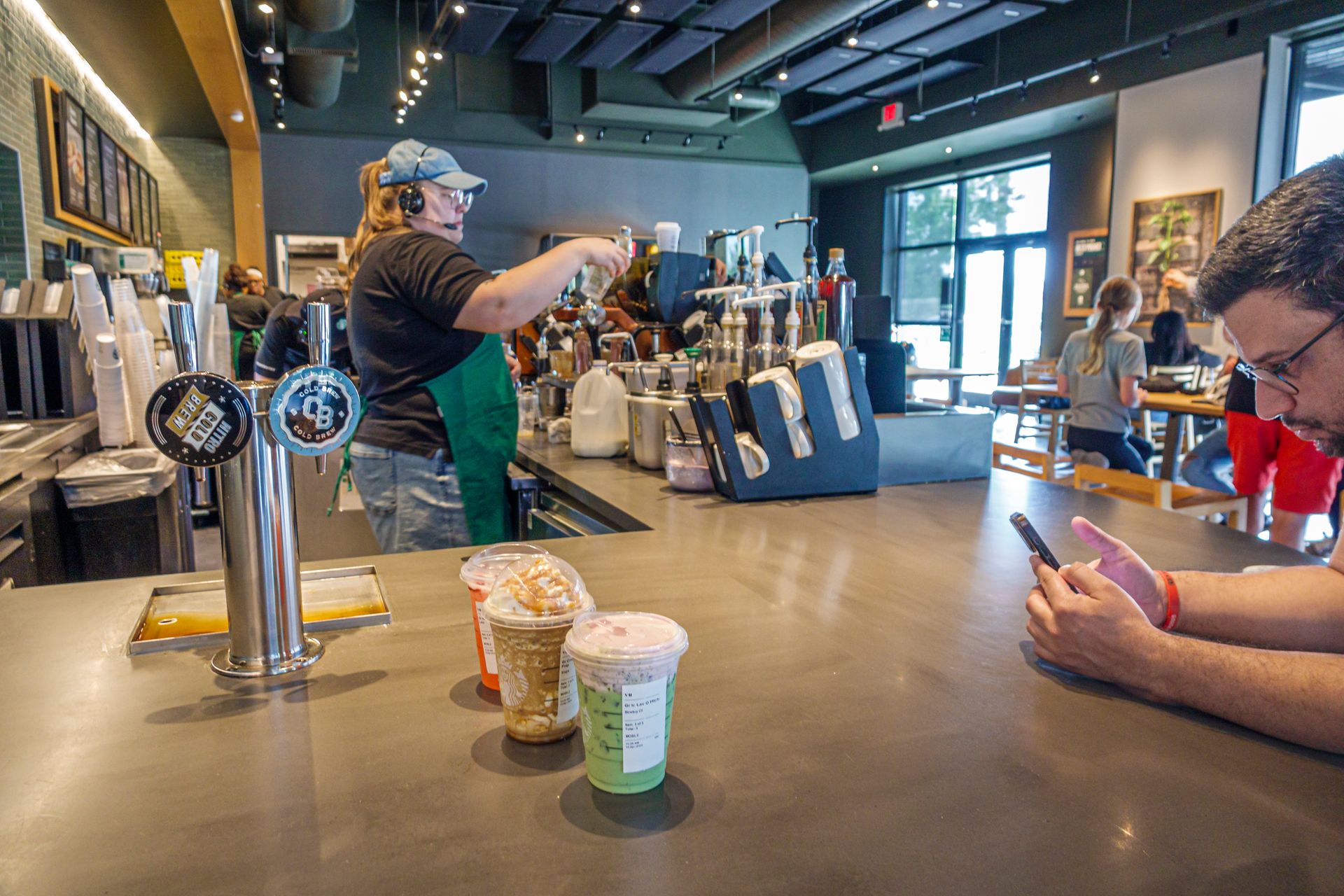
Mobile orders, in-store customers, drive-thru lines, and third-party delivery requests from DoorDash, Uber $UBER Eats, and Grubhub all feed into the same store, made by the same workers, often on the same machines. More than three in 10 Starbucks orders come through the mobile app, and the popularity of those orders had inadvertently harmed customers' experience as baristas struggled to fill the volume, according to CX Dive.
The tension reflects the broader conflict between Starbucks and its unionized baristas over understaffing, wages, and working conditions. "What would actually make it easier to connect with customers is having more workers on the floor," barista Silvia Baldwin recently told Quartz.
Starbucks told Quartz that it has "increased staffing meaningfully, including filling more than 500,000 additional shifts year-over-year."
"During Q2, we focused on continued improvements to staffing, scheduling, technology and leadership to make Green Apron Service work more reliably everyday," the company said. "As a result, customer experience scores continued to rise. Customer service times remained on target, even with greater transaction volumes. We have also taken steps to simplify operations and improve execution consistency across coffeehouses."
A Starbucks store in 2010 had one order channel: The customer standing at the counter. Today, a store can receive orders from in-store registers, the drive-thru window, the Starbucks mobile app, and at least two third-party delivery platforms. Starbucks has offered delivery through Uber Eats since 2018, and integrated DoorDash-powered delivery directly into the Starbucks app in November 2024.
Each channel arrives at the same espresso bar, competing for the same barista's attention. Both walk-in and mobile orders contribute to work in progress, while throughput, or the number of baristas and their capacity, remains relatively constant. As mobile orders increase, total work-in-progress grows, and without a corresponding increase in throughput, longer lead times follow, particularly for walk-in customers.
The dynamic creates a version of what operations analysts call a hidden queue. CEO Brian Niccol acknowledged the dysfunction on a January 2025 earnings call, saying mobile orders "come flooding in faster than even our customer can get there," leaving drinks "sitting on the counter" at the expense of the in-store experience.
Union members have pushed for the right to control that flow. Among Starbucks Workers United's bargaining proposals is the ability to shut down mobile ordering when there are just five orders in the queue. The company has dismissed such proposals as unserious. But baristas describe the issue in visceral terms. "We have to ask permission to turn mobile ordering off when we're drowning, when we have a wait time of 40 minutes on our line," one worker told Restaurant Dive.
Rather than add staff proportional to the increase in ordering channels, Starbucks spent years investing in equipment. The company started rolling out the Siren System, special equipment designed to speed up drink making, in 2022. Leaders have since pinpointed processes, not capacity, as the main culprit for slowdowns, according to CX Dive.
Under Niccol, the approach has shifted. The emphasis on staffing is a reversal from Starbucks' strategy from the past couple years, when the company was aiming to offset the loss of people with equipment. The company is now piloting an order-sequencing algorithm that prioritizes in-store and drive-thru customers, targeting a four-minute wait for those channels and 12 minutes for mobile and delivery. More than 80% of company-owned cafes have hit the four-minute average since the algorithm launched, Niccol said on a Q4 2025 earnings call.
Starbucks has also added labor hours. The company filled 500,000 more shifts in the second quarter of 2025 than the same period a year ago, according to Niccol. And it simplified the menu, reducing items by roughly 30% by the end of fiscal year 2025.
Other chains have taken a different structural approach. Chipotle $CMG, where Niccol was CEO before joining Starbucks, addressed the problem by physically separating the workflows. Digital and catering orders are made on a second assembly line in the back of the restaurant so they do not interrupt service for in-person customers, according to Fortune. Chipotle invested in staffing by ensuring each restaurant has a takeout specialist dedicated to outside orders, with additional staff assigned to that second line during peak periods, Fortune reported.
Chipotle also developed a proprietary logistics package called Smarter Pickup Times, which provides information on incoming orders and restaurant busyness at given times, according to a Fortune report. The system can throttle digital orders when a location is overwhelmed.
Dutch Bros took another path. The drive-thru coffee chain chose to keep human servers central to the ordering experience rather than push mobile order-ahead. "Every Dutch Bros. experience starts with an in-person human connection," then-CEO Joth Ricci said in 2021, according to PYMNTS. The company launched mobile ordering only in late 2024. After going systemwide in Q4 2024, mobile accounted for 8% of transactions, rising to 11% in Q1 2025, according to QSR Magazine. That is a fraction of Starbucks' 30% mobile share, giving Dutch Bros time to adapt operationally before the channel dominates.
The operational puzzle — how to manage three or four simultaneous order channels through a single production area — is real. But the solutions carry labor implications that extend past algorithm design.
When Starbucks prioritizes in-store orders, mobile customers wait longer. When mobile volume floods in unchecked, walk-in customers and the baristas serving them bear the cost. The company's algorithm may balance these demands more efficiently, but the tension cannot be resolved by sequencing alone. It requires enough workers on the floor to serve the parallel queues that digital ordering created.
While Starbucks is spending more on labor, executives have not discussed wages, a topic the union has been pressing. The median Starbucks worker earns less than the federal poverty line for an individual, and the union is pushing for a $20 minimum wage for baristas, according to Restaurant Dive.
More shifts filled and faster algorithms are operational improvements. They do not address whether the people running those parallel restaurants are compensated in proportion to what is being asked of them.
Join 500,000+ readers who start their day with Quartz.
By subscribing, you agree to our Terms of Service and Privacy Policy.