

Lifestyle
Burning Man attendees are spending more money than ever. These charts show whyIt’s costing more and more to escape capitalism.
Updated July 20, 20222 min read
It’s costing more and more to escape capitalism.

Today (Aug. 22), former Chinese leader Deng Xiaoping, who died in 1997, would have turned 114 years old. Known as the chief architect of China’s reform and opening up policy, Deng was without a doubt one of the most influential figures of the 20th century.

Netflix doesn’t do average.

The Hajj is a huge feat of logistics. In 2018, an estimated 1.5 million people will take part in the annual Islamic pilgrimage to holy sites in and around Mecca, Saudi Arabia. About 1.3 million of them will come from abroad, according to Arab News. For many, it will be a once in a lifetime experience.

This article part of the series called Discrete Choice, in which we ask economists about the most important research they have read recently.

It might be time for data scientists to learn a new programming language. Particularly if they have a need for speed.

Betty Soskin, a 96-year-old National Park Ranger, says we often get history wrong. She has seen the books written about her time, and knows what gets overlooked. ”I don’t think it’s by design or by grand conspiracy,” she says. “It’s just about who tells the stories.”

Mohamed Salah’s 2017-18 season for Liverpool was a revelation. The Egyptian striker scored 32 goals in just 36 Premier League appearances, establishing himself as one of the best players in the world.

The release of the new movie Crazy Rich Asians this weekend, featuring an all-Asian cast, is an important milestone for people who care about diversity in pop culture. As a recent Vanity Fair headline declares, it could be a “watershed moment for Asian representation in Hollywood.”

Cities drive economic growth. They foster innovation, connect industries, and serve as key nodes in the global economy. Lately, this is particularly true for cities of China.

The financial crisis of 2008 devastated many US households, but in many ways the country seems to have recovered. Median household income is higher than before the crash, the unemployment rate is lower, and recently the job market has been particularly good for low-income workers (paywall).

This article part of the series called Discrete Choice, in which we ask economists about the most important research they have read recently.

In terms of job creation, if nothing else, Donald Trump seems quite similar to his predecessor.

The US has a housing affordability problem. Of the nearly 43 million households that rent their homes, almost two fifths spend over 30% of their income on housing, and about 17% pay more than half (pdf). Rental costs are rising faster than household incomes, and taking up an increasing part of people’s paychecks. Low-income households in the largest Americans cities are facing the toughest crunch—52% of the average janitor’s income goes to housing in New York, versus only 21% of a lawyer’s pay.
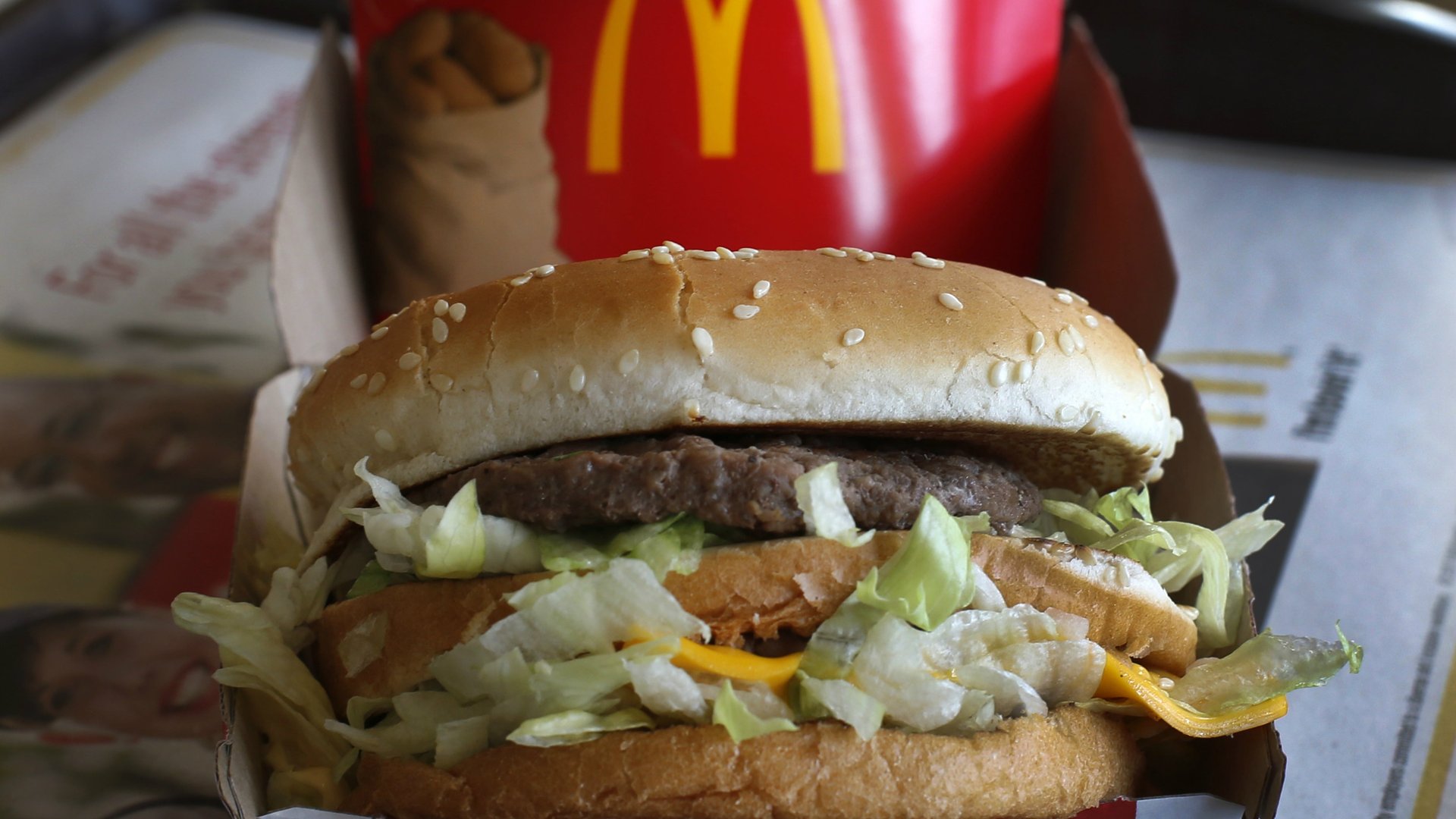
It is the big 5-0 for the Big Mac, and McDonald’s is doing something special to celebrate the bestselling burger. Since this is 2018, what better way to mark the occasion than by launching a gimmicky pseudo-cryptocurrency?

Ask Americans how much time they spend slacking off at work, and they’re likely to . . . hedge. Other people may waste hours on the clock sleeping, watching YouTube videos, or shopping online, sure, but few people are willing to admit to doing it themselves.

We experience the world as a symphony of stimuli collected by the senses, though the influence of those various inputs changes over time.

The decline of poverty in China is perhaps the greatest economic story of the past half-century. From 1981 to 2013, the share of Chinese people in extreme poverty, according to the World Bank’s definition, fell from 88% to 2%. This is an astonishing improvement.

This article part of the series called Discrete Choice, in which we ask economists about the most important research they have read recently.

The US economy grew by 4.1% in the second quarter, according to the Commerce Department. The data published today suggest a strong economy that, at least in the short-term, has been buoyed by federal tax cuts passed late last year.

Scott Winship started his career as a moderate Democrat, believing in progressive solutions to the US’s economic issues. After college, he worked at the liberal community organizing-group ACORN on a campaign to increase the minimum wage.

From 1916 to 1970, about 6 million African-Americans moved from the South to the Northeast, Midwest, and West. While more than 90% of African-Americans lived in the South in in 1910, this was true of only 53% in 1970. Referred to as the Great Migration, it is the largest internal movement of any group in American history.

Americans are actually pretty good at counting calories. According to a new survey from Morning Consult, people tend to be, on average, just 110 calories off when estimating calories for items at popular restaurants.

Phil Collins’ cover of the The Supremes’ “You Can’t Hurry Love” is the first song on the very first Now That’s What I Call Music!—or “Now,” as it’s popularly known—released in the UK in 1983. Yesterday (July 20), the 100th UK volume of the series was released; its first song is Calvin Harris and Dua Lipa’s electronic dance hit “One Kiss.” Listen to both tracks and you’ll see that we’ve come a very long way, baby.