For the last three decades, Donald Trump has ranted that America is getting stiffed on trade. But as president, he’s done little to back up his “America First” slogan—until now.

For the last three decades, Donald Trump has ranted that America is getting stiffed on trade. But as president, he’s done little to back up his “America First” slogan—until now.

Since the heady days of Mao Zedong’s dictatorship, the president of China has never served more than two five-year terms. No longer. The Chinese Communist Party announced a proposal to scrap that rule Sunday, setting the stage for current president Xi Jinping to rule beyond the end of his second term in 2023.

Back in 2000, China made fewer than 15% of Asia’s total exports. But in the years that followed, the Middle Kingdom’s share surged—peaking above 40% in 2015.

Since Donald Trump seized upon it as a campaign theme in 2016, the media has bemoaned rampant unemployment in central Appalachia due to the “death of coal.”

Donald Trump’s only policy success so far is a tax cut that mainly benefits corporations and the mega-rich—a coup that benefits the Republican donor class more than the president’s populist voters. Many expect Trump to prioritize his own agenda this year in an effort to appeal to those voters. And at the top of the list is Trump’s grand ambition of shrinking the yawning US trade deficit.

Just before 8 am on December 7, 1941, two waves of Japanese planes pierced the sky over Pearl Harbor, raining bombs on the US naval base there and killing 2,400 Americans. The next day, US president Franklin Roosevelt asked Congress to declare war on Japan. It took fewer than three months for Roosevelt to stretch the contours of “enemy” beyond the bounds of nationality, or even citizenship, to include a whole race.

It’s often said that there are plenty more fish in the sea. For most of human history, that was true. From ancient Minoans to postwar industrial trawl fleets, mankind found wealth from harvesting more and more of the sea’s seemingly endless abundance of creatures. The more fishermen tried, the more their catches grew, such that, between 1950 and the mid-1990s, global fish landings more than quintupled.

Going public was once a sign of a young startup’s promise. But these days, a growing number of young companies are avoiding IPOs altogether. In 1997, the average age of US-listed firms was a sprightly 12 years old. Now the average age is 20. US public companies have also gotten bigger. Between 1975 and 1991, around half of listed companies had a market capital of less than $100 million (in 2015 dollars)—compared with 22% in 2016.

Ingvar Kamprad, the entrepreneur who created IKEA, died yesterday. Here are some surprising facts about the quirky Swedish tycoon and the low-cost furniture revolution he began.

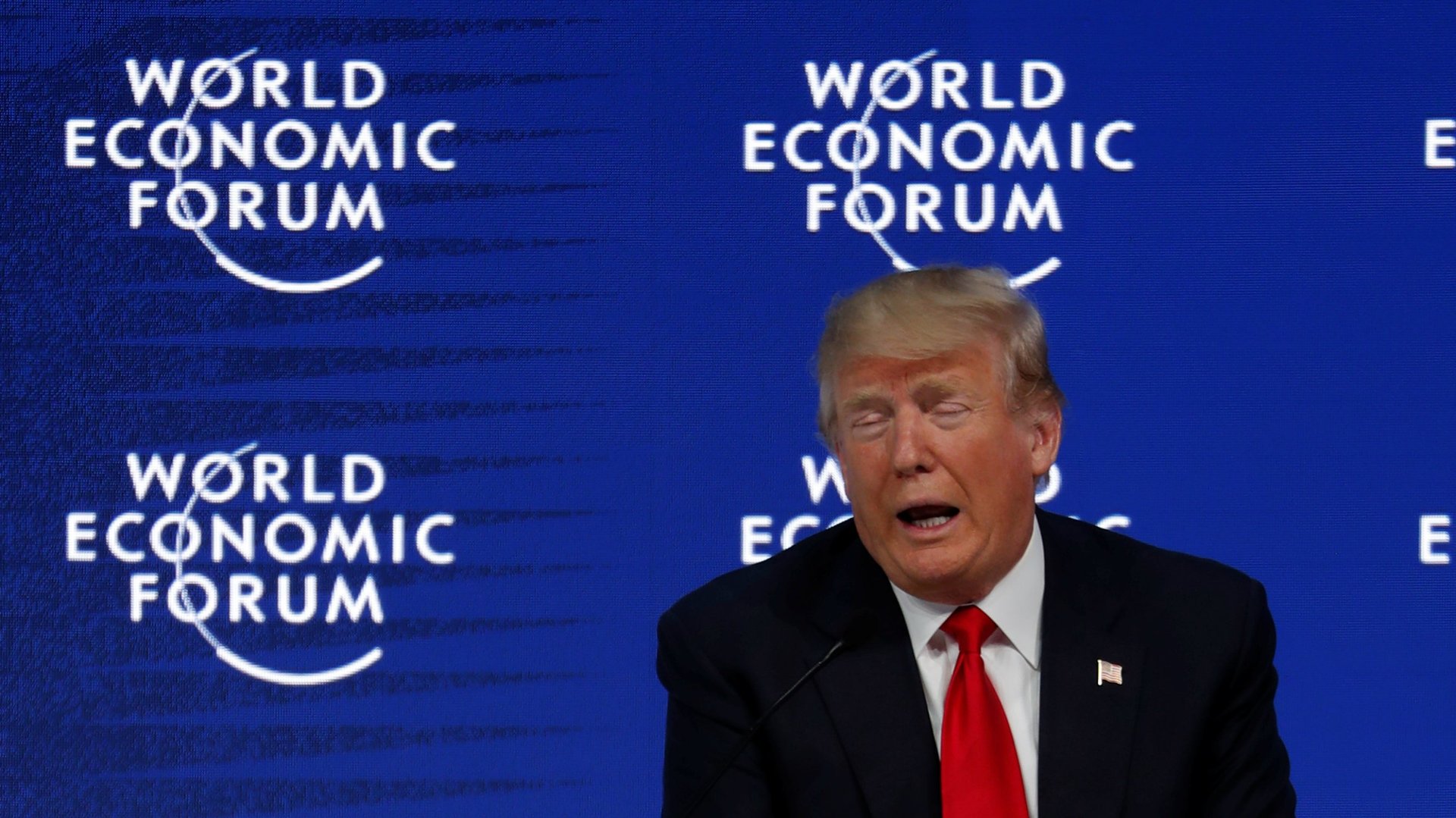
Hey, world—Donald Trump wants your investment. “We are creating an environment that attracts capital, invites investment, and rewards production,” the US president declared today (Jan. 26) at the World Economic Forum.

In 1572, the killings began. That year, authorities in the tiny settlement of St Maximin, in present-day Germany, charged a woman named Eva with using witchcraft to murder a child. Eva confessed under torture; she, along with two women she implicated, were burned at the stake.

China’s private companies are the engines of its economy, generating seven-tenths of its GDP and employing 85% of its workforce. As such, the country’s long-term growth hinges on their success. But they’re coming up against a formidable opponent: their own government.

The first time Nick Mullins entered Deep Mine 26, a coal mine in southwestern Virginia, the irony hit him hard. Once, his ancestors had owned the coal-seamed cavern that he was now descending into, his trainee miner hard-hat secure.

In his economic masterwork The Wealth of Nations, the great Scottish economist Adam Smith reveals himself to be a deep admirer of Irish poor folk. Or, more specifically, their preferred food, potatoes.

Will sweeping corporate-tax cuts succeed in juicing the US economy and buoying middle-class wage growth? Most assuredly, says the Trump administration, with Congress poised to pass the Republican tax bill.

China has a master plan to oust the US as preeminent global superpower—and this time it just might work. That’s according to the Washington Post’s David Ignatius (paywall), citing two Pentagon briefs.

Imagine a ship carrying commodities from Australia to China, and another carrying the same, but in the opposite direction. Both routes are equal in distance. Yet that first journey, from Australia to China, costs 33% more, on average, than the return trip.

Last month, Ecuadorian authorities busted a ship carrying one of the largest caches of illegally caught sharks in history. The crew of the ship has now been tried, fined, and sentenced. Yet the plot of this complicated tale—a rare glimpse into the black market trade made possible by industrialized global fishing—just keeps on thickening.

In JK Rowling’s Harry Potter series, children at the wizard boarding school Hogwarts are assigned to one of four houses—each with its own distinct character. This is done by the Sorting Hat, a sentient headpiece that plumbs the psyches of new students to deduce whether they are at heart a courageous Gryffindor, ambitious Slytherin, loyal Hufflepuff, or brainy Ravenclaw. But the headmaster of Hogwarts himself worries that the Sorting Hat may wind up determining children’s development rather than predicting it. “You know,” Albus Dumbledore muses, “I sometimes think we Sort too soon.”

Earlier this year, the US government charged Canada with giving its logging industry an unfair leg up and slapped steep tariffs on Canadian timber. This is bad news for Canada since, like most of its exports, around three-quarters of its softwood lumber goes to the US.

Over the last two decades, working-age American men have been ever so quietly exiting the labor force. These days, around 12% of prime-age men, those between 25 and 54, are neither employed nor looking for work—up from around 8% in the mid-1990s. During that same time, and nearly as quietly, America began pounding painkillers: between 1999 and 2015, sales of prescription opioids per person more than quadrupled.

The grim tale of America’s “subprime mortgage crisis” delivers one of those stinging moral slaps that Americans seem to favor in their histories. Poor people were reckless and stupid, banks got greedy. Layer in some Wall Street dark arts, and there you have it: a global financial crisis.

Steve Bannon, the White House’s chief strategist, has left the Trump administration that he helped put into power, after losing long-running feuds with the president’s economic and security advisors. ”We are grateful for his service,” said the White House press secretary in a statement, “and wish him the best.”

Which side—the white nationalists or the counter-protesters—bears greater responsibility for the Charlottesville violence, which directly resulted in the death of a 32-year-old counter-protester? It should be a factual question. And also a moral one, considering that the demonstrators had gathered in the spirit of a homegrown terror group that lynched thousands of blacks and a foreign one that murdered around 6 million Jews.